Showing posts with label Aristotle. Show all posts

14 September 2020

The classical elements

Earth; Fire; Air; Water. Long ago, Empedocles theorised that four elements lived together in harmony. Then everything changed when Democritus attacked. Only Aristotle could stop him. But when the world needed it most, modern chemistry was still several thousand years from being invented ...

Empedocles’ poems don’t survive. But Aristotle’s Physics and On coming to be and passing away does. As a result, a number of people have got it into their heads that Aristotle was reponsible for the idea of the classical elements. Here’s a snippet from a 2002 lecture by a Florida State physics professor about ‘Aristotelian’ physics:

  • everything on Earth made of (mixture of) four elements: earth, water, air, fire
  • every element has a “natural place”:
    • earth at center of Earth,
    • water above earth,
    • air above water,
    • fire above air;
  • celestial bodies (stars, planets, Moon) made from fifth element, “ether”, which also fills space between them; ether is perfect, incorruptible, weightless; ...

This slide has ended up being cited by the Wikipedia article on ‘Aristotelian physics’ as the supreme authority on the classical elements.

Now, it isn’t completely made up — in the limited sense that some people, including even some specialists, do claim some of these things.

For example Werner Jaeger (1948), Aristotle. Fundamentals of the history of his development, Oxford, 143ff. One report on a lost Aristotelean work refers to the elements earth, water, and air, then refers to the fourth as Latin ardor. Jaeger confidently translates the word as ‘aether’ (149).

But you won’t find any of it in Aristotle himself.

  • Aristotle never says that all matter is made of (a mixture of) earth, water, air, and fire.
  • He doesn’t talk of elements having a ‘natural place’.
  • He doesn’t add aether as a ‘fifth element’.

The thing about aether is probably the biggest one, because I have seen it repeated in so many places. So let’s just repeat. Aristotle doesn’t treat aether as a fifth element.

Here’s what Aristotle does say.

  • He uses Empedocles’ four elements as categories of material qualities, rather than substances.
  • He also refers to Democritus’ model of matter, which is based on atoms, not elements, and which allows an unlimited variety of fundamental substances.
  • He accepts and rejects aspects of both models. He suggests that matter is differentiated by the presence or absence of various properties, rather than the substances it’s made of; and he’s willing to go along with Anaxagoras’ idea that every homogeneous material is an element, to the extent that each homogeneous material corresponds to a unique set of properties.
  • He talks of materials having a natural motion depending on their properties: hot things (including fire and air) tend to rise, that is, move away from the centre of the earth, while cold things (including earth and water) tend to move towards the centre.
  • And, in a discussion that has nothing to do with elements, he does say that the sky uniquely has a circular natural motion — the sky as a single thing, that is, not individual heavenly bodies — and he borrows the ancient name ‘aether’ to refer to this unique motion.

Now a lot of this is wrong of course. Atoms are real; natural motion isn’t a thing, but buoyancy is; it’s the earth that’s rotating, not the sky. But that’s no excuse for misrepresenting Aristotle. His theory of matter is about four physical properties, not about four substances. And nowhere does he declare a canon of five elements, with aether as the fifth.

He even calls Empedocles’ model self-contradictory. Empedocles’ elements are supposed to be distinct, fundamental substances; yet Water evaporates into Air, condensation from Air produces Water.

So Empedocles evidently contradicts the observed phenomena, and contradicts himself too. For he says that none of the elements can emerge from another, but that everything is made of these; but at the same time, once he gathers all of nature (except Strife) into the One, he says that each of the elements is derived from the One.
The early Greek flat-earth cosmology as found in Homer, centuries before Aristotle. Thick, foggy Air is at ground level; above it is the clear Aether, where it is hard to breathe and there are no clouds. Elements played no role in this cosmology.

Aether

A second-hand report of one of Aristotle’s lost works makes it clear that he thought of heavenly bodies as ‘fiery’, and not made of a fifth element.

Therefore, because the Fire of the sun is similar to those fires that exist in the bodies of animate creatures, it must be that the sun is also animate ... So since the origin of some creatures lies in Earth, others in Water, and others in Air, Aristotle thinks it absurd to imagine that no animal is generated in that element which is most suited to generating animate things.

Cicero (our source) goes on to talk about how the ‘stars occupy the aetherial region, which is extremely thin’. Various modern scholars have taken that as meaning that Aristotle, too, linked aether to the usual four elements. But, again, it’s indirect. And even Cicero doesn’t cast aether as the fifth member of a set of five. He refers to ‘the aetherial region’ (aetherium locum) as a location, not a substance. He talks of stars being generated there: that is, Cicero is actually thinking of ‘the aether’ as a place occupied by Fire, but only very sparsely, until it generates stars.

Aether isn’t a distinct element: it’s a hangover from archaic flat-earth cosmologies. For example in Homer, thick misty Air (aēr) is at ground level, and clear, bright Aether (aithēr) is above it, filling the heavens. On mountain-tops the air is thinner, and you find yourself above the clouds: that’s supposedly where you get close to the aether.

The elements in Plato

Aristotle isn’t our earliest source on Empedocles’ elements. There’s an earlier report in Plato’s Timaeus. And it’s Plato, I think, that has prompted some modern readers to think in terms of a group of five.

The passage is hard to interpret (like most of the Timaeus): Plato could be misconstrued as saying that celestial bodies are made of a fifth element. What he really seems to be talking about is the shape of the universe as a whole, not the material that stars are made of.

Aether does come up a bit later, in passing. But Plato makes it very clear that it isn’t a separate element. He treats aether as a variety of Air, in the same way that flames, firelight, and glowing embers are all varieties of Fire (Timaeus 58c-d).

The context is that Plato is trying to combine two theories of matter: Empedocles’ model of four elements, and Democritus’ atomic theory. Plato also injects his own fondness for ideal abstractions. He proposes that each of the four elements is made of a single type of atom, and the four atom types have the shapes of the ‘Platonic solids’. There are five possible Platonic solids, so according to Plato’s perfectionist logic, that implies there must be some fifth thing in the material world that corresponds to the fifth solid, the dodecahedron.

The ‘Platonic solids’: the regular tetrahedron (4 sides), cube (6), octahedron (8), dodecahedron (12), and icosahedron (20). These solids have a number of unique properties that no other solid can have. Each has equilateral faces all the same shape (equilateral triangles, squares, or pentagons); every vertex coincides with the surface of a circumscribed sphere; the centre of every face coincides with the surface of an inscribed sphere.

Of these solids, Plato decides the cube is the most ‘immobile’ one, so that’s Earth. For the others, Fire is the lightest and smallest, made of tetrahedron-shaped atoms; Water is the largest of the triangle-faced solids, the icosahedron; Air is in between, the octahedron.

And, since there was still one more structure — the fifth — God applied it to the whole, and decorated it with life.

‘The whole’ must mean the cosmos, the sky. But not the substance of the sky. In the last bit, ‘decorated it with life’, the Greek word used, diazōgraphōn, is probably meant to evoke the twelve constellations of the zodiac around the ecliptic. The zodiac isn’t arranged in a dodecahedral shape, but perhaps the theme of twelve-ness was enough to sustain Plato’s wordplay.

For Plato, it seems, the dodecahedron is the shape of the cosmos. It looks like the idea is that a dodecahedron is the shape that most closely approximates a sphere — the sphere of the sky.

Surprising but true. Intuitively, you’d imagine an icosahedron would be closer to spherical, because it has more polygons. It turns out that pentagon-shaped faces are more of an advantage. The dodecahedron is better at filling a sphere. If you’re an ancient Greek and you want to calculate the volume of a sphere, but you don’t know the value of pi, and so you resort to the method of exhaustion that was popular in classical Greek geometry, then a dodecahedron provides closer bounds than any other solid.

Solid Number of faces Corresponding phenomenon (Tim. 53c-56e) Volume as proportion of sphere
tetrahedron 4 Fire 12.3%
cube 6 Earth 36.7%
octahedron 8 Air 31.8%
dodecahedron 12 universe 66.5%
icosahedron 20 Water 60.5%
A cube, all of its corners touching a sphere from the inside, fills a bit over a third of the sphere; a dodecahedron fills just under two thirds.

So, in Plato’s model, the dodecahedron is the shape of the universe; the other four solids are the shapes of the four kinds of atoms. Don’t go taking this seriously, of course! Plato liked maths, but he was definitely no empiricist. This whole imaginary concoction is driven by his obsession with the idea that real phenomena are manifestations of ideal abstractions.

Aristotle’s theory of matter

Aristotle is more logical, albeit with the same limitations on his knowledge. Given that he knew nothing about atoms and elements as we understand them nowadays, he still makes a reasonable amount of sense, so far as he goes.

For Empedocles says that there are four physical (elements); or a total of six, including those (elements) that cause motion (i.e. Love and Strife). Anaxagoras and Leucippus and Democritus, on the other hand, say there are infinitely many. The first (Anaxagoras) treats homogeneous things as elements, like Bone, Flesh, and Marrow, and every substance where a portion is synonymous with the whole. Democritus and Leucippus, however, say that these (homogeneous) things consist of indivisible particles, and that they are infinite in number and in their shapes; while substances differ from one another depending on the elements they consist of and their composition and arrangement.

Anaxagoras’ followers apparently take a stance opposed to that of Empedocles' followers. For Empedocles says that there are four elements — Fire, Water, Air, and Earth — and that these are the substances that are simple, rather than flesh and bone and other homogeneous substances. But Anaxagoras’ followers say that it is these homogeneous substances that are simple elements, while Earth, Fire, Water, and Air are compounds.

Aristotle rejects Democritus’ atomic theory, but he also rejects Empedocles. He accepts the four elements as empirical phenomena, but he rejects the idea that everything is made of them. He doesn’t reject Anaxagoras’ ideas about homogeneous substances: it seems that’s where his sympathies lie.

For Aristotle, Empedocles’ elements are emergent. They’re derived from combinations of properties: hot, cold, dry, and wet. Apply these properties to raw matter — what he calls hylē (literally ‘wood’) — and you get stuff that approximates the four elements. If something is hot and dry then it’s fiery, if it’s cold and wet then it’s watery. The properties come first.

  Hot Cold
Wet Air Water
Dry Fire Earth

He quickly gets into trouble, though. Aristotle questions whether these binary properties denote the presence vs. absence of a quality: so hot = ‘with heat present’, cold = ‘without heat’, and so on.

But someone might well be puzzled about a simple absence, and whether it is one of two terms in an opposition. For example, is it that Earth and other massive matter denotes the absence of a quality (heat), while Fire and rising substances denote the presence of that quality? Or is it that Earth also denotes a presence, while the absence denotes raw substance — the hylē of both Fire and Earth alike? And is the hylē of each of them different? For then they could not come to be out of one another, that is, out of their opposites. For the oppositions are manifested in these things: Fire, Earth, Water, Air.

This is where Aristotle’s lack of knowledge gets him tied in knots: this passage makes little sense to a modern reader. It’s obvious to us, with an understanding of chemical reactions and thermodynamics, that these are actually very bad questions. We know that physical properties are determined by heat and pressure, not by irreducible characteristics like whether ‘wetness’ is present.

This business of thinking about presence and absence of qualities misleads Aristotle before he can even begin. I think it’s still a huge improvement on Plato, with his fantasies about four species of polyhedral atom. But it isn’t like you’ll actually learn anything about chemistry from Aristotle.

23 January 2020

Detecting the earth’s curvature

How did ancient observers work out that the earth is (very nearly) spherical?

It’s pretty well-known these days that the spherical shape of the earth was discovered by ancient observers. As I wrote in an older post, the turning point seems to be a little before 400 BCE in Greece. Before that date, all reports have the earth as flat; after 400, round-earthers pop up quickly, and there are only a handful of flat-earthers. Flat-earthism has never been anything more than a fringe opinion since then, in any place that had access to their findings.

What’s obscure, though, is this: how exactly did the Greeks discover it? What was the key piece of evidence?

A ship receding over the horizon. (NB: This is not how the ancients discovered the shape of the earth.) Notice the distortion caused by refraction. Source: ‘Mathias Kp’, preview image for ‘Ship sailing into the horizon’, YouTube, Feb. 2016.

Ancient sources don’t tell us directly. Let’s jump straight to academic opinions. Here are some lecture notes from a reputable astronomy professor. This is what Ohio State University astronomy students have learned since at least 2004:

Ancient Greek philosophers argued earth was a sphere, on several grounds:
  • Sphere a "perfect" shape.
  • Ships disappear over horizon.
  • Positions of constellation above horizon change as one goes north or south.
  • Earth casts round shadow on moon during a lunar eclipse.
Prof. David Weinberg, Ohio State, A161 lecture notes

Weinberg’s first point is completely imaginary. Ancient writers who discuss evidence for the earth’s shape talk about matter falling towards local minima in the earth’s surface, not about ‘perfection’. The second point, about ships going over the horizon, is the biggest myth here: it doesn’t appear in any ancient Greek source. It’s a second-hand misrepresentation of a Roman source, and as we’ll see below, the Roman writer himself suffered from some severe misunderstandings. The third point isn’t precisely what the ancient sources say, but close enough. The fourth point is the most accurate: it does appear in surviving ancient accounts, Aristotle and Ptolemy.

Note: The lecture notes have some other errors too, especially in the bit about Eratosthenes. Most of them are copied from Carl Sagan’s inaccurate treatment in Cosmos (1980): I’ve dealt with that in an earlier post. The thing about the well is untrue. Two more specific points: the angular distance between Eratosthenes’ cities was 7.2°, not 7.5°; and his calculated circumference was ca. 46,600 km, not the 39,300 that Weinberg states. The standard Greek stadion was 185 m, plus or minus a metre. It’s true there’s some confusion over the length of the stadion, thanks to some variations, and some misreporting in the early 20th century, but the 185 m standard really is unproblematic: see here for more discussion. Anyway, Eratosthenes’ high figure comes from the fact that he didn’t have great figures for the distances between cities. His data seem to have been based on traditional measures of Egypt dating back to well over a thousand years before his lifetime.

Ships going over the horizon get brought up very, very frequently when people think about how ancient people detected the earth’s shape. You’d think it’s something people observe every day. I wonder how many people have actually seen it. Of them, I wonder how many saw it without a telescope or a really good camera.

The problem is that it doesn’t actually work very well. Not because it’s false! Ships do indeed descend past the horizon.

It’s because human eyesight isn’t good enough. Sure, with a really good zoom, or a telescope, it’s possible to observe the phenomenon. But most people’s eyesight can’t resolve details that fine.

A Nikon P900 can see this, but your eyes might not be up to the task: the schooner Denis Sullivan, photographed from Frankfort, Michigan, 2 July 2016. The ship is apparently about 18 km offshore, judging from how much of it is concealed. The height is 29 m. I assume that about a third of it is concealed by the horizon, and camera height at 2.5 m above sea level. At that distance, the angular size of what’s visible here would be about 0.06°, less than an eighth the diameter of the moon. According to Wikipedia, someone with 6/6 vision (20/20, for American readers) can discern contours 1.75 mm apart at a distance of 6 m. That’s an angular size of 0.0167°. The sails appear 3.6 times larger than that, so the feat is possible. But only about a third of people have 6/6 vision. Calculations are based on Walter Bislin’s Advanced Earth Curvature Calculator, and account for atmospheric refraction. Photo source: MLive.com.

Aristotle

When Aristotle discusses empirical evidence for the earth’s shape, in On the sky 297a-298a, the evidence that he actually mentions is as follows:

  • Gravity -- or as Aristotle puts it, ‘the nature of mass to be borne towards the centre’ (τὸ φύσιν ἔχειν φέρεσθαι τὸ βάρος ἔχον πρὸς τὸ μέσον) -- ensures that all parts of the earth come to rest at a local minimum, so the resulting shape must be roughly spherical.
  • The earth’s shadow on the moon during a lunar eclipse is always circular, and only a sphere has a shadow that is invariably circular.
  • Even a relatively short journey to north or south changes which stars are visible.

By ‘short journey’, he may mean as little as a twelfth of a degree of the earth’s curvature, since that’s the precision in latitude we find reported in Ptolemy’s Geography. That’s a bit over 9 km -- a couple of hours’ walk.

From all this, then, it is clear that not only is the earth’s shape curved, but also that it is not a huge sphere. Otherwise people would not be able to see it so quickly, when they move only a short distance. ... All the mathematicians who try to calculate the size of its circumference say that it is about 400,000 (stadia, i.e. 74,000 km).
Aristotle, On the sky 298a.6-8, 15-17

Even that figure is too high, obviously, and a century later Eratosthenes came closer.

Ptolemy

Ptolemy’s evidence for the earth’s shape, Almagest i.1.14-16 (ch. i.4), is a bit different:

  • Lunar eclipses take place at the same time for all observers, but they are reported at an earlier hour by observers further east, and at a later hour by observers further west; and the difference in hour is proportional to the east-west distance separating the observers.
  • Alternative shapes for the earth -- concave, plane, polyhedral, cylindrical -- are ruled out by various astronomical observations (omitted here).
  • Travelling north or south changes which stars are visible in the sky, and the change is proportional to the north-south distance travelled.
  • Observers on a ship moving towards a mountain see the mountain gradually rising up out of the sea as they approach.

The last point comes within spitting distance of the ships-going-over-the-horizon trope, but it’s far more realistic than the popular idea. A trireme 20 km away may be too small to make out properly, but mountains are a much bigger target.

Samothraki seen from Thasos, 75 km away. Photo by Borislav Angelov. Source: Google Maps.

Here’s an example from the Greek world: Mt Fengari, on the island of Samothraki, seen from the shore of Thasos, 76 km away. Fengari is the highest peak in the Aegean Sea, at 1611 m.

The photo is taken from the edge of the shore, so let’s assume eye height at 2 m. A basic geometrical calculation would have it that the bottom 394 metres of the island are concealed by the earth’s curvature. However, we also need to account for atmospheric refraction. The vertical distortion from refraction actually reduces the effect of the earth’s curvature, so that distant objects are more visible.

Diagram illustrating the relationship between a distant object’s actual location, and the place where it appears as a result of refraction. Source: Walter Bislin’s Calculator.

With the standard refraction figures used by the Advanced Earth Curvature Calculator, created by Walter Bislin, a Swiss engineer, it turns out that the actual portion of Samothraki that is concealed by the horizon is the first 322 metres. That’s 20% of the mountain’s height. The angular size of the visible part of the mountain is just under 1°, double the apparent diameter of the moon, so the effect ought to be noticeable for someone who knows the shape of the island well.

Now, when I said mountains, you probably thought of Mt Olympus, the highest peak in Greece at 2917 m. Actually, Olympus doesn’t work well for this. But let’s do the calculation anyway.

Mt Olympus seen from Sani, Halkidiki, 80 km away. Source: Sani Resort website.

Using Bislin’s calculator again, this time assuming 3 m eye height, it turns out that the first 349 metres of its height are concealed: more than a tenth of the mountain’s height. But the effect is going to be harder to see. The land at Olympus’ base is higher than 349 metres, so the skyline is still above the horizon. The apparent shape of the land wouldn’t be very different from how it looks up close.

Basically, for best results, sail towards islands.

Pliny

There’s just one ancient writer who mentions the trope of ships going over the horizon: dear old Pliny the Elder.

It is the same reason why land is not seen from ships, but is visible from ships’ masts. Also, when a ship is sailing far away, if a shining light is attached to the top of the mast, it appears to go down gradually and is finally concealed.
Pliny, Natural history 2.164

So, this line is the ultimate source of the myth. It isn’t hard to imagine that this is an experiment that someone might actually have tried.

But notice the difference. In the popular myth, you’re supposed to discern the contours of a distant ship, unaided. In Pliny’s version, it’s the light that you’re supposed to observe descending into the sea. That’s much easier to believe: a light-emitting source is way, way more visible than distant contours.

Still, I’m pretty sure Pliny isn’t the source that professors teaching the history of astronomy are getting it from. (If they were reading ancient sources, they’d know Aristotle doesn’t talk about spherical ‘perfection’.) I’m betting the modern myth is filtered through a much more recent source: Copernicus.

It is understood by sailors that waters also press down into the same shape (a sphere): for land which is not visible from (the deck of) a ship is regularly seen from the top of the mast. Conversely, if something shining is placed at the top of the mast as the ship is moved away, it seems to people remaining on shore to go down gradually, until at last it is hidden as if setting.

Weirdly, Copernicus bases the structure of his introduction on Ptolemy, but his arguments are inspired by Pliny -- the worst possible choice, out of the three ancient sources we’ve looked at so far.

Because Pliny is not a good source of evidence for the shape of the earth. OK, yes, he does say it’s a sphere. But most of his ‘evidence’ is ridiculous. He thinks mountains in the Alps are over 50 Roman miles high, that is 74 km (NH 2.162); he thinks the earth’s shape is demonstrated by the shape of drops of water; that a convex meniscus on a liquid surface is a consequence of the earth’s curvature; that heavy objects placed in a cup of liquid don’t cause it to overflow, because the surface acqures a convex curve (NH 2.163).

If you’re looking for empirical evidence for the earth’s shape, Pliny should not be your main resource. Copernicus, I’m afraid, gets C+ for treatment of textual evidence.

Cleomedes

Cleomedes’ discussion of the earth’s shape is similar to Ptolemy’s, in that he spends time rejecting alternative shapes, then at the end he tacks on the appearance of mountains when approaching them by sea. This is slightly odd given that he never cites Ptolemy, but let’s not get into that. His exact arguments are (Circular motions of heavenly bodies 1.5, = pp. 72-86 Ziegler):

  • The length of time between sunrise and sunset is different in different places.
  • Eclipses are observed at different hours in different places.
  • The celestial pole has a different azimuth in different places.
  • Different stars appear in the sky depending on how far north or south you are.
  • When you approach mountains by sea, they appear to gradually rise up out of the sea.

However, this is already some way into his treatise: he invokes a number of arguments for sphericity earlier on in his book, too. More about that in a moment.


We still haven’t got to the root of the question. How did the person who worked out the earth’s shape do it?

One thing we can be absolutely sure of is this: they didn’t work it out by looking at ships or mountains. They were looking at the sky. All of the evidence cited by Aristotle, Ptolemy, and Cleomedes is based on astronomy, not geography. Ptolemy and Cleomedes only tack on the thing about mountains as an afterthought, to make it easier for readers to accept.

Here are two theories. First, Otto Neugebauer:

... [I]t seems plausible that it was the experience of travellers that suggested such an explanation for the variation in the observable altitude of the pole and the change in the area of circumpolar stars, a variation which is quite drastic between Greek settlements, e.g., in the Nile Delta and in the Crimea.
Neugebauer 1975: 576 (more generally see 575-578)
And second, Dirk Couprie:

Several sources ascribe the discovery of the ecliptic (or the Zodiac) to Oenopides, who lived about one century after Anaximander and was a younger contemporary of Anaxagoras (DK 41A7). This makes Oenopides a serious candidate for the discovery of the sphericity of the earth as well, as the ecliptic must be thought of as inclined to the celestial equator, which is the projection of the equator of a spherical earth on the celestial sphere.
Couprie 2011: 169 and 201-202
Couprie’s theory about Oenopides and the ecliptic may take a little explaining.

Left: the ecliptic plotted on a celestial sphere. Right: the ecliptic plotted on a rectilinear map of the stars as seen from earth.

The ecliptic is a path against the fixed stars, which the sun, moon, and planets stick close to at all times. On a rectilinear map it looks like an S-shape, but plotted onto a spherical sky it is a circle at a fixed angle to the celestial equator. That angle is 23.5°, but it wobbles slowly: in Eratosthenes’ time it was closer to 23.9°. The Greeks called it hēliakos ‘the sun’s (path)’, ekleiptikos ‘(the path) of eclipses’, or zōidiakos ‘belt-like’, since it is a circle around the earth. That of course is where we get the name for in reference to the constellations along the ecliptic, the zodiac.

Note, added later. As a respondent points out in a comment below, I committed an elementary blunder here: ζῳδιακός has nothing to do with ζώνη ‘belt’.

Now, that’s the geocentric point of view. In reality, the ecliptic is the plane in which the earth and other planets revolve around the sun. The earth’s equator is at an angle to that plane, and that’s what produces the phenomenon.

Couprie’s idea is this. The astronomer Oenopides is said to have discovered the ecliptic, but we know that’s not true. It was well known to Babylonian astronomers a millennium earlier. However, the ecliptic implies a spherical geometry for the sky. So, Couprie thinks, what Oenopides really discovered is that that somehow implies a spherical geometry for the earth too.

It doesn’t imply that all by itself, mind. It does tend to imply that it’s the earth that’s rotating, not the stars -- but ancient testimony is pretty hostile to that theory (Aristotle On the sky 296a.26-27; Ptolemy Almagest i.1.24-25 = ch. i.7).

However, if you take it in conjunction with Neugebauer’s point about Greek colonists in Ukraine and Libya noticing different astronomical phenomena, then you get a line of reasoning that looks very similar to the opening chapters of Cleomedes’ work. Cleomedes doesn’t present the earth’s shape as a premise. He works his way up to it.

Cleomedes starts off by establishing the spherical geometry of the sky; he describes the celestial equator, tropics, and arctic and antarctic circles, and how these have corresponding zones on earth; then he moves on to the planets and their motion relative to the ecliptic, and how the ecliptic is at an angle to the celestial equator; and then he gets to the key point that

The Earth is spherical in shape, and thus [located] downwards from every part of the heavens; as a result its latitudes do not have an identical position relative to the zodiac, but different ones are located below different parts of the heavens.
Cleomedes 1.3 = p. 36.21-26 Ziegler (tr. Bowen and Todd)

This is basically the conjunction of the spherical cosmology, the ecliptic, and Neugebauer’s point about the angle of the celestial sphere being different depending on how far north or south you are. Cleomedes carries on in exactly this way, talking about how ‘the heavens slope’. Only later on does he get into explicit arguments to support the earth’s sphericity.

It’s pretty likely that his manner of exposition is very close to the original reasoning. It isn’t a certainty. The ecliptic doesn’t come up in Aristotle’s or Ptolemy’s discussions of evidence for the earth’s shape. But I think the beginnings of the idea must have followed something like Cleomedes’ reasoning.

I want to add, as a postscript, that though Greek thinkers prior to 400 were all flat-earthers, including beloved names like Thales and Democritus, their work wasn’t a waste of time. Anaximander, in particular, can be credited with the important realisation that the earth isn’t the base of the cosmos, but is suspended in space. He was wrong about why it is suspended -- pre-Socratic philosophers thought it must be held up by air pressure -- but it was a crucial step. Without that notion, I doubt the spherical earth could have been discovered until many centuries later.

References

  • Bowen, A. C.; Todd, R. B. 2004. Cleomedes’ lectures on astronomy. University of California Press.
  • Copernicus, N. 1543. De revolutionibus orbium coelestium. Ioh. Petreius (Nürnberg).
  • Couprie, D. L. 2011. Heaven and earth in ancient Greek cosmology. Springer.
  • Neugebauer, O. 1975. A history of ancient mathematical astronomy (2 vols). Springer.

15 September 2017

Aristotle’s errors

How many teeth did Bertrand Russell have? Did Galileo float in water?

Ἔχουσι δὲ πλείους οἱ ἄρρενες τῶν θηλειῶν ὀδόντας καὶ ἐν ἀνθρώποις καὶ ἐπὶ προβάτων καὶ αἰγῶν καὶ ὑῶν· ἐπὶ δὲ τῶν ἄλλων οὐ τεθεώρηταί πω.

Males have more teeth than females, in the cases of humans, sheep, goats, and pigs. In other species an observation has not yet been made.

Aristotle, History of animals 501b (2.3.13)

Aristotle sometimes gets a rep nowadays as a pretentious idiot: The Scientist Who Got Everything Wrong. Sometimes even Aristotle’s fans think this —

[Bertrand] Russell provides a concise summary of the thoughts of both [Plato and Aristotle], as well as painting a picture as to why they are so important, despite being wrong about almost everything.

This from a fan of Aristotle! And Bertrand Russell loathed Aristotle:

Aristotle maintained that women have fewer teeth than men; although he was twice married, it never occurred to him to verify this statement by examining his wives’ mouths. He said also that children will be healthier if conceived when the wind is in the north. One gathers that the two Mrs Aristotles both had to run out and look at the weathercock every evening before going to bed. He states that a man bitten by a mad dog will not go mad, but any other animal will (Hist. An., 704a); that the bite of the shrewmouse is dangerous to horses, especially if the mouse is pregnant (ibid., 604b); that elephants suffering from insomnia can be cured by rubbing their shoulders with salt, olive-oil, and warm water (ibid., 605a); and so on and so on. Nevertheless, classical dons, who have never observed any animal except the cat and the dog, continue to praise Aristotle for his fidelity to observation.
Russell, The Impact of Science on Society (2016) pp. 6–7 (orig. publ. 1952)

The trouble with attacking the entire oeuvre of a scholar and scientist in this way is that the examples are very, very cherry-picked. These five blunders are taken from a span of over 400 pages of tiny print full of thousands of observations about the animal world. Do we take Russell on faith that they’re representative?

No, we don’t. And I’m not going to let that ‘and so on and so on’ pass. If you want to show that Aristotle was wrong about almost everything, show that he was wrong about almost everything. ‘And so on’ is lazy if you can’t back it up. Russell couldn’t.

Russell’s first criticism, about women’s teeth, is the one that gets the most traction. That must be because it’s the easiest one to correct. Testing the claim about conception during a north wind would require an enormous amount of coordination and many years of research; no one is going to try out the effects of rabies on humans; I defy anyone to get a shrew to bite a horse on command; and elephants were not exactly an everyday sight in ancient Greece.

In fact some of them don’t even necessarily look like blunders, if you approach them in the right way. Seasonal winds are a thing: in Greece, a north wind at conception will often correspond to a birthday between mid-February and the summer solstice. And the time of year of a birthday can correlate very strongly with a child’s success under some circumstances. Aristotle didn’t know why that was, but he did know something about astrology, a field which was not considered ridiculous in his day, and which made similar kinds of predictions. And the behavioural effects of rabies are unquestionably different in animals that can talk and communicate their distress (humans) and those that cannot (every other species). I won’t venture to defend Aristotle on shrew bites and elephant massages.

And then there’s the teeth thing. Aristotle doesn’t use it as a way of showing that women are inferior to men, contrary to what is often claimed — but it does look ridiculous.

Aristotle on teeth

Did Bertrand Russell count the teeth of any of his wives?

Robin Herbert poses this question in an eloquent defence of Aristotle written in 2014. I certainly haven’t ever counted anyone else’s teeth. I only even counted my own when I was about 10 and was wondering how my adult teeth were coming on. Aristotle, Russell, Herbert, and myself — we all rely on other people to do that for us.

It may still be fairly argued that women’s teeth is one observation that Aristotle really should have done for himself. I think that’s fair. But only on one condition: you’re only allowed to make that argument if you first go and count the teeth of someone of the opposite sex. After all, you’re the one claiming it’s easy to check ...

Herbert’s defence of Aristotle focuses on rejecting the false idea that Aristotle put his own preconceptions ahead of any observations.

Of course Aristotle is wrong, but he is wrong because he was misinformed about the observation, not — as Russell and de Bono suggest, because he did not believe that observations were important.

With that in mind, let’s do a fact-check of all of Aristotle’s claims about teeth in History of Animals book 2 chapter 3. We don’t want to cherry-pick, do we?

  1. All mammals have teeth — TRUE
  2. Camels have no teeth in the upper jaw — FALSE
  3. Some species have tusks, e.g. boars — TRUE
  4. Some species have pointed teeth, e.g. lions, panthers, and dogs; in such cases, the teeth on either jaw fit into each other — TRUE
  5. No animal has both tusks and horns — TRUE as far as I can find out
  6. In general front teeth are cutting teeth, hind teeth are molars — TRUE
  7. There are exceptions: seals have only cutting teeth — TRUE
  8. No mammals have a double row of teeth — TRUE as far as I can find out (apart from anomalous situations, e.g. when a child’s milk teeth don’t fall out until after the permanent teeth have come through)
  9. Doubt cast on Ctesias’ claim of a species called ‘martichora’ that has three rows of teeth — TRUE that Ctesias’ claim is nonsense
  10. Some species shed their teeth, including humans, horses, mules, and asses — TRUE
  11. But no species sheds molars — FALSE
  12. Doubt expressed over reports that some species shed only canines — TRUE that caution warranted, because the report is inaccurate
  13. Older dogs have blunter teeth — TRUE
  14. Most animals’ teeth darken as they age; horses are an exception, as their teeth whiten with age — TRUE observation, but FALSE interpretation in the case of horses: horses’ permanent teeth gradually emerge from the gums and wear down at the tips, over a period of many years, meaning that there will be less discolouration
  15. Canines, between the cutting teeth and molars, are wide at the base but sharp at the tip — TRUE
  16. Males have more teeth than females in humans, sheep, goats, and pigs — FALSE
  17. Humans with more teeth tend to be longer-lived; humans with gaps between teeth tend to be shorter-lived — probably TRUE (edit: because of the economic implications of having good/bad teeth, if nothing else)
  18. Wisdom teeth appear around the age of 20; but sometimes at an advanced age, in which case they are very painful — TRUE (I haven’t been able to confirm/reject Aristotle’s claim about wisdom teeth erupting as late as age 80, but it is true that problems with wisdom teeth increase significantly with age)
  19. Elephants have four molars on each side — TRUE
  20. Elephants have two tusks: large and turned upwards in the case of males, small and bent downwards in the case of females — mostly TRUE: female elephants’ tusks do curve upwards, like males’, but often will be too short to have a significant curve
  21. Elephants have teeth at birth — TRUE

I’ll score TRUEs as 1. Number 14 gets 0.75: the observations are all accurate, but the interpretation is only half accurate. Number 20 gets 0.75 as well, since female elephants’ tusks curve upwards.

So Aristotle on teeth gets a score of 17.5 out of 21, or 83% correct. In my university’s marking schedule, that would get him a grade of A–. Certainly not perfect. But it could be much much worse.

The usual accusation cast at Aristotle is that he put theory, logic, and his own preconceptions ahead of any empirical evidence. Do you seen any sign of that in the list of his claims about teeth? I sure don’t. I see a whole bunch of second-hand reports of empirical observation: most accurate, some inaccurate. I don’t see any trace of a priore assumptions.

Aristotle on gravity

Robin Herbert’s essay brings up another common accusation against Aristotle: that, according to Aristotle, heavier things fall faster than light things. Many modern scientists will put it even less generously: the historian Herbert Butterfield claimed that

Aristotle’s argument [was] that the falling body moved more jubilantly every moment because it found itself nearer home.
Butterfield, The Origins of Modern Science: 1300-1800 (1959) p. 6

— and many eminent scientists, like B. F. Skinner and Stephen Hawking, have taken this claim on faith even though it is the most bald-faced lie.

Now, it probably is true that Aristotle believed that heavier bodies fall faster than light bodies. And it is certainly true that he was interpreted that way throughout the Mediaeval period and Renaissance, until Galileo’s famous experiments. But once again, Aristotle’s problem isn’t a result of letting a priore assumptions take precedence over empirical evidence. This time the problem is one of confusion.

The confusion is between gravity and buoyancy. Because in buoyancy, things absolutely do accelerate differently depending on their density.

The context of Aristotle’s claims about heavy and light bodies accelerating differently, in On the sky 308a–b (4.1-2), makes it crystal clear that he is really talking about buoyancy, without realising it.

Language recognizes (a) an absolute, (b) a relative heavy and light. ... Our predecessors have not dealt at all with the absolute use of the terms, but only with the relative. I mean, they do not explain what the heavy is or what the light is, but only the relative heaviness and lightness of things possessing weight. ... By absolutely light, then, we mean that which moves upward or to the extremity, and by absolutely heavy that which moves downward or to the centre. By light or relatively light we mean that one, of two bodies endowed with weight and equal in bulk, which is exceeded by the other in the speed of its downward movement. Those of our predecessors who have entered upon this inquiry have for the most part spoken of light and heavy things only in the sense in which one of two things both endowed with weight is said to be the lighter.
Aristotle, On the sky 308a7–308b2 (trans. Stocks)

(My underlinings.) You see how the confusion arises? He believes some things like flames are ‘absolutely light’ because apparently they always go up; and he’s wrong about that, because fire is buoyant in air, not because it’s ‘absolutely light’. He hasn’t understood that light : heavy is something different from buoyant : unbuoyant. His definition of heaviness relates to buoyancy, not weight: ‘that one, of two bodies endowed with weight and equal in bulk, which is exceeded by the other in the speed of its downward movement’. This is an exact description of a relatively dense body, that is to say, an unbuoyant body.

So, once again, his problem isn’t that he hates empirical evidence. On the contrary: he has a good grasp of how buoyancy works in practice. It’s that he doesn’t realise that there are situations where even a maximally buoyant object, like a flame, won’t move upwards — namely, in a vacuum.

If he had lived a century later, and had a chat with Archimedes (whose discovery of the Archimedes principle was more explicitly about buoyancy), Aristotle might well have worked it out. Unfortunately, he didn’t. Archimedes didn’t connect the dots, though he could have. Nor did any of Aristotle’s mediaeval followers. Instead, we had to wait for Galileo, who wasn’t interested in the context of Aristotle’s original claim. Because in context, the underlying idea was dead right: Aristotle’s mistake was in generalising from it.

In fact, it’s hard to believe Galileo ever even read the Aristotle passage I quoted above, because he distorts it so badly.

Salv. ... I greatly doubt that Aristotle ever tested by experiment whether it be true that two stones, one weighing ten times as much as the other, if allowed to fall, would so differ in speed that when the heavier had reached the ground, the other would not have fallen more than 10 cubits.

Simp. His language would seem to indicate that he had tried the experiment, because he says: We see the heavier; now the word see shows that he had made the experiment.

Sagr. But I, Simplicio, who have made the test can assure you that a cannon ball weighing one or two hundred pounds, or even more, will not reach the ground by as much as a span ahead of a musket ball weighing only half a pound, provided both are dropped from a height of 200 cubits.

Salv. But even without further experiment, it is possible to prove clearly, by means of a short and conclusive argument, that a heavier body does not move more rapidly than a lighter one provided both bodies are of the same material and in short such as those mentioned by Aristotle.

Galileo, The Two Sciences (1638) p. 63; p. 62 in the 1914 Crew-De Salvio translation

First, Aristotle does not say ‘We see the heavier’ at any point. Where he does describe his observations of buoyancy, they are strictly accurate. And second, ‘a heavier body ... [and] a lighter one provided both bodies are of the same material’ is exactly not ‘such as those mentioned by Aristotle’. What Aristotle actually says is: ‘two bodies endowed with weight and equal in bulk’ (δυοῖν ἐχόντων βάρος καὶ τὸν ὄγκον ἴσον).

Galileo, who was not a well-mannered man at the best of times, is arguing against what he imagines Aristotle said. Recent figures like Russell, Butterfield, Skinner, and Hawking are following all too closely in Galileo’s footsteps: in misrepresenting an exceptionally clear-headed researcher who was an empiricist, albeit one who made mistakes; someone whose chief flaw was that he sometimes trusted reports of observations which, in hindsight, he should not have trusted.

Put another way: taking other people’s reports on faith is a flaw shared by Aristotle, Skinner, and Hawking. If that makes Aristotle the scientist who got everything wrong, doesn’t it do the same for Stephen Hawking?

21 July 2016

Ancient flat-earthers

‘In the fourteenth century, most people believed the world was flat.
‘It makes you think.’
-- Victoria University of Wellington TV ad campaign, ca. 2005
...or rather: a decade ago, many people believed that people in the fourteenth century believed that the world was flat.

In 2016 it’s fairly widely known that there was no such belief in the flat earth. Not at that time, anyway. The myth even has its own Wikipedia page, ‘Myth of the flat earth’. The whole idea of mediaeval flat-earthism was more or less invented out of thin air in the 19th century. I still occasionally encounter someone who assumes it’s true, but I get the impression it’s less universal than it once was.

The cylindrical earth envisioned by Anaximander, early 6th cent. BCE
(Illustration by Léon Benett: C. Flammarion, Histoire du ciel, Paris, 1872, p. 289)

The myth’s underlying assumption is that, once upon a time, Eratosthenes estimated the circumference of the earth, but at some point, the knowledge that the earth is (very nearly) spherical somehow vanished. 19th century proponents of the myth often blame this on Catholics. And -- still according to the myth -- knowledge of the earth’s spherical shape was reinvented by Columbus in 1492.

To be clear, Europeans throughout the whole mediaeval period were well aware that we all live on a ball, not a pancake; and Columbus wasn’t out to prove the earth was round, he was trying to reach the East Indies, believing it was a journey of no more than 5000 km. (In fact it’s over 22,000 km, or would be if the Americas weren’t in the way; Columbus’ estimate of the east-west width of Eurasia was around 40% too high, and he accepted Ptolemy’s lower figure for the earth’s circumference, which was 28% too low). The idea that Columbus was fighting against entrenched flat-earthism was fabricated by Washington Irving in his History of the Life and Voyages of Christopher Columbus (1828; especially book 2, chapter 4). Irving believed that opposition to Columbus was based on ‘monkish bigotry and false learning’ (p. 10-11). Throughout the 19th century, anti-Catholic sentiment continued to fuel the Columbus myth: another key moment was Draper’s History of the conflict between religion and science (1875). Jeffrey Burton Russell’s book Inventing the flat earth: Columbus and modern historians (1991) tells a detailed story of how the Columbus myth came about.

To be fair, Washington Irving doesn’t deserve 100% of the blame for the myth -- maybe only 90%. Long before he came along, Copernicus and Kepler had both cherry-picked ancient flat-earthist testimony as a strawman for their own arguments.

For make no mistake: genuine flat-earthers did exist. Flat-earthism has probably never been anything other than a fringe belief, in any place and time where an awareness of the earth’s curvature has been known at all (with one possible exception, as we shall see below). But there has to have been a first time that the earth’s curvature was discovered; and even after discovery, dissenting voices have existed.

A scene from a debunking of flat-earthism. Modern flat-earthers have made screeds of ‘proofs’ of the earth’s flatness, but it is relatively uncommon to see a simulation like this of a ‘realistic’ flat earth, which pretty much instantly dispels the myth.
(source: YouTube)

Before Aristotle

In the Greek world, the turning-point between flat-earthism and round-earthism seems to be ca. 400 BCE. Prior to 400 BCE we have no evidence of anyone knowing or believing that the earth is round; after 400 BCE we see scarcely any more flat-earthers, and round-earthers pop up very quickly.

Early Greek myth didn’t have a single, coherent cosmology. The earliest texts that give us any idea at all of a cosmology are the mythical poems of Homer and Hesiod, in the first part of the 7th century BCE. Hesiod is vague and inconsistent, however: he doesn’t give a consistent portrayal of a well-defined universe. There’s more consistency in Homer, and Homer is much better known, which tends to give the impression that his version was standard; but that isn’t necessarily the case. In Homer, the cosmos comes broadly speaking in four layers, with ground-level at the middle.

A very approximate sketch of Homeric cosmology

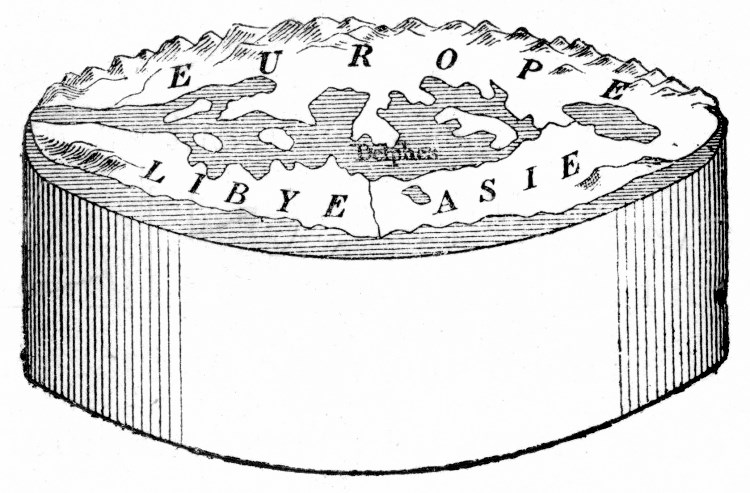
Modern discussions sometimes portray the earth in Homeric cosmology as a disc. All we’re actually told is that it’s flat: that doesn’t automatically imply circular. The descriptions of Achilles’ and Heracles’ shields in the Iliad (ca. 670-650 BCE) and the Shield (ca. 600 BCE?) have them portraying a symbolic world surrounded by the mythical river Ocean running in a circle around the earth, but the shields were circular, so that’s not exactly surprising.

We get indications of a flat disc, or at least a circular object, in the 6th and 5th centuries BCE, with Anaximander (early 500s) and Herodotus (ca. 420s). Herodotus tells us that early map-makers were in the habit of making the Ocean circular (4.36.2): he condemns the practice, believing the shape of the Eurasian-African landmass to be more irregular. Anaximander is credited as the very first map-maker, and he envisaged the earth as a cylinder (see the illustration at the start of this post):
ὑπάρχειν δέ φησι τῶι μὲν σχήματι τὴν γῆν κυλινδροειδῆ, ἔχειν δὲ τοσοῦτον βάθος ὅσον ἂν εἴη τρίτον πρὸς τὸ πλάτος.
And he says that the earth is cylindrical in shape, and has a depth that is however much a third of its width is.
τὴν δὲ γῆν εἶναι μετέωρον ὑπὸ μηδενὸς κρατουμένην, μένουσαν δὲ διὰ τὴν ὁμοίαν πάντων ἀπόστασιν. τὸ δὲ σχῆμα αὐτῆς γυρόν, στρογγύλον, κίονι λίθωι παραπλήσιον: τῶν δὲ ἐπιπέδων ὧι μὲν ἐπιβεβήκαμεν, ὃ δὲ ἀντίθετον ὑπάρχει.
(And he says) that the earth is suspended in the sky, not held up by anything, staying in place because of its equal separation from all things. And that its shape is curved, round, similar to a stone column; and we walk on one of its faces, but it has an opposite (face).
(Anaximander frs. 12.A.10, A.11 ed. Diels-Kranz; similarly A.21, A.25, B.5)
(I have encountered some people who have been misled about Anaximander by Isaac Asimov: in an educational children’s book (1972), he misinterpreted the first of these fragments as suggesting that we live on the curved side of the cylinder. Actually the ‘stone column’ refers to column segments like these. The second fragment above, and Herodotus’ criticism of map-makers, both make it clear that Anaximander envisaged the cylinder as lying flat.)

It would be nice if we had more information about what early natural philosophers thought. Some testimony does exist, though. Two isolated, and very late, references attribute round-earthism to Pythagoras and Thales: Pythagoras, Diog. L. 8.48; Thales, Aëtius Plac. 3.10. But there’s essentially no doubt that these are both untrue. The Pythagoras passage also ascribes round-earthism to Hesiod and Anaximander, and we know both of these are false; and the source, Diogenes Laertius, isn’t very reliable as a rule. And in Thales’ case, a much earlier source tells us that he taught the earth floats in water like a piece of wood (Aristotle On the sky 294a28-b1 = fr. 11.A.14 ed. Diels-Kranz; see further Couprie 2011: 63-7).

Besides, in 6th-5th-century BCE thinkers we see an overwhelming consensus that the earth was flat. If Pythagoras or Thales were round-earthers, it would have been a very exceptional thing, so we’d expect a well-informed writer like Aristotle to highlight it. Here’s a selection of what pre-Socratic thinkers did believe about the shape of the world (fragment numbers follow the standard edition of Diels and Kranz 1952):
  • Anaximenes (500s BCE): the earth is πλατεῖαν μάλα ‘very flat’ (fr. 13.A.6; also A.7§4, which adds that sun, moon, and other astronomical bodies are all flat; also A.20), and suspended in space by air pressure underneath (A.20).
  • Anaxagoras (ca. 460-430): the earth is πλατείας ‘flat’ (frs. 59.A.1§8, A.42§3, A.47, A.87); as in Anaximenes, it is suspended by air pressure (13.A.20).
  • Archelaus (ca. 450): the earth is not perfectly flat but κύκλῳ μὲν οὖσαν ὑψηλήν, μέσον δὲ κοίλην ‘high in a ring, and concave in the middle’; he uses this to explain different times of sunrise and sunset in different parts of the world (fr. 60.A.4§4).
  • Empedocles (mid-400s): the earth is κυκλοτερής ‘circular’ (i.e. disc-shaped; fr. 31.A.56; also A.50, which discusses the earth’s horizontal expanse).
  • Leucippus (400s): the earth is τυμπανῶδες or τυμπανοειδῆ ‘drum-shaped’ (frs. 67.A.1§30, A.26), but tilts downwards to the south, resulting in colder climates in the north (A.1§33).
  • Diogenes of Apollonia (ca. 440-430): the earth is στρογγύλην, ἠρεισμένην ἐν τῷ μέσῳ ‘circular, supported in the middle’ (fr. 64.A.1; στρογγύλος can also mean ‘spherical’, but in context it must refer to a flat circle).
  • Democritus (second half of 400s): as in Archelaus, the earth is δισκοειδῆ μὲν τῷ πλάτει, κοίλην δὲ τῷ μέσῳ ’disc-shaped in its surface, but concave in the middle’ (fr. 68.A.94); it is not a perfect disc, however, but προμήκης ... ἡμιόλιον το μῆκος τοῦ πλάτους ἔχουσα ‘elongated, oblong along the length of its surface’ (B.15§2); as in Leucippus, the earth tilts downwards to the south (A.1§33); as in Anaximenes and Anaxagoras, it is suspended in space by air pressure underneath (13.A.20).
Early Greek cosmology could get pretty wild. It’s just as well we don’t have to go into the cosmology that we see in Parmenides and in Plato’s Timaeus just now, or we’d really go bananas. However, in the midst of all this speculation some useful ideas did pop up. Notably Anaximander and Archelaus: though they were flat-earthers, they did lay an important piece of conceptual groundwork for the principle of round-earth gravity, in which all things fall towards the centre of the earth. As we saw above, Anaximander’s earth was stable in the centre of the cosmos because of its ‘equal separation from all things’; Archelaus’ earth was at the centre because all things gravitate towards the centre (fr. 60.A.4§2). In both cases the earth requires no physical supports. Both of these are counter-arguments to the Pythagorean picture of the cosmos, which has the earth attached to one of the celestial spheres moving around the central fire. If Anaximander’s and Archelaus’ ideas of the suspended earth hadn’t existed, it might have been a lot harder for round-earthism to take off.

For take off it did. We don’t know who came up with the idea first. Dirk Couprie (2011: 169) suspects Oenopides (mid-400s BCE), who is credited as the discoverer of the ecliptic. The ecliptic is the plane of the earth’s orbit, at an angle to the equator, so one might wonder if Oenopides also realised that it implied a spherical earth. We can’t be sure.

Whoever it was, the earth’s sphericity was well known enough by the early 300s BCE that Plato could take knowledge of it for granted (Phaedo 108e-109a). By the mid-to-late 300s we find Aristotle (On the sky 296b-297b) explicitly discussing empirical evidence for the spherical shape of the earth; how gravity impels all objects towards the centre of the earth; and an (inaccurate) estimate for its circumference. Perhaps most famously, in the mid-200s Eratosthenes comes up with the first roughly accurate and empirical determination of the earth’s circumference.

Aristotle’s evidence for the earth’s sphericity
(source: PracticalPhysics.org, adapted)

From Aristotle onwards the earth’s shape was common knowledge.

Aristotle to the 4th century CE

Flat-earthers didn’t vanish altogether -- Epicurus, who lived into the 200s BCE, was a flat-earther, and plenty of later Epicureans subscribed to his teachings -- but they were a minority. Roman thinkers like Cicero and Pliny spend time discussing the spherical earth and Aristotelean gravity; the round earth is fundamental to the work of astronomers like Hipparchus; and its shape was considered very carefully in Eratosthenes’ Geography, Strabo’s Geography (2.5.1-11), and Ptolemy’s Geographica.

All three of these writers discuss the problem of how to project a spherical surface onto a flat map. Strabo, the least technical of the three, is relatively dismissive: as far as he’s concerned, make the map big enough and the inaccuracies won’t matter (2.5.10). But for Eratosthenes and Ptolemy it was a serious problem. (Even today people still argue over which flat projection is best.) Ptolemy devotes most of the first book of the Geographica to an extended theoretical discussion of the ‘right’ projection; the rest of his atlas is a catalogue of place-names and topographical details, using a very modern-looking system of latitude and longitude. For Eratosthenes and Strabo things were somewhat simpler, in that they only needed to worry about a smaller portion of the earth as known to them. Eratosthenes regarded the known world, or oikoumenē, as a quadrilateral on the curved surface of the earth (Eratosthenes Geography fr 30 ed. Roller = Strabo 2.5.5-6; similarly Erat. frs. 31, 32, 33, 34). According to Strabo, the resulting non-Euclidean shape was called a sphondylos (‘whorl’), and the land within this region was the shape of a chlamys (‘cloak’) draped over the sphere.

Eratosthenes’ sphondylos ‘whorl’: the quadrilateral of the known world (oikoumenē). The edges of the quadrilateral are lines of latitude and longitude.

Incidentally, Ptolemy is the person responsible for the modern convention of putting north at the top of a map. This practice isn’t self-evident, and it wasn’t a universal standard in Ptolemy’s time: Cleomedes (somewhere between 2nd and 4th century CE) arranges west at the top, and north to the right. Ptolemy, in the prologue to Geographica book 2, observes that he has the most detailed geographical data for the north-west of the Eurasian landmass, so he decides to put that material in the first place that people will look -- at the top left of his map. In the Renaissance, 15th century western cartographers revived Ptolemy’s convention, so that it has become the modern standard. (If Greek had been written right-to-left in Ptolemy’s time, our maps today would have west at the top ...)

Crates of Mallos, a Greek scholar living in Rome in the 2nd century BCE, is sometimes credited as creating the first ever globe map. He certainly discussed the nature of the globe, as reported by Strabo 2.5.10: but Strabo doesn’t refer to a physical globe, only to a Kratēteion, ‘Crates’ (interpretation)’. Anything else would be very surprising anyway: Crates wasn’t a natural philosopher, but a very bookish literary critic. Strabo was probably thinking of Crates writing about the geography in the Homeric Odyssey, and Crates’ bizarre argument that Homer must have known the earth was spherical (Crates frs. 37 and 54 ed. Broggiato).

Even poets took the round earth for granted. Here’s a passage from the opening of Ovid’s epic the Metamorphoses, describing the primordial state of the universe (Met. 1.5-13) --
Before the sea and earth, and the sky which touches all things,
the form of nature was one throughout the entire universe:
they called it Chaos. ...
... and [as yet] the earth did not hang in the air flowing around it,
poised by its own weights ...
‘Poised by its own weights’ refers to the Aristotelean teaching on gravity: all bodies are attracted to the centre of the earth, so the earth’s weight is balanced around the centre.

Late antiquity and the mediaeval period

In the history of the Latin west we know of vanishingly few flat-earthers prior to the emergence of modern flat-earthism in the Victorian period. The only one who is at all well known is Lactantius, a rhetorician and Christian apologist of the late 200s/early 300s CE. His mockery of round-earthism (Divine institutes 3.24) is routinely cited as exemplary of the backwardness of Christian thought. It was Copernicus who began the tradition of targetting him -- though unlike later writers, Copernicus doesn’t pick on Lactantius’ religion (De revolutionibus ivb).

But Lactantius is almost unique. Nearly all other figures in the Latin world who had anything to say on the subject -- Augustine, Macrobius, Boethius, Isidore, Bede, Thomas Aquinas, Dante (all Christians, you’ll notice) -- were round-earthers. Augustine, City of God 16.9, is sometimes cited as belonging to the flat-earth camp, but the only doubt he expresses is over the assumption that there must necessarily be a landmass at the antipodes, or that if there is one that it is necessarily inhabited. (By luck he was quite right: the point on the earth’s surface opposite his hometown, Hippo in modern Algeria, is underwater in the southern Pacific, over 1100 km east of Auckland, New Zealand -- and indeed there were no humans in New Zealand in Augustine’s lifetime.)

Bede is an especially striking exemplar of western learning on the subject: his treatise On the measuring of time is precisely about the astronomical basis for the calendar, and he talks at length about the spatial relationships between the sun, moon, stars, and the spherical earth: for example (De ratione temporum §32),
causa autem inaequalitatis eorundem dierum terrae rotunditas est: neque enim frustra et in scripturae divinae, et in communium literarum paginis orbis terrae vocatur. est enim re vera orbis idem in medio totius mundi positus, non in latitudinis solum gyro, quasi instar scuti rotundus, sed instar potius pilae undique versum aequali rotunditate persimilis: ...
The cause of the inequality of days is the roundness of the earth. It is not for nothing that it is called ‘the orb of the earth’ in the pages of both divine scripture and general literature. For in fact the orb is positioned in the centre of the entire cosmos, not just in a wide circle in the likeness of a shield, but rather in the likeness of a ball which is identical in equal roundness on every side ...
Notice that this passage doesn’t just show an awareness of the earth’s shape, but also of the angle of the ecliptic and its importance to the seasons. See also Bede’s De natura rerum, at sections §46 (‘We refer to the orb of the earth not because its shape is that of a perfect orb, given the great difference between mountains and plains, but because ... [its overall shape] makes a figure of a perfect orb’) and §5-§10.

The Greek-speaking world is much less tidy. There, we do find a cluster of genuine flat-earthers, and a pronounced absence of round-earthers -- to the point where it looks very much as if some parts of the early Byzantine world were, after all, predominantly flat-earthers.

In the decades before and after emperor Theodosius I, who waged a campaign of radical dehellenisation in the 380s and 390s CE, we find many figures espousing flat-earthism on the basis of biblical passages -- Ephrem of Syria, John Chrysostom, Diodorus of Tarsus, Severian of Gabala, and Theodore of Mopsuestia, and perhaps several others who are less clear-cut. Most of these figures came from Syria and learned from each other: John Chrysostom studied under Diodorus, Severian knew Ephrem’s work and had a troubled relationship with both Chrysostom and Diodorus. Johannes Zellinger has written of them as representing a ‘Syrian-Antiochene school’ of biblical literalism (Zellinger 1916: 75). Was flat-earthism confined to Syria, though? John Chrysostom, Diodorus, and Severian taught and preached in Constantinople too.

Full references:
Later Byzantines were less concerned with literalism. John Philoponus (6th cent.) admits, in his On the creation of the world, that it’s impossible to write about the Genesis creation story in physical or astronomical terms without contradiction (De opificio mundi 1.2). And Photius, the 9th century scholar and patriarch who is our source for Diodorus of Tarsus, is doubtful about Diodorus’ theories (Myr. 210b.4: ‘there is no compelling proof of this’).

But flat-earthism lived on beyond the 4th and 5th centuries. The most notorious piece of Byzantine flat-earthism comes from Philoponus’ time. In the 6th century we find a work called Christian topography by Cosmas, an Alexandrian monk (nicknamed Indikopleustes, ‘sailor to India’, because he embarked on a voyage there once, though he didn’t reach his destination). Cosmas again adopts a radically literalist reading of some biblical passages, but goes into far more detail than any of the Syrians. Topography book 2 (text; translation) gives a description of the shape and size of the world that is totally uncontaminated by anything non-biblical. Led by Genesis 1, Cosmas takes Hebrews 9:1-14 to be saying that the universe has the same form as the tabernacle described in Exodus 25-26, and that the earth has the same form as the ark of the covenant -- that is to say: flat, with four walls, and a lid on top. (Yes, really. Here are a couple more discussions of Cosmas that go into more detail: 1, 2.)

Cosmas’ conception of the earthly world (source: Zellinger 1916: 81)

So even though none of the details invented by Washington Irving are real, the flat earth myth isn’t all imaginary. There were flat-earthers in antiquity and in the early mediaeval period. And some flat-earthers did take their beliefs from literalist interpretations of biblical passages. But, once round-earthism initially took off, they were never a majority -- with the possible exception of 4th-5th century Syria (and Constantinople?).

‘But yeah but yeah but that was only educated people. Uneducated people still believed the earth was flat, right?’

That kind of anti-scepticism -- the insistence that people in times past must have been stupid -- is worthy of the History Channel. Ultimately what we have to go on is what the evidence tells us. And the evidence suggests that flat-earthism was a tightly confined phenomenon, at least until the Victorian era. We have essentially no evidence of flat-earthism in the Latin west; and the evidence that we do have from the Greek east comes to us from only one period of religious extremism.

References

  • Asimov, I. 1972. How did we find out the earth is round? New York: Walker & Co.
  • Broggiato, M. 2001. Cratete di Mallo. I frammenti. La Spezia: Agorà Edizioni.
  • Couprie, D. 2011. Heaven and earth in ancient Greek cosmology: from Thales to Heraclides Ponticus. New York: Springer.
  • Diels, H.; Kranz, W. 1952. Die Fragmente der Vorsokratiker, 3 vols., 6th ed. Berlin: Weidmann.
  • Roller, D. W. 2010. Eratosthenes’ Geography. Princeton: Princeton University Press.
  • Zellinger, J. 1916. Die Genesishomilien des Bischofs Severian von Gabala. Münster: Aschendorffsche Buchhandlung.