Showing posts with label astronomy. Show all posts

10 April 2024

Naming the days of the week

Ever wondered where the weekday names come from? The answer may go back a bit further than you think. But it’s also incomplete.

The easy part of the answer is that the days are named after the seven planets. Not the modern solar system, though. The planets as they were known to ancient astronomers like Ptolemy. And in English, six of the seven planet names were swapped out, and Old English words or gods’ names put in. But the idea’s the same.

Sunday. Sun; relief of Sol (Museo Nazionale Romano, Rome)
Planet Roman name Old English Modern English
Sun dies Solis Sunne Sunday
Moon dies Lunae Mōna Monday
Mars dies Martis Tiw (~Týr) Tuesday
Mercury dies Mercurii Wōden (~Odin) Wednesday
Jupiter dies Iovis Þonar (~Thor) Thursday
Venus dies Veneris Frīg (~Frigg) Friday
Saturn dies Saturni Saturday

In antiquity the Sun and Moon were frequently counted among the planets because, like the planets, they travel along the ecliptic relative to the fixed stars. Sometimes ancient writers talk of seven planets (including Sun and Moon), sometimes just five.

That’s the easy bit. I think the more interesting questions are:

  1. When did Greco-Roman gods get attached to the seven day cycle?
  2. Why are they in that order?
Monday. Moon (CambridgeInColour.com); Luna in chariot (Arch of Constantine, Rome)

Roman weekday names

The weekday names apparently arrived in Rome in the late 1st century BCE. The earliest reference to a day bearing one of the modern names is in the elegiac poet Tibullus, in a poem dating to the early 20s BCE.

aut ego sum causatus aves aut omina dira
      Saturnive sacram me tenuisse diem.

I used birds or bad omens as a pretext,
      or that the day sacred to Saturn detained me.

Tibullus 1.3.17–18

Petronius’ Satyrica alludes to all seven planets being associated with weekdays. However, the date of the Satyrica is in some doubt these days. It used to be dated to the reign of Nero (54–68 CE), but some scholars now think it’s a 2nd century novel.

... two timetables were posted, one on each doorpost. One of them, if I recall correctly, had this note: ‘third day and day before Kalends of January [30–31 December]: our C. dines out.’ The other depicted the course of the moon and paintings of the seven stars.
Petronius, Satyrica 30

The modern sequence of days appears in two graffiti no later than 79 CE, found at Pompeii. One is in Greek; the other, in Latin, omits Wednesday. Both graffiti start the week on Saturday.

θεων ημερας | κρονου | ηλιου | σεληνης | αρεως | ε[ρ]μου | διος | [αφρο]δειτης
Days of the gods: (day of) Kronos, Sun, Moon, Ares, Hermes, Zeus, Aphrodite

saturni | solis | lunae | martis | iovis | veneris
(day of) Saturn, Sol, Luna, Mars, Jupiter, Venus

Sogliano 1901: 330
Note. These and some further references are helpfully compiled by Schürer 1905: 25–34.

A graffito similar to the second has been found in Tunisia at Thuburbo Maius, not far from Carthage (IL Tun. 710 = Merlin 1944: 126), but that’s probably a couple of centuries later. It too starts the week on Saturday. The canonical sequence of seven appears in many later writers — including a short 4th century poem by Ausonius. In Ausonius, the week now begins on Sunday.

Some of these later writers were puzzled by the order. Plutarch, in the 2nd century, devoted a section of his Table talk to the question ‘Why they name the days after planets but number them differently from their sequence’ (Plutarch, Moralia 672c). Unfortunately that part of the Table talk is lost.

Tuesday. Mars (Fvalk.com); C. F. von Saltza, ‘Týr’ (F. Sander, Edda Sämund den vises, Stockholm, 1893, p. 78)

The order of the seven (or five) planets

The five planets, aside from the Sun and Moon, are the ones that are visible to the naked eye: Mercury, Venus, Mars, Jupiter, and Saturn. (Theoretically Uranus is too — occasionally, and with a keen eye. But only for a rather Simpsons-esque sense of ‘theoretically’.)

Those who are skilled in astronomy say that there are seven bands, on which the seven stars are carried. On the highest is carried the star of Kronos; on the one after that the star of Zeus; on the third the star of Ares; on the fourth the star of the Sun; on the fifth the star of Aphrodite; on the sixth the star of Hermes; and on the seventh the star of the Moon.
Achilles, Eisagoge 16 (Maas 1898: 42,25–30)

So the standard sequence, starting from the outermost planet, is: Saturn, Jupiter, Mars, Sun, Venus, Mercury, and Moon.

This arrangement isn’t really ‘Ptolemaic’, or only incidentally. Ptolemy himself allowed doubt over whether the inner planets are ‘beneath’ or ‘above’ the Sun, since the Sun’s brightness makes it impossible to observe whether Venus and Mercury pass in front or behind. And he’s explicit that he can’t measure the planets’ distance, since he can’t measure any parallax. He just accepts the conventional sequence as, well, a convention.

πιθανωτέρα μᾶλλον ἡ τῶν παλαιοτέρων τάξις καταφαίνεται ...

the order assumed by the older [astronomers] appears the more plausible ..

Ptolemy, Almagest 9.1 (ii.207 Heiberg; tr. Toomer)

Some other features of the ‘Ptolemaic’ system aren’t really Ptolemaic either. Ptolemy has no word for ‘deferent’, the circular orbit on which the epicycle is centred (though he does use the concept); he doesn’t give figures for the distances of the planets. That’s all mediaeval.

Wednesday. Mercury (Cronodon.com); Ian McShane as Wednesday (promotional poster for American gods, 2017–2021)

The standard order took time to become settled. Otto Neugebauer gives a handy run-down of the different sequences seen in different ancient cultures and different ancient authors (1975: 690–693). Some of them omit the Sun and Moon; some are reversed; some omit Jupiter and Saturn. His verdict is that no standard order existed prior to the time of Hipparchos, in the 2nd century BCE.

Egyptian Jupiter, Saturn, Venus, Mercury, Mars
older Babylonian Jupiter, Venus, Saturn, Mercury, Mars
Persian/Hellenistic era Babylonian Jupiter, Venus, Mercury, Saturn, Mars
Archimedes according to ps-Hippolytos Refutatio 4.7–11 Moon, Sun, Venus, Mercury, Mars, Jupiter, Saturn, fixed stars
Plutarch On generation 1028b (Pythagorean) Central fire, Counter-earth, Earth, Moon, Mercury, Venus, Sun
Plutarch On generation 1029b Mercury, Venus, Mars, Jupiter, Saturn
‘some’ according to Achilles, apparently including Eratosthenes (Maass 1898: 42,30–43,2) [Mars], Venus, Mercury, Sun, [Moon]
‘others’ according to Achilles (ibid.) [Mars], Mercury, Sun, Venus, [Moon]
Eudoxos papyrus, inscription of Keskinto Saturn, Jupiter, Mars, Mercury, Venus
Vitruvius Architecture 9.1.5 Moon, Mercury, Venus, Sun, Mars, Jupiter, Saturn
Ptolemy Almagest 9.1, Cicero On divination 2.91–92, Pliny Natural history 2.34–44 Saturn, Jupiter, Mars, Sun, Venus, Mercury, Moon
Cicero On the nature of the gods 2.52–53 Saturn, Jupiter, Mars, Venus, Mercury
(Indian) Varāhamihira Pancha-siddhantika 13.39 (i.121 Neugebauer-Pingree) Moon, Mercury, Venus, Sun, Mars, Jupiter, Saturn, nakṣatras

(Notice, by the way, that Vitruvius and the 6th century Indian astronomer Varāhamihira have the same sequence as Ptolemy, but reversed; so do Cicero and Plutarch, reversing one another, but both omitting the Sun and Moon.)

In spite of the variation, and the fact that Ptolemy regarded the sequence as purely conventional, the ‘Ptolemaic’ sequence came to be universally regarded as the standard order. Ptolemy calls it ‘the order of previous astronomers’ (ἡ τῶν παλαιοτέρων τάξις), but as mentioned above, it’s inconsistent with pre-2nd century BCE sequences, Neugebauer suggests that no sequence existed until around the time of Hipparchos.

Thursday. Jupiter (Aol.com); Chris Hemsworth as Thor (promotional poster for Thor: the dark world, 2013)

The order of the weekdays

Here’s how the planets get reordered into weekdays, starting with Saturn, as in Ptolemy and the Pompeii graffiti.

We don’t actually have any good evidence on why this reordering happened. It clearly isn’t random, though: notice how for each weekday, you skip two planets — or conversely, for each planet, you skip four weekdays

One modern book on the history of the week, by Eviatar Zerubavel, favours a theory based on the premise that Egyptian astronomers assigned each of the planets to hours of the day (1985: 14–17); however, everything about this theory is hypothetical. It’s claimed by an ancient author, as we’ll see below, but not a very trustworthy author. It can’t be corroborated as anything more than, well, some ancient guy making guesses.

There are three ancient theories on record, including the one Zerubavel prefers. Personally I think all three are pretty tenuous. The lost essay by Plutarch that I mentioned above may have had a fourth explanation, but alas, we’ll never know what it was.

Friday. Venus (Deepsky2000.com); C. E. Doepler, ‘Frigg and her handmaidens’ (W. Wägner, Nordisch-germanische Götter- und Heldensagen, 3rd ed. 1882, p. 109)

The first theory comes from a 6th century Indian astronomer, Varāhamihira.

(Ascending) up from the Moon (each successive planet) is lord of the month, (descending) down from Saturn lord of the hour. (Ascending) up in order (every) fifth (planet) is lord of the day; the lords of the year are clear.
Varāhamihira, Pancha-siddhantika 13.42 (i.121 Neugebauer-Pingree)

This is simply a restatement of the pattern I mentioned: start from Moon = Monday, then for each successive day, move on five planets (counting inclusively; four, counting exclusively). Why anyone would do that, he doesn’t explain. So this is a pretty weak theory.

The second and third are found in Dion Cassius (3rd century CE). He attributes them both to ‘the Egyptians’, which is ... doubtful, to say the least. But let’s hear him out. Here’s theory number two:

For if you apply the so-called ‘principle of the tetrachord’ (which is believed to constitute the basis of music) to these stars, by which the whole universe of heaven is divided into regular intervals, in the order in which each of them revolves, and beginning at the outer orbit assigned to Saturn, then omitting the next two name the lord of the fourth, and after this passing over two others reach the seventh, and you then go back and repeat the process with the orbits and their presiding divinities in this same manner, assigning them to the several days, you will find all the days to be in a kind of musical connection with the arrangement of the heavens.
Dion Cassius 37.18 (tr. Cary)

The tetrachord was indeed the basic element of ancient Greek music: it was a sequence of four notes, spanning an interval of what we would call a perfect fourth (a frequency ratio of 4:3). That is, this theory is that you rotate through the planets in the same way that musical keys modulate through a cycle of fifths.

That isn’t as crazy as it might sound. These are all real things: the tetrachord, the Pythagorean preoccupation with perfect harmonic intervals, and the idea that the planets are tied up with musical theory in some way. Unfortunately we know basically nothing about Pythagoreanism in the 1st century BCE, so we have no way of deciding whether this theory is plausible, or completely daft.

Saturday. Saturn (UniverseToday.com); relief of Saturnus from altar of Malakbel (Palmyra, Syria), Musei Capitolini, Rome (Wikimedia.org)

Here’s theory number three, also from Dion Cassius:

If you begin at the first hour to count the hours of the day and of the night, assigning the first to Saturn, the next to Jupiter, the third to Mars, the fourth to the Sun, the fifth to Venus, the sixth to Mercury, and the seventh to the Moon, according to the order of the cycles which the Egyptians observe, and if you repeat the process, covering thus the whole twenty-four hours, you will find that the first hour of the following day comes to the Sun. And if you carry on the operation throughout the next twenty-four hours in the same manner as with the others, you will dedicate the first hour of the third day to the Moon, and if you proceed similarly through the rest, each day will receive its appropriate god.
Dion Cassius 37.19 (tr. Cary)

This one depends on the premise that each hour of the day is assigned to a planet, and that they’re assigned in the Ptolemaic order.

Day Day begins at hour Associated planet
1 1 Saturn
2 25 Sun
3 49 Moon
4 73 Mars
5 97 Mercury
6 121 Jupiter
7 145 Venus
8 169 Saturn

and so on. This sounds kind of plausible. It also has the advantage of predicting Saturday as the first day of the week, which is exactly what we see in early sources like the Pompeii graffiti.

There are problems, however. First, there’s no corroboration in anything we know about Egyptian astronomy for the idea of assigning planets to hours. It could easily be a figment of Dion’s imagination.

Second, Egyptian astronomy is characterised much more by a division of the day (and night) into 12 hours, not 24. According to Robert Hannah, the concept of the 12 hour day is precisely of Egyptian origin (2005: 87). As Herodotos puts it,

But as far as human affairs are concerned, [the priests in Egypt] agreed on this: that the Egyptians were the first to discover the year, and the division of it into twelve seasonal segments; and they discovered this from the stars, as they said. ... They also said the Egyptians were the first to refer to a canon of twelve gods, and that the Greeks adopted this from them ...
Herodotos 2.4 (my emphasis)

(A 12 hour cycle would produce the same result, if we start from the Moon and work our way out. But then we lose the advantage of matching early sources by outputting Saturday as the first day of the week.)

And third, what we do find in actual Egyptian astronomy is the idea of associating hours with specific stars or constellations, not planets.

The hours became associated with certain stars or star groups which rose heliacally at ten-day intervals through the year. Sirius was one of these, and it was joined by 35 other stars ... Collectively they are now known as the ‘decans’ ...
Hannah 2005: 87

This produced a system of ten-day weeks in a seven-week cycle, not a cycle of seven days. Theory number three gives every appearance of being a post hoc rationalisation of the weekday names, not a true explanation.

None of the three theories has any corroboration. Theory 1 is certainly the weakest. But the mismatch between theory 3 and what is actually known about Egyptian astronomy is so glaring that I think it has to be rejected almost as strongly.

The weird result is that the Pythagorean explanation — theory 2, rotating between the planets in musical tetrachords — is the strongest.

Not that it’s a good theory, mind. It sounds quite daft to me. It’s just that, as things stand, we don’t have anything to rule it out.

References

  • Hannah, R. 2005. Greek & Roman calendars. Constructions of time in the classical world. London.
  • Maass, E. 1898. Commentariorum in Aratum reliquiae. Berlin. [Internet Archive]
  • Mau, A. 1881. ‘Scavi di Pompei.’ Bullettino dell’Instituto di corrispondenza archeologica 1881,i–ii: 22–32. [Internet Archive]
  • Merlin, A. 1944. Inscriptions latines de la Tunisie. Paris.
  • Neugebauer, O. 1975. A history of ancient mathematical astronomy. Berlin/Heidelberg.
  • Schürer, E. 1905. ‘Die siebentägige Woche im Gebrauche der christlichen Kirche der ersten Jahrhunderte.’ Zeitschrift für die Neutestamentliche Wissenschaft 6: 1–66. [Zenodo]
  • Sogliano, A. 1901. ‘Regione I (Latium et Campania).’ In: Notizie degli scavi di antichità comunicate alla R. Accademia dei Lincei, anno 1901, s.v. ‘Luglio 1901’. Rome. 329–333. [Internet Archive]
  • Zerubavel, E. 1985. The seven day circle. The history and meaning of the week. Chicago.

09 March 2024

Aristarchus and the heliocentric theory

The earth has orbited around the sun since 1609. At least that’s when Kepler’s book on the subject came out, Astronomia nova (‘The new astronomy’). Copernicus had proposed a heliocentric theory in 1543, but with circular orbits it was a lousy model. The geocentric Ptolemaic system continued to be the better model of planetary motion until Kepler came along.

But there was another precedent. Sometime around 280 BCE, in ancient Greece, Aristarchus of Samos proposed a heliocentric model. What exactly did Aristarchus argue? How did he arrive at his theory, what did people think of it, and why did it end up being neglected?

The last question is the simplest: Aristarchus’ theory was neglected because his writings on the subject were lost. Also, other ancient astronomers found that geocentrism, with epicycles, produced a superior model of planetary motion — and they were right. Even though the reason they were right had nothing to do with the planets’ real motion, and everything to do with a form of mathematical analysis that wasn’t fully developed until the 1800s.

Aristarchus of Samos

We don’t know much about Aristarchus’ life. He was born on the island of Samos, probably in the 310s BCE, a decade or two after Alexander’s death. What we know of his dates comes from just three facts:

  • We’re told he studied under Straton of Lampsakos, who was the head of the Peripatos in Athens from 287 until 269 BCE.
  • Aristarchus observed the summer solstice in 280 BCE.
  • His heliocentric model was discussed by Archimedes in the 240s or 230s BCE.

So we know he spent a period in Athens at some point, but nothing else about his movements. We know he developed a heliocentric theory; he measured the sizes and distances of the moon and sun; discovered some trigonometric inequalities; and invented two instruments, something called the ‘disc on a level surface’, and the skaphe, a bowl with a fixed needle and gauge markings for measuring the sun’s position.

Map showing Samos (base image: Google Earth)

Much more precise equipment for measuring the sun’s position was developed pretty soon afterwards. But Aristarchus’ skaphe was straightforward enough to stick around: three centuries later, Pliny reports a bunch of skaphe readings of the sun’s altitude, varying depending on how far north you are.

Note. Pliny, Natural history 2.74, with a description of the skaphe. Aristarchus inventing the skaphe and the discum in planitia: Vitruvius 9.8.1. More precise devices for measuring the sun’s altitude are described by Ptolemy, Almagest 1.12. One of them, a device consisting of two concentric vertical rings, was in use in Meroë, Sudan, by the 2nd century BCE, and is probably also the device used by Eratosthenes: see here for details.

Only one book by Aristarchus survives: On the sizes and distances of sun and moon. It isn’t widely read. In it he measures the moon as being considerably smaller than the earth, and the sun as much bigger. This is also where we find him inventing some bits of trigonometry from first principles.

Note. Edition of Aristarchus’ On the sizes: Heath 1913: 317–414; text and translation at 352–411. Reader beware: Heath’s introduction is seriously marred by relying on Hultsch’s botched reckoning of two ancient distance units, the Egyptian schoinos and Greek stadion. See here. For a more recent and accurate discussion, see Berggren and Sidoli 2007.

The heliocentric theory and On the sizes

The heliocentric theory isn’t mentioned in Aristarchus’ surviving book. We have to rely on other ancient reports — and they aren’t generous with details.

Our main source is Archimedes. He brings up the heliocentric theory in a mathematical exercise, about devising a numerical notation capable of representing very large quantities.

Aristarchus of Samos, however, published writings of certain propositions, where it appears from the premises that the cosmos is many times larger than the standard [i.e. geocentric] cosmos. His suggestion is that the fixed stars and sun remain motionless, and the earth orbits around the sun in a circle, the sun at the centre of its path; and the sphere of fixed stars lies around the sun, with the sun at its centre. And its size [i.e. the sphere of fixed stars] is such that the circle of the earth's orbit has the same proportion to the distance of the fixed stars, as the centre of the sphere has to its surface.

This is obviously impossible: the centre of the sphere has no size, so it has to be understood as having no ratio to the sphere’s surface. So we take Aristarchus’ meaning to be: we suppose that the earth [in the geocentric model] is analogous to the centre of the cosmos [in the heliocentric model]; therefore, the earth’s ratio to the cosmos as we imagine it [i.e. geocentric] is the same as the ratio of the sphere on which the circle of the earth's orbit is inscribed to the sphere of fixed stars [in the heliocentric model].

Archimedes, Sand-reckoner 4–6 (ii.218 Heiberg)

This is obscurely phrased. Essentially, the second paragraph is saying that a lower bound for the size of a heliocentric cosmos has to be vastly larger than that of a geocentric cosmos.

Archimedes doesn’t say why. Presumably because of the parallax problem: as the earth moves around the sun, the fixed stars ought to shift their parallax in a yearly cycle. But they don’t. Therefore, either the earth doesn’t go around the sun, or the fixed stars are enormously more distant than the geocentric model would require.

(Archimedes goes on to work out how many grains of sand it would take to fill a very large cosmos. He calculates a lower bound for the universe’s diameter of a little under 2 light years — or rather, 100 trillion stadia — with room for 1063 grains of sand.)

This tells us: (1) Aristarchus proposed a heliocentric model; (2) he appreciated that the distance to the fixed stars has to be treated as effectively infinite. But it doesn’t tell us why Aristarchus thought this was better than the conventional geocentric model.

Two other passages in Plutarch are worth noting, dating to the 2nd century CE. One states that there were only two notable heliocentrists, Aristarchus and Seleucus; and that Aristarchus’ heliocentric model was only a proposal, while Seleucus regarded it as evidently true. The other passage tells a story of Aristarchus having a clash with a Stoic philosopher, Cleanthes. Several other sources discuss whether the earth is in motion rotating on its axis; the most prestigious figures, like Aristotle, Hipparchus, and Ptolemy, conclude it’s the sky that rotates.

Note. Plutarch, Platonic questions 1006c; Plutarch, On the face in the circle of the moon 922f–923a. On the question of Seleucus’ exact contribution, and the meaning of Plutarch’s word ἀποφαινόμενος, see Neugebauer 1975.ii: 697–698. On the earth’s rotation, see Aristotle, On the sky 296a–b (against); Heracleides of Pontus frs. 104–117 Wehrli (in favour); Seneca, Natural questions 7.2.3 (agnostic).

These still don’t tell us why Aristarchus favoured the heliocentric theory. But Aristarchus’ surviving work, On the sizes and distances of sun and moon, gives a pretty broad hint.

Aristarchus calculated the moon to have a diameter equivalent to about one third of an earth diameter, and the sun, about seven earth diameters. He based this on observations of the size of the earth’s shadow on the moon during lunar eclipses, and the angle between the sun and moon when the moon is half full.

His final figures are way off, because his observational tools ... well, sucked. He also wrongly assumed the moon subtends an angle of 2° as seen from earth, when it’s actually 0.5°. (And no, this isn’t a result of a typographical ambiguity.) Also, he couldn’t use trig functions on a modern calculator to convert angle measurements to distances, so he had to discover his trigonometrical inequalities to obtain lower and upper bounds.

An excerpt of Aristarchus’ On the sizes (Heath 1913: 364–365). At the bottom is where he mistakes the angular size of the moon: ‘And since it is assumed that the moon subtends a 15th of a zodiacal sign ...’ (where each zodiacal sign occupies a 12th of a circle, or 30°).

In other respects, his calculations are good. And he got one essential point right: the sun is much bigger than the earth. Sure, his figure for the sun’s size is missing a couple of zeroes. But it may still have been enough for him to infer that the cosmos ought to be imagined as centred on the colossal sun, not the puny earth.

For reference, here are his results, along with the actual figures as determined by modern astronomy.

  Aristarchus Actual Actual (km)
lunar diameter 0.3167 to 0.3981
earth diameters
0.2727
earth diameters
3475 km
lunar distance 22.50 to 30.00
lunar diameters
110.6
lunar diameters
384,400 km
solar diameter 6.333 to 7.167
earth diameters
109.2
earth diameters
1,392,000 km
solar distance 18.00 to 20.00
lunar distances
389.2
lunar distances
149,600,000 km
Note. Numbers are given to 4 s.f. The ‘actual’ columns show averages. For Aristarchus’ numbers see Heath 1913: 338. We don’t know what Aristarchus reckoned for the earth’s diameter: he may perhaps have known the 300,000 stadia estimate for the circumference that Archimedes mentions.

On the point of comparative sizes, he was obviously right, and everyone knew it. That may have been enough to push him towards the heliocentric theory. And if he realised that the theory could also explain the retrograde motion of the planets — well, that may have been a nice bonus.

What people thought of Aristarchus’ theory

People didn’t really take to heliocentrism. As I mentioned, we know of only one other ancient heliocentrist by name, Seleucus (mid-2nd century BCE).

Note. Seleucus: from the Erythraean Sea according to Strabo 3.5.9, Diels DG 328.5; from Seleuceia according to Strabo 16.1.6. He argued that Ocean tides are related to the motion of the moon (Strabo 1.1.9, 3.5.9); like Heracleides and Aristarchus he argued that the universe is infinite (Diels DG 328.5; a 10th century report quoted and translated by Pines 1963: 197).

Aristotle offered three separate objections to the idea that the earth orbits the sun — and he did so several decades before Aristarchus came along (On the sky 296a–296b).

  1. If the earth were in motion, either that motion must be the result of a force acting on the earth, in which case it’s non-natural and temporary; or it must be a natural motion shared by all parts of the earth, in which case objects should hover relative to the earth’s surface, but they don’t.
  2. If the earth orbited around something else we would observe stellar parallax, but we don’t.
  3. Weight falls to the ground: that is, it has a natural motion towards the centre of the earth. A natural phenomenon must be universal. Therefore this must actually be motion towards the centre of the cosmos. The fact that the earth’s centre is also in the same place is simply a result of the earth itself gravitating towards the centre.

Points 1 and 3 come from the observed fact that the earth is spherical. Point 2 is more specifically astronomical. We don’t know how Aristarchus would have responded to points 1 and 3; his solution to point 2 was to posit that the universe is infinite, or effectively infinite. Tycho Brahe too, in the 1600s, thought point 2 was heliocentrism’s weak point. Ptolemy thought it was point 3 (Almagest 1.7 = 24-25 Heiberg).

It’s kind of amazing how Aristotle’s points are completely wrong — but to see that they’re wrong, you need another two thousand years of science. Aristotle’s first and third objections weren’t resolved until the publication of Newton’s laws in 1687. Stellar parallax wasn’t measured until the 1830s. He was wrong ... but what a way to be wrong!

There’s no reason to imagine anyone ever thought the heliocentric theory violated any taboos. Writers like Archimedes and Ptolemy were happy to take it seriously and consider its implications, even if they disagreed with it.

The main evidence of active opposition to the heliocentric theory relates to the Stoic philosopher Cleanthes. We know Cleanthes wrote a tract called Against Aristarchus (Diogenes Laertius 7.174). Plutarch has an anecdote of Cleanthes saying that Aristarchus ought to be charged with ‘impiety’ (asebeia): in context it’s clear that that’s just a hyperbolic joke. But his opposition to the theory was genuine.

(Pharnaces said,) ‘You won’t induce me to give an account of what you’re accusing the Stoics of, until I get an account from you for turning the cosmos upside down!’

Then Lucius laughed and said, ‘Just don’t bring a charge of impiety against us! — like when Cleanthes thought the Greeks should accuse Aristarchus of Samos of impiety, because he was disturbing the foundation of the cosmos, trying to preserve observations by suggesting that the sky is immobile, and the earth orbits along the ecliptic, and rotates on its own axis.’

Plutarch, On the face in the circle of the moon 922f–923a

Note. Plutarch’s phrasing ‘preserve observations’ (φαινόμενα σῴζειν) is standard; it also appears in Simplicius’ account of Heracleides’ theory that the earth rotates (519,9–11 ed. Heiberg = Heracleides fr. 108 Wehrli).

Russo and Medaglia 1996 prefer the manuscript reading Ἀρίσταρχος ... Κλεάνθη to the usual emendation Ἀρίσταρχον ... Κλεάνθης, so that Aristarchus accuses Cleanthes of impiety rather than the other way round. However, the person in the accusative case here (a) is the one being accused, (b) is from Samos, and (c) is ‘disturbing the foundation of the cosmos’. These are very easily ascribed to Aristarchus; they cannot possibly be ascribed to Cleanthes. Cleanthes (a) wrote a treatise called Against Aristarchus, (b) was from Assos, and (c) was no astronomer. Russo and Medaglia have to make multiple other emendations to get the sentence to make sense, and their emendations rely on speculations about Cleanthes’ teachings. The usual emendation is far more robust.

Aristarchus’ theory wasn’t suppressed, it was just abandoned. The weight of opinion was against it. There was Cleanthes’ treatise; and actual astronomers had a more effective model to work with. Heath suggests that it was Hipparchus’ opposition, in the 2nd century BCE, that ‘sealed the fate of the heliocentric hypothesis’ (1913: 308). Certainly the extant Hipparchan-Ptolemaic system, with its eccentric orbits and epicycles, is better at modelling the motion of the planets.

People often scoff at the idea of Ptolemaic epicycles, but they’re missing the point. Epicycles are incredibly effective because each one is a term in a Fourier series.

A simplified form of the Ptolemaic model, ignoring eccentricity (base image: Youtube)

The principle of Fourier analysis is that any periodic function can be modelled as a composite of simple harmonic motions. Each term in a Fourier series represents a circular motion of a given magnitude and frequency. The more terms, the more accurate the model.

So even though Fourier didn’t formalise the idea until 1822, the Ptolemaic system uses the same principle. Ptolemy represents planetary motion as a Fourier series with coefficients determined by trial and error. The first term in the series is the deferent, the second is the epicycle.

No one in the present day objects when an mp3 compresses sound using 1024 epicycles, instead of encoding information about pitches, timbre, and instrumentation. It isn’t physically real, but it’s a very effective model. Epicycles in the Ptolemaic system work exactly the same way. Ptolemy treats them solely as a mathematical tool: he makes no claim to their physical reality.

Approximations of a square wave using Fourier series of 5 terms, 10 terms, and 125 terms (base image: Youtube).

Aristarchus was nearly forgotten by the time Copernicus reintroduced the heliocentric model in the early 1500s. The main source for Aristarchus’ theory, Archimedes’ Sand-reckoner, didn’t appear in print until 1544, the year after Copernicus’ death. Copernicus’ manuscript of De revolutionibus did refer to Aristarchus’ heliocentric theory, but he clearly didn’t know much about it. He removed the reference in the print edition.

Note. First print edition of the Sand-reckoner: Gechauff 1544: 120–127 (current edition: Heiberg 1913, ≈ 1881: 242–291). Copernicus’ manuscript: Biblioteka Jagiellońska, BJ Rkp. 10000 III, at f. 11v: ‘It is feasible that, for these and similar reasons, Philolaus [the Pythagorean] perceived that the earth is mobile; several sources report that Aristarchus of Samos was of the same view, for some reason other than that which Aristotle cites and refutes.’ The print edition mentions Aristarchus only in a separate context (1543: 65v).

References

  • Berggren, J. L.; Sidoli, N. 2007. ‘Aristarchus’s On the sizes and distances of the sun and moon: Greek and Arabic texts.’ Archive for history of exact sciences 61: 213–254. [Sci-hub]
  • Copernicus, N. 1543. De revolutionibus orbium coelestium. Nürnberg. [Internet Archive]
  • Gechauff, Th. (alias Venatorius) 1544. Ἀρχιμήδους τοῦ Συρακουσίου, τὰ μεχρὶ νῦν σωζόμενα, ἅπαντα. Archimedis Syracusani philosophi ac geometrae excellentissimi opera. Basel. [Google Books]
  • Heath, T. L. 1913. Aristarchus of Samos. The ancient Copernicus. Oxford. [Internet Archive]
  • Heiberg, J. L. 1913. Archimedes opera omnia, 2nd edition (first publ. 1881) vol. 2. Leipzig. [1881 edition: Internet Archive]
  • Neugebauer, O. 1975. A history of mathematical astronomy, 2 vols. Berlin/Heidelberg.
  • Pines, S. 1963. ‘Un fragment de Séleucus de Séleucie conservé en version arabe.’ Revue d’histoire des sciences 16: 193–209. [JSTOR]
  • Russo, L.; Medaglia, S. M. 1996. ‘Sulla presunta accusa di empietà ad Aristarco di Samo.’ Quaderni Urbinati di cultura classica 53: 113–121. [JSTOR]

01 July 2022

Was Sirius once red?

Back in 2020, when I wrote a piece about ancient Greek colour terms, two comments raised an interesting side-question: what colour was the star Sirius in antiquity?

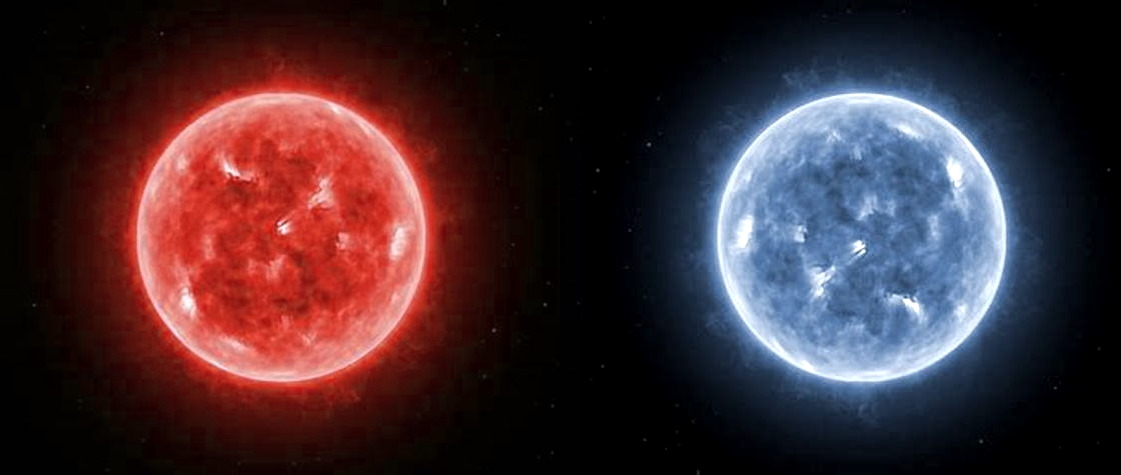
Did Sirius look red to ancient astronomers? First, be warned that the colours above aren’t real. Colours in space photos are always heavily enhanced — or, as in this picture, totally fake.

Sirius is the brightest star in our night sky. In antiquity it was also known as the Dog star; it still is today. It looks white. Or maybe blue-white: its spectrum has its peak at blue frequencies, and photographs tend to create blue halos. But really Sirius floods the entire range of visible light.

Over the last 250 years a question has been simmering, because — supposedly — some ancient writers describe it as ‘red’. Astronomers want to know: is it even possible that Sirius changed colour between the 100s and the 1700s CE?

The modern debate

But, to this rule there seems to be one exception, and that in a remarkable star: for old authors mention the Dog star, which is now white, and not at all inclined to redness, as being then very much so; as in the following places: ...
Barker 1759: 499

The colour change theory was first proposed in 1759 by Thomas Barker, an English country squire, meteorologist, and astronomer. He cited several pieces of ancient testimony, looking directly at the Greek and Latin terminology in each case:

  • Aratos, Phainomena 326–328 (3rd cent. BCE): the Dog star is ποικίλος (poikílos).
  • Cicero, Aratea fr. 34.107–108 ed. Pellacani (1st cent. BCE): the Dog star ‘shines with rutilus light’ (rutilo cum lumine claret).
  • Horace, Satires 2.5.39-40 (1st cent. BCE): refers to rubra Canicula.
  • Seneca, Quaestiones naturales 1.1.7 (1st cent. CE): refers to the rubor of Canicula.
  • Ptolemy, Almagest 7.5, 142 ed. Heiberg (2nd cent. CE): ‘the star in the mouth [of the Dog constellation, i.e. Canis Major] is the brightest, called the Dog; it is ὑπόκιρρος (hypókirrhos)’.
  • Hyginus, Astronomica 2.35 (1st cent. BCE/CE): refers to the ‘brightness’ or ‘whiteness of its flame’ (flammae candorem); Barker thinks (1) candor means strictly ‘whiteness’; so (2) this reference ‘expressly contradicts’ the others; so (3) Hyginus should be disregarded.

You’ll notice I’m leaving some Greek and Latin terms untranslated. That’s because their meaning is precisely what we’ll explore below.

I won’t cover the full history of the debate, which was argued by astronomers such as Jérôme de Lalande, Theodor von Schubert, and John Herschel. For the full story, see Ceragioli (1995).

One key development was in 1850, when Alexander von Humboldt published volume 3 of his book series Kosmos. Humboldt delved into the philology of the terms used by the ancient writers, with special attention to Ptolemy’s colour term, hypókirrhos.

The expression ὑπόκιῤῥος, which Ptolemy employs indiscriminately to designate the six stars named in his catalogue [i.e. the six stars named as hypókirrhos], implies a slightly marked transition from fiery-yellow [feuergelb] to fiery-red [feuerroth]; it therefore refers, strictly speaking, to a fiery-reddish colour. ... Κιῤῥός is, according to Galen, (Meth. med. 12,) a pale fiery-red inclining to yellow. ... Sirius is said by Seneca (Nat. Quæst., i. 1) to be redder than Mars ...
Humboldt 1851: 176 n. 46 (tr. Otté) = 1850: 204 n. 46

This report of the terminology is still widely treated as authoritative, because astronomers don’t typically learn Latin and ancient Greek these days. But as we’ll see, Humboldt is entirely wrong.

Roger C. Ceragioli, who trained as a classicist, wrote a 1995 article covering the modern debate and exposing the deluge of misinformation. Ceragioli handily disposes of most of the supposed evidence for ‘red Sirius’, but he thinks Barker’s references to Ptolemy, Horace, and Seneca stand up.

There is no doubt about what Ptolemy means. He bluntly says ‘reddish’ and other ancient sources corroborate him ...
Ceragioli 1995: 187

As a result, they still need explanation: either it’s because Sirius scintillates in various colour-flashes when close to the horizon (Ceragioli 1995), or because hypókirrhos in Ptolemy is an interpolation (Ceragioli 1996).

Note. The only other substantive discussion of the matter by a modern classicist that I’ve found is by Pellacani (2015: 156–157), who is much more willing to indulge the ‘red Sirius’ theory, is unaware of Ceragioli’s articles, and is selective in his reading of another key source, Avienius. We’ll return to Avienius below.

In fact none of the supposed evidence for ‘red’ Sirius stands up to scrutiny:

  • Hypókirrhos doesn’t mean ‘fiery red’ or ‘reddish’: it means ‘pale yellow’.
  • Horace’s and Seneca’s rubor primarily denotes ‘heat’. Its meaning as a colour term, ‘red’, is uncommon.
  • Cicero’s word rutilus primarily means ‘bright, shiny’, especially when used of celestial bodies. And anyway, when he uses the word he’s not talking about Sirius.
In fiction, Sirius is usually shown as noticeably blue to the naked eye. (Elite Dangerous, 2014)

Ptolemy: hypókirrhos

For modern advocates of ‘red Sirius’, Ptolemy’s testimony carries the most weight.

Κυνὸς ἀστερισμός.
ὁ ἐν τῷ στόματι λαμπρότατος καλούμενος Κύων καὶ ὑπόκιρρος ...
Constellation of Canis (Major).
The (star) in the mouth (of the Great Dog); the brightest; called the Dog; and hypókirrhos...
Ptolemy, Almagest 7.5, 142 ed. Heiberg

Hypókirrhos is ‘somewhat kirrhós’. But neither hypókirrhos nor kirrhós means ‘red’. A more correct translation is ‘cream, light yellow’.

Hypókirrhos and kirrhós are very rare words in most contexts. In extant classical-era texts (5th–4th century BCE) they appear only twice, both in the Hippokratic corpus. The etymology is unknown. Even at the best of times, interpreting Greek colour terms is tricky: here, extreme caution is needed.

The argument for interpreting hypókirrhos as ‘reddish’ rests entirely on these two points:

  1. Ptolemy describes six stars as hypókirrhos: Arcturus, Aldebaran, Pollux, Antares, Betelgeuse, and Sirius (Almagest 7.5: pages 50, 88, 92, 110, 132, and 142 ed. Heiberg). Of these, Aldebaran, Pollux, Antares, and Betelgeuse are noticeably golden or orange-ish to the naked eye.
  2. According to Humboldt, a passage in Galen defines kirrhós as ‘a pale fiery-red inclining to yellow’ (ein blasses Feuerroth, das in Gelb spielt; Galen, De methodo medendi book 12, x.832 ed. Kühn).

Humboldt cherry-picks his Galen, and even the passage he cites has problems. Galen’s exact words are

εἰ δ' ἄλλως ἐθέλεις ὀνομάζειν τὸ κιρρὸν χρῶμα, δύναιο ἂν λέγειν πυρρὸν ἢ ὠχρόν.
If you want to refer to the colour kirrhós differently you could say pyrrhós or ochrós (‘pale’).

In the 19th century, dictionaries treated pyrrhós as referring straightforwardly to pŷr ‘fire’. Humboldt seems to have in mind Pape’s definition (1st edition 1842):

feuerfarben, feuerroth, röthlich, in verschiedenen Abstufungen der Farben, bis zum Blonden hin ...
fire-coloured, fiery red, reddish, in various colour grades ranging to blonde ...

(Cf. Passow: ‘feuerfarb, feuergelb, feuerroth, goldgelb, überh. röthlich’.) In fact the exact linguistic relationship between pyrrhós and pŷr is unclear (Beekes 2010: 1264). Even to the extent that they’re connected, fire ... um, isn’t red.

Evidence from ancient usage of pyrrhós is a mixed bag. A pseudo-Aristotelian work implies a link to the colour of foxes; one late lexicographical source treats pyrrhós as a synonym for erythrós. Then again, another late lexicographical source defines erythrós as mélas, and pyrrhós as xanthós, keeping them as two separate colour categories. And Plato says pyrrhós is what you get if you mix xanthós (‘golden’) and phaiós (‘grey’) pigments.

The point is, there’s nothing simple about this.

Note. Ps-Aristotle, Physiognomonica 812a (xanthós-haired people have a bold spirit like lions, pyrrhós -haired people are villainous like foxes); Hesychios 6084, ii.201 Latte (ἐρυθραίνετο· ἐρυθρά ἐγένετο, πυρρά); Souda ε.3101 (ἐρυθρόν· τὸ μέλαν; similarly ε.3092), π.3235 (πυρρός· ὁ ξανθός); Plato, Timaios 68c. I am grateful to @SartrixMartiana and @oliveratlantis for pointing out the ps-Aristotle, Hesychios, and Souda examples to me. The new Cambridge Greek lexicon (2021) avoids ‘red’ in its definition of pyrrhós, except — paradoxically — when used of gold. The same lexicon omits kirrhós altogether.

Back to kirrhós. Setting aside Humboldt’s Galen passage, other contexts don’t support ‘red’. The most common use of kirrhós, in fact, is for a colour of wine — and it is not red wine.

Kirrhós wine is a white wine with relatively heavy colour: think chardonnay rather than pinot gris. It is invariably opposed to red wine, which is called mélas (‘dark red, deep brown, black’; mélas is also regularly used of blood).

Bear in mind that wine wasn’t backlit in antiquity. Ancient wine-drinkers saw their wine in the bottom of a ceramic kylix, not through the side of a transparent glass. This may help explain why they called ‘red’ wine mélas. A wine would have to be very pale to look erythrós (‘red’) in a kylix — more like a rosé.

Instead of kirrhós wines, use red ones [mélasin] ...
ps-Hippokrates, De mulierum affectibus 115
Wines are white [leukós], kirrhós, or red [mélas]. ... And Mnesitheos of Athens says: ‘Red wine is very good for growth. White wine is a very good diuretic, and is the thinnest. Kirrhós wine promotes dryness, and is good for digesting food.’
Athenaios 1.32c–d (= Mnesitheos fr. 46 ed. Bertier)
... keep watch on the testing of the wines, and always choose the one lightest in substance — the colour that Hippokrates usually calls kirrhós. You could also call it golden [xanthós]. Pale [ochrós] is also good, in between golden and white. In fact if you want to mix golden wine with white, you will produce a combination of both that is pale ...
Galen, De sanitate tuenda vi.335 ed. Kühn
Note. In Mnesitheos/Athenaios, ‘dryness’ (ξηρός) has nothing to do with the modern sense of a low-sugar wine: the word for that is αὐστηρός. See Boulay 2015: 277–279 on the vocabulary for the tastes of wine. ‘Dry’ here means foods that supposedly reduce phlegm, in the ancient medical theory of the four humours.

Here Galen sorts ‘white’ wines by the intensity of their colours, ranging from leukós, to ochrós, to kirrhós or xanthós. That is, he groups kirrhós firmly among white wines. He expands the range to red wines elsewhere:

You won’t find any wine that is thick and sweet that isn’t red [mélas]. ... There is no sweet wine that is white [leukós], but some are dry [austerós] and thick, some watery and light. Golden [xanthós] and kirrhós wines are moderately sweet, like Hippodamanteian wine, and the Faustian Falernian. Some are not sweet at all. Light red [erythrós] wines are thicker than these, just as others are (thicker) than them, as they approach the reds [mélas] in colour.
Galen, De bonis malisque sucis, vi.800–801 ed. Kühn

We can’t review kirrhós exhaustively. Galen uses the word over 100 times, far more than any non-medical writer. Almost every time it refers to wine. Let’s just highlight a few more sources that use kirrhós for things other than wine.

  • A Hippokratic text (5th cent. BCE) describes the symptoms of a sick woman, and says her faeces were hypókirrhos.
  • A fragment of Aristotle (4th cent. BCE) describes a fish as kirrhós, and the fragment is repeated elsewhere. But unhelpfully, the fish is of unknown species. (Liddell & Scott suggest it is a Labrus or wrasse, without basis.)
  • An excerpt of a lost work by Aristophanes of Byzantion (3rd cent. BCE) states that the best milk is the thickest and ‘most kirrhós’; white [leukós] milk isn’t as nourishing.
  • Dioskourides (1st cent. CE) says the best beeswax is hypókirrhos. Elsewhere he refers to three varieties of frankincense, one white [leukós], one hypókirros, and one ‘more kirrhós’; Frankincense is typically pale yellow.
  • Galen (2nd cent. CE) refers to bitter vetch, acacia, and mastic as kirrhós. Acacia is yellow; mastic is pale yellow. Bitter vetch flowers are lilac, but since he’s talking about consuming it roasted, he must be talking about the seeds, which are yellow. (Another less helpful passage says that kirrhós is synonymous with two dialectal words ... both of unknown meaning.)
  • Aetios (6th cent. CE) uses kirrhós as a synonym for hypóxanthos, ‘somewhat golden’, and assigns various foods to that colour including wheat and chickpeas — that is, light yellow.
Sources. ps-Hippokrates, Epidemics 7.11; Aristotle fr. 307 Rose = Athenaios 7.281f; Aristophanes, Historia animalium epitome 1.94; Dioskourides 2.83 (beeswax), 1.68 (frankincense); Galen, De remediis parabilibus xiv.366 Kühn (bitter vetch), xiv.533 (mastic, acacia), Glossary xix.129 (‘Zenodotos ... says the people of Sikyon refer to kirrhón as péllon’); Aetius i:proem = viii.1:29,18–21 ed. Oliveri.

In short, Ptolemy does not call Sirius ‘red’. A safer translation would be ‘cream-coloured, pale yellow’. There may still be a question of why he calls it that when it’s clearly white, but at least ‘red’ is off the table. One of Ceragioli’s explanations may still be needed for the ‘pale yellow’.

Photos reportedly taken in 2018 by Amanda Cross, an English amateur astronomer, using an out-of-focus camera to illustrate how a star’s colour varies when close to the horizon. Sirius is white when higher in the sky; the exceptional range of its colours close to the horizon lends support to Ceragioli’s argument. Source: EarthSky, March 2018.

One final point I’d better address is another place where Ptolemy uses hypókirrhos, in the astrological Tetrabiblos. There he claims that solar eclipses effectively put a colour filter over the world; and he links each ‘filter’ to one of the five planets. Hypókirrhos is the colour he associates with Mars (Tetrabiblos 2.90).

But once again, this doesn’t imply ‘red’. If you look at the whole list, it’s obvious he isn’t describing the colours of the planets themselves:

Planet Associated colour in eclipses Approximate translation
Saturn (1) μέλας (mélas) or (2) ὑπόχλωρος (hypóchloros) (1) black/dark red; (2) somewhat chartreuse
Jupiter λευκός (leukós) white
Mars ὑπόκιρρος (hypókirrhos) somewhat kirrhós
Venus ξανθός (xanthós) golden/tawny
Mercury ποικίλος (poikílos) multicoloured/dappled

Jupiter looks white to the naked eye, so that works. But Venus only starts to look a bit yellowish if you have a really good telescope. And it’s hard to see Saturn as ‘black’ or chartreuse, or Mercury as ‘dappled’. The Tetrabiblos passage adds no new information.

The sequel to The hundred and one dalmatians: Sirius, the Dog Star, addresses the dogs of the world from the top of Nelson’s Column and invites them all to come and live in space. Hey, man, it was the 60s. (Dodie Smith, The starlight barking [1967], ch. 10)

Roman sources: rubor and rutilus

With Roman writers, we don’t need to mess about with wine colours. As we saw earlier, Cicero says the Dog star ‘shines with rutilus light’; Horace refers to rubra Canicula ‘the red Dog star’; and Seneca refers to the rubor of Canicula. (Cicero, Aratea fr. 34.107–108 ed. Pellacani; Horace, Satires 2.5.39-40; Seneca, Quaestiones naturales 1.1.7.)

And rutilus, ruber, rubor certainly mean ‘red’ — in terms of their etymology, anyway. They’re cognate with Greek erythrós ‘red’, Sanskrit rudhirá- ‘red, bloody’, and Germanic rot, rood, red. Rubor regularly refers to blushing and inflammations. So at first sight, it does look like there’s a legitimate case for ‘red Sirius’ here.

First we’d better set aside one doubt about the Horace and Seneca: Canicula ‘small dog’ can also refer to Procyon, the most prominent star in Canis Minor, the ‘little dog’. Prokýon is in fact Greek for ‘dog in front’. And a recent scholarly commentary specifically identifies Horace’s Canicula as Procyon, not Sirius (Freudenburg 2021: 210). But I’m going to say that we’d better not assume that’s right. First, Procyon also looks white. Second, Sirius was proverbial in antiquity for scorching heat, rising as it does in the ‘dog days’ of summer, so Procyon should never be the default interpretation. For now at least, let’s assume there is a real question over Sirius.

The more substantive problem is that, though the words are etymologically linked to ‘red’, and though these words can sometimes mean ‘red’, they hardly ever actually refer to a literal hue. To illustrate, here’s the earliest attested appearance of rubor in Latin:

frigit saetas rubore ex oculis fulgens flammeo.
His hair roasts, he shines a flaming rubor from his eyes.
Accius, Meleager fr. 4 ed. Ribbeck

The metaphorical meaning ‘heat’ is much more salient here than a literal red hue.

And this isn’t a one-off. I’ve checked all appearances of rubor before the 1st century CE, and a few references in the 1st century, and only once does rubor refer to a literal hue. Its primary meaning is ‘shame, modesty’. Additional senses include ‘fiery heat’ (Accius, above); in the medical writer Celsus, it can mean either ‘blush’ or ‘inflammation’; once Cicero uses it for a blush cosmetic, evoking ‘shame’ still more metaphorically. And once, and once only, Vergil uses it to refer to a literal colour: the rubor of Tyrian dye.

Note. rubor = ‘shame, modesty’: Plautus, Captivi 962; Publilius Syrus R 8 (= 576 ed. Woelfflin); Catullus 42.16, 65.24; Cicero, De oratore 2.242, Topica 52, De re publica 4.6 fr. 1, Tusculae disputationes 4.(8).19, De natura deorum 1.(27).75, fr. 15.2; ps.-Cicero, Ad Herennium 4.(10).14; Tibullus 2.1.30; Vergil, Aeneid 12.66. rubor = cosmetic, standing for shame: Cicero, Orator (23).79 (‘let all cosmetics of candor and rubor be abolished (from oratory)’). rubor = ‘blush, inflammation’: Celsus, frequently. rubor = red dye: Vergil, Georgics 3.307.

Some of these things are (or can be) literally red, but the real theme connecting the primary meanings — ‘shame, blush, inflammation’ — is heat. Fire, an embarrassed blush, and an inflammation are each hot; Vergil makes it even clearer, with a rubor running through someone’s ‘heated face’ (rubor et calefacta per ora cucurrit).

In short, the most common meaning of rubor is actually ‘heat’. And for Sirius that makes perfect sense. Remember, Sirius was and still is proverbial for the scorching heat (or ‘dog days’) of midsummer.

In Seneca, the context is that he’s paraphrasing a discussion by Aristotle of atmospheric phenomena, explaining that ‘fires’ in the sky, such as comets, are caused by ‘evaporations’ from the earth, and these evaporations manifest as different phenomena depending on their heat. Seneca then gives Sirius, Mars, and Jupiter as celestial parallels to the terrestrial phenomenon. And he straight-up tells us that while Jupiter converts its brightness into ‘pure light’ without heat, in Sirius’ case it becomes rubor.

As for Horace, unfortunately, we have no context. His reference to rubra Canicula is a quotation from another poet, Furius Bibaculus, whose works have been lost.

Note. Seneca’s discussion is paraphrased from Aristotle, Meteorologica 341b; the reference to Sirius is Seneca’s own insertion. On Horace’s quotation of Furius, see Freudenburg 2021: 210–211.

We have one last ‘red Sirius’ passage to deal with. It’s in the fragments of Cicero’s Aratea, a Latin translation of Aratos’ Greek poem the Phainomena. Aratos’ Phainomena is a poem about astronomy, dating to the 3rd century BCE, which spends some time describing the major constellations.

Aratos himself doesn’t call Sirius ‘red’: he refers to the constellation as a whole as poikílos, ‘variegated’, in reference to the uneven brightness of its stars.

And behind [Orion’s] towering back, what a guardian
appears! A Dog walking on both his hind legs,
variegated [poikílos], however, not shining all over ...
... The tip of its
fierce chin is marked with a star which scorches [seiriáei]
more keenly than any other, and people call it
Sirius.
Aratos, Phainomena 326–337

The ‘scorching’ is another reference to the midsummer heat associated with Sirius. Cicero turns this passage into:

For beneath [Orion’s] feet there shines with rutilus light
the fiery Dog, shining and reflecting the light of the stars. ...
But not from all its body does it breathe flame
and make summer fires burst out with its strong breath:
all the blazing shines from its mouth and is cast upon mortals.
Cicero, Aratea fr. 34.107–112 ed. Pellacani

Two points to observe here:

  1. Just like Aratos’ poikílos, Cicero’s ‘rutilus light’ refers to the constellation as a whole. Sirius itself is the star at the Dog’s mouth, the totus ... micans ... ardor in line 112.
  2. While rutilus is linguistically linked to ruber ‘red’, it is routinely used to describe stars. And when describing stars, it doesn’t mean ‘red’: it means ‘bright, shining’.

It’s instructive to compare what Avienius does with the same passage, in another translation of Aratos dating to the 4th century:

[The Dog] burns, studded with rutilantes stars,
but its intensity isn’t the same all over ...
... The heavy blazing flows from its chin,
and burns the aether under a terrible title: Sirius.
When the sun turns its rutilos poles that way,
what suffering threatens people’s bodies, threatens the fields!
Avienius, Phaenomena 730–735

Avienius makes it clearer that rutilans doesn’t refer to Sirius, but to ... well, every other star in the constellation. And in line 734, it’s the sun itself that has a rutilus axis, not Sirius.

Can we hammer the point home even harder? Oh, you betcha. Avienius mentions Sirius again later on:

Meton set the very start of the year at the season
when Phoebus’ rutilus star scorches Cancer,
when the sea carries away Orion’s belt,
when Sirius burns with its blue [caeruleo] star.
Avienius, Phaenomena 1373–1376

Here again it’s the sun that’s rutilus, ‘the star of Phoebus’. And Sirius is — well, what do you know. He calls it blue. How about that.

And that isn’t a one-off either. Another astronomical poem by Manilius (1st century CE) refers to it as ‘blue’.

A great assurance of [the Dog’s] power are its colour, and the twinkling
of fire in its mouth — hardly less than the sun, except that it’s fastened
far off. Cold are the beams it brandishes in its blue [caeruleo] face.
Manilius, Astronomica 1.407–409

The paradox here isn’t that Manilius calls it blue, it’s that he calls Canis Major cold. For every other ancient author, Sirius is the symbol par excellence of midsummer sweltering.

The upshot

To sustain ‘red Sirius’ on Greco-Roman evidence, you’d have to ignore all the metaphorical flavour of rubor, which was really its primary meaning; you’d have to throw away every reference to kirrhós wine, milk, beeswax, chickpeas, acacia, and so on. And you’d have to ignore the fact that when Avienius uses the word rutilus, he doesn’t use it to refer to Sirius, he uses it to contrast with Sirius.

As well as that, you’d have to imagine that Sirius was red when Horace and Seneca were active, in the 1st centuries BCE and CE, but it turned blue by the time Manilius was active, also in the 1st century CE. Then it turned red again for Ptolemy in the 2nd century, then blue again when Avienius came along in the 4th century.

Stuff and nonsense. No, Virginia, ancient Greco-Roman astronomers did not describe Sirius as red.

Pale yellow, maybe. And if you really want to push it, maybe you can make that a problem. But given that that’s based entirely on a single throwaway line in Ptolemy ... I don’t fancy your chances.

References

  • Barker, T. 1759. ‘Remarks on the mutations of the stars.’ Philosophical transactions 51: 498–504. [JSTOR | Internet Archive]
  • Beekes, R. 2010. Etymological dictionary of Greek. Leiden/Boston.
  • Boulay, T. 2015. ‘Wine appreciation in ancient Greece.’ In: Wilkins, J.; Nadeau, R. (eds.) A companion to food in the ancient world. Oxford. 273–282.
  • Ceragioli, R. C. 1995. ‘The debate concerning “red” Sirius.’ Journal for the history of astronomy 26: 187–226. [Sci-Hub]
  • —— 1996. ‘Solving the puzzle of “red” Sirius.’ Journal for the history of astronomy 27: 93–128. [Sci-Hub]
  • Freudenburg, K. 2021. Horace. Satires book II. Cambridge.
  • Holberg, J. B. 2007. Sirius. Brightest diamond in the night sky. Chichester.
  • Von Humboldt, A. 1850. Kosmos. Entwurf einer physischen Weltbeschreibung, vol. 3. Stuttgart. [Internet Archive]
  • —— 1851. Cosmos. A sketch of a physical description of the universe (trans. E. C. Otté; English translation of the above). [Internet Archive]
  • Jouanna, J. 2012 [1996]. ‘Wine and medicine in ancient Greece.’ In: Greek medicine from Hippocrates to Galen. Selected papers. Tr. N. Allies. Leiden. 173–193. Orig. publ. as ‘Le vin et la médicine dans la Grèce antique.’ Revue des études grecques 109.2: 410–434. [JSTOR]
  • Pellacani, D. 2015. Cicerone. Aratea. Parte I: Proemio e catalogo delle costellazioni. Bologna.

25 August 2021

Mercury isn't named Mercury because it's fast

The planets from Mercury to Saturn got their names from Roman gods. How were the names chosen? Here are the explanations given by the International Astronomical Union’s Working Group for Planetary System Nomenclature:

  • Mercury: ‘Named Mercurius by the Romans because it appears to move so swiftly.’
  • Venus: ‘Roman name for the goddess of love. This planet was considered to be the brightest and most beautiful planet or star in the heavens.’
  • Mars: ‘Named by the Romans for their god of war because of its red, bloodlike color.’
  • Jupiter: ‘The largest and most massive of the planets was named Zeus by the Greeks and Jupiter by the Romans; he was the most important deity in both pantheons.’
  • Saturn: no reasoning given (just ‘Roman name for the Greek Cronos, father of Zeus/Jupiter’.)

These explanations are entirely bogus. They’re made up.

The solar system bodies known in antiquity: the earth and the seven moving bodies (planētai, including moon and sun)

You might say it’s not a big deal, no one minds, it doesn‘t make a difference what the historical reasons for the names are. That’s all true. Still, here are some counter-points:

  1. These are literally the people in charge of planets’ names. They had one job!
  2. These explanations get repeated whenever anyone wonders how the planets got their names. If you make up something and it gets repeated as fact all over the world, that’s not OK.
  3. It’s not as though it’d be hard to get it right. You just need to open a book written by someone who knows something about ancient astronomy. If anyone’s going to do make that minimal effort, you’d think it would be the people who are bloody well in charge of planets’ names.

The IAU has professional reasons to take an interest in the history of the names, sure. That doesn’t mean they’re experts. It’s painfully clear that they couldn’t care less what real experts have to say.

For reference, here’s a sample of people who have been misled, often introducing some new fictional material along the way: The Washington Post (7 October 2016), Universe Today (Mercury, Venus, Jupiter, Saturn; Mars omitted), Cornell University, Medium.com, Science ABC (along with the bizarre claim that Venus was first observed by the Maya), Planets for kids, Wonderopolis, Sporcle.com, Quora (Dec. 2020), StackExchange, and the Name Explain YouTube channel (with the bonus howler ‘Roman gods were based on Greek gods’). A number of social Q&A sites since 2013 have referred to an author called ‘Dustin Chiasson’ with similar explanations, but ‘Dustin Chiasson’ appears to be another fabrication.

Let’s consider some more detailed points.

1. Mercury.

It orbits the sun at a velocity of 50 km/s, so the Romans appropriately named it after their swiftest god, Mercury.

No. Ancient astronomers had no way of measuring Mercury’s real orbital speed. They could only observe its apparent motion. And while Mercury bounces from one side of the sun to the other more frequently than Venus, their apparent speed isn’t much different.

Mercury’s real orbital speed is faster, but when they’re on the near side of the sun Venus is closer and that makes up nearly all the difference. In transits of the sun, for example, both planets transit at roughly the same speed, about an eighth of the sun’s diameter per hour. (Not that ancient astronomers observed transits of Mercury or Venus! This is just a convenient direct comparison.) For real information about what ancient astronomers thought about their motions, see Van der Waerden 1982.

If you’re choosing a planet to assign to a messenger god, you’d be better to choose the planet that travels the furthest. Mercury’s apparent position always stays within 28° of the sun; Venus ventures as far as 47° away, and the outer planets go all the way around the sky.

In ancient Babylonian astronomy, by the way, some planets’ names did reflect their apparent motion. The Akkadian name for Mercury, Šihṭu ‘attack, jump’, nicely matches its yo-yo-like motion around the sun; Saturn’s name, Kayyamānu ‘steady’, suits its slow motion. But there’s no indication of anything like that in connection with the gods linked to those planets.

2. Venus. Venus is the brightest planet (not counting the sun and moon, which ancient astronomers did count as planets). But who says brightness is ‘beauty’? Not anyone ancient, I can tell you that. Besides, Venus/Aphrodite’s field of interest wasn’t beauty, if anything it was lust, passionate sexual desire. The ‘brightness = beauty’ explanation isn’t just wrong, it’s also prudish.

At one time, some of the astronomers in the ancient past thought that Venus was actually two stars. This was due to the fact that it appeared as both the morning and the evening star.

Not true. Ancient astonomical texts are perfectly clear that the ‘light-bringer’ and ‘evening star’, or rather Greek Phosphoros and Hesperos, were two names for the same planet (see e.g. Cleomedes, On the heavens 1.2). The same applies to most other ancient civilisations that had multiple names for the inner planets: for example, see Quark 2019 on ancient Egyptian astronomy. In Greek, Homer actually gives us three names for Venus: see below.

3. Mars. In some other ancient cultures Mars does have a name that probably reflects its redness, such as the Chinese name Huǒxīng ‘fire star’, or the late Egyptian form ‘Horus the red one’. That doesn’t impose an obligation on the Romans to do the same, and anyway those names denote ‘red’, not ‘bloody’. I haven’t found any Greco-Roman source that links Mars’ colour to blood.

4. Jupiter.

Jupiter shares a title with the king of the gods because it's the solar system's giant.

Ancient astronomers certainly did not know Jupiter’s size. They had no way of measuring its radius or mass. This is from the science column, by the way: this writer wasn’t just ignoring ancient evidence, they were trying really hard to avoid imagining how the planets look when you don’t have a telescope.

5. Saturn.

Saturn is the last planet visible in the sky without any kind of aid, and named after the Roman god for agriculture–introducing agriculture to the people. The Greek equivalent to Saturn is Kronos — and both govern time (as well as the harvest we just established).

Saturn may have been an agricultural god, but it’s doubtful whether Kronos was. Conversely, in some contexts Kronos could indeed be imagined as having something to do with time (Greek chronos), in mystical forms of Greek religion that drew on name-magic. But that’s Kronos, not Saturn, and the mystical wordplay has no bearing on astronomy anyway.

The actual origins of the names

The names are simply translations. ‘Mercury’, ‘Venus’, etc. are romanised versions of the Greek names ‘star of Hermes’, ‘star of Aphrodite’, and so on. And the Greek links to various divinities were in turn borrowed from links to Babylonian divinities in Babylonian astronomy.

Addendum, an hour later: for maximum clarity, this is as far as we can push the explanation. The evidence trail ends with Nabu, Ishtar, Marduk, etc. We can’t know why Babylonian astronomers linked those gods to those planets: we can only point out that they weren’t gods of ‘speed’, ‘beauty’, and so on. Basically, the real explanation boils down to: ‘Because tradition.’
Old Babylonian cylinder seal depicting Ishtar/Inanna, with Venus shown as an eight-pointed star to the left (Oriental Institute Museum, Chicago; source: Wikimedia, CC BY 3.0)

For accurate accounts of planetary naming systems in antiquity, your top pick for an online source is the Oxford research encyclopedia of planetary science. For Roman and Greek names, see ‘The moon and the planets in classical Greece and Rome’, in the subsection ‘The planets’ (Hannah 2020); and for the Babylonian naming system, ‘The moon and planets in ancient Mesopotamia’, in the subsection ‘The moon, the sun, and the planets in religion, cult, and mythology’ (Ossendrijver 2020). The Encyclopedia covers several other ancient and non-European civilisations too. Neugebauer also has some good material on the Babylonians (1955: ii.498-503, ii.467-497), and the most detailed account of Greek naming systems is an older article by Franz Cumont (1935), who also covers regional variations.

Here are the planet naming systems side by side: English/Latin, Greek, and the Babylonian systems.

Latin, English Associated Greek god(s) Associated Babylonian god(s) Akkadian name
Sol/sun Hyperion, Helios (‘sun’) Šamaš Šanšu
luna/moon Selene Suen/Sin Sīnu
Mercury Hermes, Apollo Nabu, Ninurta Šihṭu (‘rising, attack, jump’)
Venus Aphrodite, Hera Ishtar Dilbat (‘radiant’?)
Mars Ares, Herakles Nergal Ṣalbatānu (meaning unknown)
Jupiter Zeus Marduk, Šulpaea Peṣû (‘white’), Mulbabbar, Sagmegar, Nēberu, etc.
Saturn Kronos Ninurta, night-time version of Šamaš Kayyamānu (‘steady’)

Now, there are a few catches.

  • The Romans put a lot of work into linking their native gods to Greek gods. That’s how we got to having Mercury identified with the Greek god Hermes, Venus with Aphrodite, and so on. That isn’t the same things as Mercury being derived from Hermes. Only a handful of Roman gods were actual imports.
  • With other pantheons things aren’t nearly as tidy. In particular, with the Babylonian gods there’s no real sense of qualities like ‘god of messengers’, ‘god of beauty’, and so on. When Greek astronomers borrowed the Babylonian set of links between gods and planets, Ishtar could be treated as an equivalent to either Aphrodite or Hera depending on context. Some places like Anatolia and Egypt had their own equivalences. (For details about regional variants, see Cumont 1935.)
  • No one thought the planets actually were gods. Greek astronomers called them ‘star of Hermes’, ‘star of Aphrodite’, and so on. Planets could however metaphorically represent the gods in some poetic contexts, like when the Neo-Platonic Hymn to Ares (5th cent. CE?) refers to the god as ‘whirling [his] fiery sphere among the sevenfold courses of the aether’.
  • The borrowed names were in use in the Greek world by the time of Plato (Hannah 2020). The borrowing from Babylonian astronomy probably took place in the 5th century BCE, a few decades earlier. Things are unclear because we don’t have any tracts written by astronomers in that period.
  • Prior to that borrowing, we know almost nothing about homegrown Greek planet names. The only ones we know of are three names for Venus that appear in Homer: Eosphoros ‘dawn-bringer’, Eoios ‘morning (star)’, and Hesperos ‘evening (star)’.
  • In Babylonian astronomy the planets had their own names, as well as being associated with a god. It’s only the divine names that survived translation into Greek and Latin.
  • Egyptian astronomy doesn’t have anything much to do with the Greek naming system. The ancient Egyptians named all of the outer planets after Horus (Mars = ‘Horus of the horizon’, Jupiter = ‘Horus who bounds the two lands’, Saturn = ‘Horus bull of the sky’), and until relatively late their ‘morning star’ was Mercury, not Venus. (See Quack 2019.)

Alternate names: ‘shiny’, ‘shiny’, ‘shiny’, ‘shiny’, and ‘shiny’

Finally, there was an alternate set of Greco-Roman names based on words for ‘shiny’. The alternate names only pop up from Ptolemy onwards, and when they are mentioned they’re normally explained by referring to the divine names. Here’s how Martianus Capella introduces them (viii.851, trans. Stahl and Johnson):

Saturn is called ‘the Shiner’ (Phaenon), and Jupiter ‘the Blazer’ (Phaëthon), and Mars ‘the Fiery’ (Pyrois), Venus ‘the Light-Bringer’ (Phosphoros), and Mercury ‘the Twinkler’ (Stilbon).

In other words, the divine names were the older system, and it seems they were always more standard. Latin translations of the alternate Greek names could also be used.

Latin, English Alternate Greek name Alternate Latin name
Mercury Stilbon Scintillans
Venus Phosphoros Lucifer
Mars Pyroeis Rutilus
Jupiter Phaethon Splendidus
Saturn Phainon Lucidus

These alternate names aren’t very distinctive in meaning. I’d guess that in this system it was harder to remember which planet is which. It isn’t surprising that the older god names continued to stick.

References

  • Cumont, F. 1935. ‘Les noms des planètes et l’astrolatrie chez les grecs.’ L’antiquité classique 4.1: 5–43. [Persée link]
  • Hannah, R. 2020. ‘The moon and the planets in classical Greece and Rome.’ In: Oxford research encyclopedia of planetary science, online [DOI link]
  • Neugebauer, O. 1955. Astronomical cuneiform texts, 3 vols. Princeton (reprinted New York, 1983).
  • Ossendrijver, M. 2012. Babylonian mathematical astronomy: procedure texts. New York.
  • —— 2020. ‘The moon and planets in ancient Mesopotamia.’ In: Oxford research encyclopedia of planetary science, online [DOI link]
  • Quack, J. F. 2019. ‘The planets in ancient Egypt.’ In: Oxford research encyclopedia of planetary science, online [DOI link]
  • Van der Waerden, B. L. 1982. ‘The motion of Venus, Mercury and the sun in early Greek astronomy.’ Archive for History of Exact Sciences 26.2: 99–113. [JSTOR link]