Showing posts sorted by relevance for query Trojan War. Sort by date Show all posts

Monday, 1 August 2016

The Trojan War #1: the consensus

Part 1. The consensus | Part 2. Homer | Part 3. Bronze Age evidence
...there is a general consensus that the story is based upon a Greek attack against Troy. However, the details of this attack are unknown.
A general consensus has emerged among modern scholars. There does seem to have been some great conflict circa 1200 BCE that pitted Greeks against Anatolians.
review of Barry Strauss’ The Trojan War: a new history (2007)
When Schliemann ‘discovered’ the remains of Troy — actually he didn’t, he was just the first to do major excavation there — that wasn’t any kind of proof of the reality of the Trojan War. If that logic made any sense then the existence of Thebes would prove the reality of Oedipus, Nottingham would prove the reality of Robin Hood, and New York would prove the reality of The Avengers.

But what I want to stress today isn’t that there was no Trojan War — or, conversely, that there was — or that ‘it’s more complicated than that’, or that the question needs to be fine-tuned, or anything like that. No, the important thing is this: there is no consensus.
Rubens, ‘Achilles slays Hector’ (ca. 1630–1635)
It isn’t by any means crazy to believe it was a historical event. Doubts resulting from a lack of evidence, or disagreements about how to interpret the evidence, are fine and good. That isn’t a modern myth, it’s just a good old argument. But if someone claims that ‘there is a general consensus’, then that is most definitely a false understanding.

It’s easy to see why someone would think that, mind. There are several semi-popular treatments out there which do come down firmly in favour of a historical Trojan War: the best examples are Michael Wood’s In search of the Trojan War (1985; the TV documentary it’s based on is on YouTube); Joachim Latacz’ Troy and Homer (2001, English translation 2004); various lectures and interviews by Manfred Korfmann; Eric Cline’s The Trojan War: a very short introduction (2013).

Latacz is the most cheerily optimistic:
However, the possibility that a historical event could underlie the tale of Troy/Wilios... has grown ever stronger. The abundance of evidence pointing precisely in this direction is already almost overwhelming. And it grows with every month... So we can look forward today to the continuation of research with keen anticipation. The earlier uncertainty dissolves and the solution seems nearer than ever.
Cline doesn’t get carried away but is still positive. Here’s his summing-up:
Were the events and plot of the Iliad and Epic Cycle believable? Is it plausible that what Homer and the other epic poets describe actually took place and in the way that they say it did? Would an entire nation (or its ancient equivalent) really have gone to war over one person?... [more questions omitted here]
The answer to all of the above questions is yes. For instance, Homer’s descriptions of the action, travels, battles, and other minutiae all ring true and the events depicted in the Iliad are believable, even if the arms, weaponry, and tactics come from a broad span of time...
In favour of historicity: Wood (1985), Latacz (2001), Cline (2013)
Discussions that argue against historicity aren’t nearly so visible. That doesn’t mean there’s a consensus. Books that confirm the historical reality of a beloved story are the ones that sell. Just like in the natural sciences, no one wants to hear about negative results. No one writes entire books about how the evidence doesn’t support a Trojan War — they’re too busy looking at what the evidence does show.

There’s one important exception: in Germany, this topic has been heated enough over the last 15 years that there have actually been several partisan publications arguing that the Trojan War is pure myth. See some of the essays in C. Ulf (ed.), Der neue Streit um Troia: eine Bilanz (2003); three books by Dieter Hertel (2001–2008); and Frank Kolb’s Tatort ‘Troia’ (2010). But even there, these stern books don’t sell as well as the upbeat pro-historicity ones. Go check their bestseller ranks on Amazon.de, and then compare them with Latacz’ Troia und Homer — and then bear in mind that the latter went through six German editions from 2001 to 2010.
Against historicity: Hertel (2001), some chapters in Ulf (2003), Kolb (2010)
As an Oxford doctoral student recently argued, in a superbly written blog post,
So, did the Trojan War actually happen? I think the case is far from proven. Those who believe it has been are exercising an extreme form of the Positivist Fallacy, which is usually understood as assuming what is archaeologically visible is historically significant... Ultimately, ‘did the Trojan War actually happen?’ sounds like an interesting question, but it obscures the much more fascinating histories of the Late Bronze Age eastern Mediterranean and the development of the Epic Cycle from the sixteenth to the seventh century and beyond.
Nearly-anonymous is quite right. The Trojan War legend is and always has been extraordinarily popular, so it has a kind of inherent importance — it sometimes even has a certain minor impact on the construction of modern Greek-Turkish international relations and national identity — but strictly in terms of Late Bronze Age history, the question over its historicity is not really significant.

Now, the Bronze Age Collapsethat’s important. This refers to a drastic economic, political, and demographic transformation of the Greek and Anatolian mainlands in the decades after 1200 BCE. In that story Troy is a tiny plot-point, however significant it was within its own region.

(No, Troy wasn’t a world power with a strategic stranglehold on access to the Black Sea. That was invented for the movie! The real Troy didn’t even have a decent harbour, just a silty inlet with no infrastructure. Troy was a sizeable city throughout classical antiquity, but it never had the remotest chance of controlling the Hellespont the way that Byzantium dominated the Bosporos. That’s what a real superpower looks like.)

So, if there’s no consensus, what are the arguments? I’d say the following points represent the most directly relevant problems that need to be fought out:
  1. Early Greek epic, especially Homer: how well does Homer preserve information about the Late Bronze Age?
  2. How to interpret Late Bronze Age evidence — archaeological evidence, and Hittite documentary evidence — concerning
    1. the ‘Bronze Age Collapse’;
    2. the cultural and political context of the real Troy; and
    3. relations between the Hittite and Greek worlds.
It turns out that when historians and other scholars comment on these subjects, they usually aren’t arguments in favour, or against, the Trojan War. More often we find them expressing a much more cautious view: that while a historical Trojan War is possible, there’s no actual evidence in favour of it; and that Homer is not a depiction of the Late Bronze Age, but nearly completely based on late Iron Age geopolitics and society (ca. 8th century BCE).

(Examples: a 1998 article by Kurt Raaflaub, and his chapter in the Blackwell Companion to ancient epic (2005); Michael Siebler, Troia: Mythos und Wirklichkeit (2001); Wolfgang Kullmann’s review of Latacz, and his own book Realität, Imagination und Theorie (2002; chapter 3 is in English); a 2002 article by J. Cobet and H.-J. Gehrke; J. V. Luce’s chapter in Troia and the Troad (2003); Trevor Bryce, The Trojans and their neighbours (2006), pp. 182–186; Jonas Grethlein’s chapter in Epic and history (2010).)

Within that position there’s still a lot of leeway for different opinions. And there are an awful lot of secondary questions. What do we make of Bronze Age Hittite documents apparently referring to Troy and Greece as Wilusa and Ahhiyawa? What did the relationship between Troy, the Hittites, and the Greeks look like in the Late Bronze Age? Does it make sense to interpret Homer as depicting Bronze Age events with the trappings of near-contemporary culture, as Cline argues? What kinds of myths and legends existed in the 12th century Greek and Hittite worlds? What kind of oral tradition existed between the 1100s and 600s BCE? When were the Iliad and Odyssey composed? How did their stories come into being, and how much did they change in transmission? How much did the Classical-era Greeks know about the Bronze Age?

Having a strong opinion about the historicity of the Trojan War is going to mean having an opinion on most of these questions too.

For some of them there is a broad agreement. For example, we can confidently state that the Classical-era Greeks knew absolutely nothing at all about the Bronze Age Collapse, since they had no access to documentary evidence from that period, and did not practise archaeology in anything like the modern sense. On the other side, most scholars do now accept the equations Troy = Wilusa and Achaia = Ahhiyawa (though there are dissenting voices). But other questions, like the prehistory of the Homeric oral tradition, or the political landscape of the Aegean-Hittite interface ca. 1200 BCE, are much more difficult.


To finish, and as a taster for looking at the relationship between Homer and history next time, let’s just remember that there were disagreements in antiquity too. Ancient historians measured time from the end of the Trojan War, starting with Ephorus of Cyme (ca. 350 BCE). So determining which year Troy fell was a key question.

Historians in antiquity had no unified year-numbering system to work with — every major city had its own way of referring to years — so some historians specialised in chronography, the job of synthesising the histories of different places into a single timeline. One key figure is Hellanicus, a contemporary of Herodotus. He adopted a year-numbering system based on who was high priestess of Hera at Argos at the time: so for example the Peloponnesian War began in the 48th year of the priestess-ship of Chrysis. That was still laborious: you still needed a list of priestesses, and how long each one’s tenure was. So it was a big advance when Timaeus, ca. 130 years later, instead chose to specify years by counting Olympiads (4-year periods since 776 BCE).

Eratosthenes came up with the most influential general chronography by combining Ephorus’ general timeline with Timaeus’ Olympiad system. As in Ephorus, the fall of Troy was the beginning of history; and Timaeus’ system began 407 years after that landmark. So Eratosthenes is responsible for the traditional date for the fall of Troy: 1184 BCE.

It’s perhaps surprising, then, that if we look to other records from around that time, we find an awful lot of disagreement on the date. Here are some alternate datings (NB: most of the links require a subscription):
Notes
1 Clement of Alexandria is our source for Ephorus, Phanias, Timaeus F 126, and Cleitarchus. He reports their dates for the return of the Heracleids, but also states that his sources put that event either 120 or 80 years after the fall of Troy: ἔτη ἑκατὸν εἴκοσι ἢ ὀγδοήκοντα, Clem. Al. Strom. 1.21.139.3. ‘120 or 80 years’ corresponds to a period of either three or two 40-year generations. Those figures must certainly be based on king lists with either two or three names given between the Trojan War and the return of the Heracleids.)
2 In F 125 Timaeus’ date for the fall of Troy is given as 1194/3. This would leave a 40-year gap between the fall of Troy and the return of the Heracleids. But see n. 1 above: this looks like a contradiction between F 125 and F 126.
And this is just looking at historians up to the end of the Hellenistic period. These dates range from Douris’ 1335 to Phanias’ 1130 — a range of 205 years. Does that lack of precision give cause for doubt? After all they’re talking about events that supposedly happened 800–1000 years before their lifetimes, and on that scale 205 years is only +/-10%.

More about that next time. In part 2 we’ll be looking at what kinds of connections we can draw between the Late Bronze Age and classical-era Greek documentary evidence; and in part 3 we’ll turn to Bronze Age evidence.

Part 1. The consensus | Part 2. Homer | Part 3. Bronze Age evidence

Sunday, 23 January 2022

The chronology of Greek myth

Is it possible to build a chronology of Greek mythology? Yes, kind of. It’s hopeless to expect full internal consistency, though.

We see different traditions in different parts of the Greek world, and they’re often incompatible with each other. In some traditions, the first mortal to be created was Pandora, and the first mortal couple were Deukalion and Pyrrha. But in Argos, the first mortal man was Phoroneus, the son of the water divinities Inachos and Melia.

A vision of the mythical Heroic Age according to Walter Leaf’s 1900–1902 edition of the Iliad

For some parts of the world, the important mortals in the earliest phase of Greek legend were Agenor and Belos, supposedly early kings of Phoenicia and Egypt. But elsewhere the most important ancestral figure was Hellen, who gave his name to the Hellenes (the Greeks), and his children and grandchildren Aiolos, Doros, Ion, and Achaios, who gave their names to Greek ethnic groups: the Aiolians, Dorians, Ionians, and Achaians.

And while most family trees go back to divinities, some go back much further than others. Herakles’ family tree goes back thirteen generations to the divinities Inachos and Melia (twelve, if you stop at Io); Achilles’ goes back only three, to Zeus and Aigina.

The big picture

Ancient Greek writers paint a picture where there’s a gradual transition from the heroic age to the contemporary world: a gradient from purely mythical material, to material that looks more like history. In mainstream myth this gradient looks something like:

Cosmogonic Age myths about gods only; creation of cosmos; Titans, Typhoeus, etc.; establishment of Olympian pantheon
Heroic Age legendary heroes and wars; Perseus, Herakles, etc.; ends with Trojan War
Migration Age transitional period to explain differences between the Heroic Age and the ethnography of the contemporary world: migrations of Dorian, Ionian, Achaian, and Aiolian peoples
Colonial Age mythologised events which may potentially have a genuine historical kernel: some 8th–6th century wars; legendary lawgivers; ancestors of aristocratic families; increased interest in wider colonial world
Historical Age historical settings; events that may have actually taken place similarly to how they appear in extant sources

It’s the ‘Heroic Age’ that gets the most attention. The Theban Wars, the Trojan War, Herakles, Perseus, Jason and the Argonauts: they all belong in that timeframe.

But beware: the word ‘timeframe’ is a trap. These Ages aren’t real historical periods, they’re how classical-era Greeks imagined the past. The mythical Heroic Age isn’t a real historical period any more than the Cosmogonic Age is.

Even for stories set in the Colonial Age, it’s hard to be sure they have any resemblance to historical reality. No modern scholars think there’s anything real about the First Messenian War (even though the Wikipedia article in my link gives no hint that it’s pure fiction!). Conversely, many scholars suspect that the Lelantine War in Euboia was real, though it’s far from certain. And then there’s the founding of Cyrene, in what is now Libya. It’s possible that most of the story is fictional, but still, there’s no doubt that Greek colonists really did found a city there in the 600s BCE.

The actual historical period of early colonisation, roughly 800–500 BCE, had an impact on Greek myth beyond providing the setting for Colonial Age myths. It caused the wider colonial world to be incorporated into legends of the Heroic Age too. Any time we see a legend set in Italy, the Black Sea, the Maghreb, or the Atlantic, it must be during that real historical period that the legends were either invented, or transplanted to those geographical settings.

Recently we looked at the setting of the Medusa story in the western Maghreb and/or the Atlantic. Where did the Greeks imagine Medusa lived, before the historical colonisation period? Or did they not devise the legend until that time? We don’t know. Where did the Greeks imagine the Argonauts travelled to, in the time before Greek colonies began springing up around the Black Sea? Where did they think Odysseus had his wanderings, before Greek colonies sprang up in Italy? We don’t know.

The chronology of the Heroic Age

The Heroic Age is an entirely fictional setting, so don’t go expecting too much internal consistency. Take the example of the Dorians, a subethnicity of the Hellenes (Greeks). Many groups around the Peloponnesos, Crete, and the south-east Aegean identified as Dorians.

The Spartans believed the Dorians came from central Greece to the Peloponnesos along with the Heracleids, 80 years after the end of the Trojan War. The Cretans thought the Dorians came there from the Peloponnesos with Doros’ son Tektamos, four generations before the Trojan War. Hesiod claims that the namesake of the Dorians, Doros, married his daughter to the Argive hero Phoroneus — but in Argos, Phoroneus was considered to be the first mortal man. We have at least three chronological contexts for the myth of Dorians coming to southern Greece.

Similarly, the exact length of the Heroic Age varies depending where you look. The timeline is framed around individual heroes’ genealogies. Here are two branches of the family tree descended from Io, her son Epaphos, and her granddaughter Libya (Libya is the mythical namesake of ‘Libya’, the ancient Greek name for the Maghreb, that is to say northern Africa):

  • In Herakles’ genealogy, there are 11 generations from Libya to the Trojan War. Herakles’ son Tlepolemos, a half-brother of Hyllos, appears in the Iliad as the leader of the Rhodian contingent. From Hyllos there are 3 more generations to the Dorian invasion.
  • By contrast the genealogy of Idomeneus, who appears in the Iliad as the leader of the Cretan contingent, has 5 or 6 generations to the Trojan War.
The genealogies of Herakles (left) and Idomeneus (right), descended from the brothers Belos and Agenor, the primordial kings of Phoenicia and Egypt respectively. This genealogy omits siblings. Divinities have their names in blue. Europa is the daughter of Phoinix according to Homer; later authors make her the daughter of Agenor.

A five generation discrepancy is pretty drastic, but these generations were never designed to be part of a coherent timeline. Hellenistic- and Roman-era mythographers did often try to take a more systematic approach to mythical genealogies. My point isn’t that they failed, it’s that their goal was artificial. This isn't a system. It's a muddle of variant myths from different times and places.

It is fun, though. Just as another taster, here’s three genealogies which, when you combine them, results in a six generation discrepancy for when the Trojan War takes place. These are the family trees of Phoroneus, the first mortal man in Argive myth (left); Hellen, the eponymous ancestor of the Hellenes (top); and the house of Atreus (bottom right).

The family trees of Phoroneus (left), Hellen (top), and the Atreids (bottom right). Names of divinities are in blue.

Now, of course, this mash-up is built by cherry-picking genealogical chunks from different places. The story that Phoroneus married Doros’ daughter appears in only one ancient source, the Hesiodic Catalogue of women (fr. 11 ed. Most). Pelasgos, Phoroneus’ grandson, comes from the fragments of Akousilaos of Argos (FGrHist 2 F 25a, F 25b). And the story that Pelops murdered the Arkadian hero Stymphalos comes from yet another source, the Library of pseudo-Apollodoros (3.12.6).

There’s no objective timeline. But there are chunks of timelines. The duration of the Heroic Age can extend anywhere from seven to thirteen generations, depending on where you look. And that’s enough genealogical space to accommodate any hero you want.

The Myth of the Races

I haven’t said anything about how the Heroic Age fits into the Hesiodic ‘Myth of the Races’, which appears in Works and days lines 106-201. That’s because the Myth of the Races is a totally different way of imagining the past.

The model I’ve been outlining so far is the framework that houses actual mythical stories. The Myth of the Races isn't a framework at all: it’s a parable. Hesiod has added a new element to the traditional format, the ‘Race of Heroes’, but that’s his only gesture at the Heroic Age. No one ever envisioned cosmogonic myths or migration legends in terms of the Myth of the Races. Hesiod doesn’t try that either.

Here’s how the Hesiodic version begins (tr. Glenn Most):

If you wish, I shall recapitulate another story,
correctly and skillfully, and you lay it up in your spirit:
how the gods and mortal human beings came about from the same origin.
Golden was the race of speech-endowed human beings
which the immortals, who have their mansions on Olympus, made first of all.
They lived at the time of Cronus, when he was king in the sky ...

Hesiod describes the Golden Race, who live with no toil, no care, and no old age; a Silver Race who spend a hundred years as a small child, then skip over adulthood to hit old age as soon as they reach adolescence; a Bronze Race who are violent, have massive bronze limbs with hands sticking straight of their bodies, and who have only bronze tools and no iron; a Race of Heroes who wage wars — Hesiod specifies the Theban Wars and the Trojan War — and who dwell on the Islands of the Blest; and an Iron Race, the present race, whose lives are full of suffering, and who will end in misery one day when babies are born with grey hair, sons fight against fathers, and injustice and envy rule the day.

In the mythical timeline we looked at above, the Golden Race could arguably have a place if we were to imagine them living in the Cosmogonic Age. The Iron Age might make sense as a depressing view of history since the Trojan War. But there’s no space in Greek myth for the Silver and Bronze Races.

That’s because the Myth of the Races was never designed as a framework for Greek mythology. Rather, it’s an independent trope, borrowed from older Near Eastern models. The earliest evidence of the ages = metals trope comes from Bronze Age Sumerian texts: the An = Anum god list, and the Lagash king list. The latter, dating to around the 18th century BCE, describes the period just after the Flood as follows (tr. J. A. Black):

In those days a child spent a hundred years in [?nappies?],
spent a hundred years in his rearing.
He was not made to perform (any) assigned tasks.
He was small, he was feeble/stupid, he was [with] his mother.

Here we don’t yet have any links drawn between metals and races, but it's extraordinarily close to how Hesiod describes the Silver Race.

From there, and presumably other contexts that are long since lost to us, the parable found its way into a range of later poetic and literary texts: the most detailed later ones are

  • the Hebrew book of Daniel (2nd century BCE), 2.31–45, which describes a vision of a statue made of gold, silver, bronze, iron, and mixed iron and clay, representing historical kings or dynasties;
  • the Iranian Avesta (ca. 3rd–7th century CE) has a bit where Zoroaster sees ‘a tree with four branches of gold, silver, steel, and iron ore ... and Ahura Mazda explained to him that they were the ages of the world’;
  • there‘s a possible echo in the Indic Mahabharata and Laws of Manu, where eras are associated with die rolls, not metals, but the progressive degradation is similar to the other examples: ‘In the last age the law is ended, crops fail, sickness is rife. Men father children at the age of ten and are grey-haired at sixteen ...’

For further information on these parallels, how the Hesiodic version relates to them, and for source citations of the Sumerian, Iranian, and Indian quotations, see M. L. West, The east face of Helicon (Oxford, 1997), 312–319.

The Hesiodic version has the same overall sense: starting out in idyllic bliss and immortality, and each new race is worse than the last, until the last one ends in suffering and people dying young. The big difference is the Race of Heroes, which is a step up from the Silver and Bronze Races.

It’s pretty clear why: the Race of Heroes wasn’t originally part of the Myth of the Races. It’s an innovation, inserted just before the final race, that is, before the time of the now. And Hesiod has inserted it specifically in order to accommodate mainstream Greek myth and the Heroic Age.

There are other Greek versions of the Myth of the Races, and the scholarship on this subject is too extensive to sum up in a few sentences. Parts of the parable may go all the way back to Sumerian models, but there’s one element in the Greek, Hebrew, and Iranian versions that suggests that the parable as a whole has a more recent origin: namely, iron. Iron was in use before the end of the Bronze Age, but not in great quantity. It took time to develop the technology of smelting it. It seems likely to me that the parable as a whole ought to be later than the development of widespread iron smelting. That doesn’t rule out the possibility of older versions. But as things stand, Hesiod’s version is the oldest complete Myth of the Races that we have.

Tuesday, 23 August 2016

The Trojan War #2: Homer

Part 1. The consensus | Part 2. Homer | Part 3. Bronze Age evidence

Last time we finished by looking at when ancient Greek writers thought the Trojan War happened. They disagreed by anywhere up to 205 years, and I posed the question of whether this discrepancy really matters — given that they lived up to 1000 years later, and that for 400–500 of those years there was complete illiteracy, with no textual transmission of any documents.
Troy, 2004: Hector (Eric Bana) gets killed by Achilles (Brad Pitt)
And now the answers. No, the imprecision doesn’t really matter; yes, the 400–500 year gap most definitely does matter.

Here’s a way of exposing the real problem. These writers weren’t just looking at which year Troy fell, but also at the calendar date; and most Hellenistic investigations put the date of Troy’s fall in the month of Thargelion, or less often, Panemon or Skirophorion. And it’s rather conspicuous that those are all months in the classical Athenian calendar.

Eratosthenes’ date isn’t based on secret archives from Babylon or anything like that. It’s a synthesis of the work of other Greek historians, most of them within the last hundred years, working without any special access to lost evidence, and making their estimates using a contemporary calendar. It was guesstimation by consensus. As far as Herodotus, Ephorus, or Eratosthenes were concerned, there was no documentary evidence from that era — other than Homer.

In other words: Eratosthenes carries no weight. He had far less evidence to work with than we do.
Note: on ancient datings of the Trojan War see also Clinton, Fasti Hellenici (1834) pp. 123–140 — old, but thorough. Clinton also goes into traditional dates for the Dorian and Ionian migrations.
If we’re going to find any authentic memories of the Bronze Age in classical-era Greek texts, it’s going to be in Homer. With Homer, it is at least feasible to posit a chain of testimony via an oral tradition that reached from the 1100s BCE to the early 600s. Can we actually identify anything of that kind? Well, that’s where the complications start.
Helen of Troy, 2003: the Trojan prince Hector (Daniel Lapaine) about to engage with Achilles. Notice how all the Trojans are all wearing authentic Greek boar’s tusk helmets? Hector’s breastplate, too, is pleasingly reminiscent of some 6th century Greek depictions. (By the way, is it coincidence that Hector keeps getting played by Australians? Just wondering.)

False archaism

It’ll become more obvious today where my own sympathies lie. Just to lay all my cards on the table: in my judgement,
  1. there is inadequate evidence to corroborate the historicity of the Trojan War legend;
  2. arguments in favour of historicity often give the Trojan War special treatment, while happily being sceptical about other legends like Heracles’ wars — not to mention much more recent ‘events’ like the Lelantine War (supposedly ca. 700 BCE) and the First Sacred War (supposedly ca. 600–575 BCE);
  3. when looking for the historical context of the Trojan War legend, it makes much more sense to look at a more proximate setting, namely Greek colonisation of the Troad in the 8th century BCE.
Like I said last time, though, that’s a position in an argument, not an authoritative truth. There are some very reputable people who do support the historicity of the Trojan War. And they’re not crazy.

It would be boring (and take a long, long time) to discuss every piece of potential evidence in Homer that has ever been discussed. Still, in fairness, I’d better list off the elements that appear in Homer that do unquestionably hark back to the Bronze Age in one way or another: they are
  1. a Mycenaean boar’s tusk helmet described in Iliad 10.261–265;
  2. references to a handful of towns which were abandoned at the end of the Bronze Age and were not resettled until after the time of the Iliad, especially the Boeotian town of Eutreus (TH Ft 140) or Eutresis (Iliad 2.502); and
  3. one word that gets used in a sense that hadn’t existed since the Bronze Age, anax ‘king’, which gets used regularly for the Greek leader Agamemnon (king of either Argos or Mycenae depending on which bit of the Iliad you’re looking at) and a handful of times for other characters.
Boar’s tusk helmets: a fresco
from Orchomenos dating to LH IIIB
(source: Wikimedia.org)
There are a few other elements that some scholars in the past have assigned to a Bronze Age context, but they’re not robust: things like Aias’ massive shield (see this article, pp. 132–133: it’s simpler to interpret it as an Archaic aspis but in giant proportions) and Troy itself (but the historical Troy continued to be inhabited until ca. 950 BCE, and was re-settled in the 700s BCE). Don’t put too much stock in those.

Homer doesn’t just have archaisms: there’s plenty of late material too. It’s a mixed bag. Funerary customs, political structures, religious practices all belong to the Archaic period. Even passages with genuine Bronze Age references, like Eutresis or the boar’s tusk helmet, contain plenty of late linguistic features: both passages lean heavily on καί, a post-Mycenaean word for ‘and’, and the Eutresis passage also uses a relatively late form of a word for ‘ships’, νέες. That demonstrates that they’re not quotations from a Bronze Age poem.

What I’d actually like to talk about is a methodological problem that scholars sometimes mention, but — I think — greatly underappreciate: false archaism.

False archaism is a specific kind of anachronism. When you take something ancient out of its context and insert it into a story set in the distant past, that is false archaism. False archaisms are often genuinely archaic, they’re just out of place. They’re there for tone: to give an atmosphere, a flavour of archaic-ness. Some well known examples are the woad in Robin Hood: Prince of Thieves and Braveheart (set ca. 1190 and 1297, both at least a thousand years out of place); Samuel Johnson’s appearance in Blackadder III (set ca. 1810, 55 years after Johnson’s Dictionary came out); references to Roman gods in King Lear (set in pre-Roman Britain).

Scholars will occasionally mention a possible case of false archaism in Homer (though often it’s just to reject the idea). But if you look for them, you quickly see that Homeric epic is absolutely flooded with potential false archaisms.

It goes without saying that for each of the points I discuss below, other Homerists will have competing interpretations.

1. Iron man

Iron was just starting to see widespread use in 1200 BCE, and the classical Greeks were aware that iron smelting was difficult and a comparatively recent technology. So in the Iliad, iron is depicted as a rare, prized metal. But look at how Achilles describes a hunk of unrefined pig-iron when he makes it a prize in an athletic contest:
Next Peleus’ son (Achilles) placed a pig-iron ingot
which strong Eëtion used to throw once upon a time ...
... He stood up and made this speech among the Argives:
‘Come on, anyone who wants to win this prize!
Even if the winner’s rich flocks are very far away,
it will last him for a full five years
using it: his shepherd won’t need to go to the city in want of iron,
nor his ploughman. This will provide it.’
Ploughs and shepherds’ crooks. Does this sound like a prestige object? In one of the previous contests the fourth prize was two talents of gold (Il. 23.269): two gold talents would be perhaps around 50 to 200 g — not the much heavier Greek silver talents of 25 to 34 kg each! — but still worth $2100 to $8500 USD (€1900 to €7600 EUR) in today’s money.

We have a mismatch between iron’s supposed status (surely hundreds of years ago it must have been a prestige object!) and its actual use (it was valuable because it was useful). Hence: false archaism.
Homer’s Cyclopes are so backward that they don’t cook their food. This posed a problem for the poet: in the underlying folktale, the hero blinds the monster with a metal cooking spit. Homer wrote himself out of a corner by using a wooden stake instead (though it still glows when it’s hot!). Early Greek pictures of the story retained the traditional spit, but this artist, an Etruscan working ca. 625 BCE, was aware of the Homeric innovation. (source: A. Snodgrass, Homer and the Artists, 1998, p. 97)

2. What Cyclopes want

In the famous Cyclops episode in Odyssey 9, Odysseus describes the Cyclopes’ society very harshly. They have no laws, no assemblies, no kings, no temples or gods, no agriculture, no shipmaking or navigation skills. This is in spite of the fact that they have bounty on their doorstep, with fruit growing wild, and an excellent harbour. Some modern readers have actually been tempted to take this as a distorted depiction of a real hunter-gatherer society (here’s an example). Later we find out that they don’t cook their food, and that they have a very warped sense of guest-friendship (Polyphemus’ guest-gift to Nobody: ‘I will eat you last’).

But what actual characteristics does their society possess? We’re not told of any! Everything is characterised by its absence. It’s as though the poet is going through a list of technologies and cultural practices — rather like the one in the 5th-century play Prometheus Bound, lines 447–506 — and then declaring, ‘the Cyclopes don’t have that’.

The intent isn’t to give any kind of a faithful description, it’s to cast them as being as backward as possible — ‘a negation of human values’, as one commentator puts it. So: not a real Neolithic hunter-gatherer society, but false archaism.
The Trojan Horse (La guerra di Troia), 1961: Achilles (Arturo Dominici, left) vs. Aeneas (Steve Reeves, right). Hector doesn’t appear in this version. Reeves was hot stuff in the 50s and early 60s, but his judgement was questionable: after this film he reprised his role as Aeneas in The Avenger (La leggenda di Enea, 1962), but turned down the leading roles in Dr. No (1962) and A Fistful of Dollars (1964).

3. Trading places

In the Odyssey, relationships between people living in separate lands are routinely cast in terms of guest-friendship (xenia, or in Homeric, xeiniē) and mutual hospitality. Trade consists of guest-gifts given in the context of hospitality. In particular, when people get wealthy on their travels, if it’s not by piracy then it’s by gaining guest-gifts. Odysseus becomes tremendously wealthy by being given guest-gifts from the Phaeacians in this way, and we’re told that there’s no one cleverer than him at gaining wealth from guest-gifts. Guest-gifts and piracy, yes; commerce, no. That’s how we know we’re in Olden Days.

But wait: when Athena appears on Ithaca in book 1, disguised as Mentes, she tells Telemachus that she’s en route to southern Italy to trade a large quantity of iron. Oops what a giveaway!

The Homeric world has commerce, but the poet has partially erased it to make his society sound more old-fashioned. False archaism.

4. Dude, where’s my chariot?

The use of chariots in the Iliad is a notorious trouble-spot for ancient historians. The heroes of the Trojan War use them as an infantry delivery platform, not as attack vehicles. As far as we know, chariots weren’t used in warfare in mainland Greece in the 7th century BCE, so it’s often thought that the poet simply didn’t know how they were used in battle, and was just guessing. One military historian, P. A. L. Greenhalgh, famously complained about the Homeric ‘taxi-service’ in a 1973 book. One very capable historian has defended the Homeric depiction of military chariot use, though: Hans van Wees, in this landmark article.

I’d agree with Greenhalgh that it’s simpler to see the chariot as a false archaism. It’s a symbol of old-fashioned aristocratic prestige, standing in for a much more familiar piece of military equipment: the horse.

In Homer there’s no such thing as horse-riding (except possibly in Iliad 10.498–501): horses are consistently depicted with charioteering language. Conversely, we know that in real life classical Greece, chariots were used for racing, but we have no evidence (other than Homer) to suggest any military use. Horses did have a military use — but not as cavalry. Most horses in Greece were too small to be suitable for cavalry. Only Thessaly had true cavalry, and when southern states really needed cavalry they would hire Thessalians. What people like the Athenians and Spartans had instead were mounted infantry. They used horses, but for transport, not for attacking — that is: as an infantry delivery platform.

So once again we’ve got a mismatch between reality and portrayal. We’ve got contemporary 7th century BCE military methods (using horses for moving infantry) dressed up with an archaic-sounding and prestigious artefact (chariots) to make them seem old-fashioned. False archaism.
Helen of Troy, 1956: Hector (Harry Andrews, left) vs. Achilles (Stanley Baker, right).
Don’t ask me what those weapons are meant to be. They’re pretty hilarious though. Watching this I can’t help but think of that Star Trek episode with the atrocious fight between Kirk and the Gorn. By the way, in Homer it’s Paris, not Hector, who wears the leopard skin.

5. Around the (Greek) world in eighty minutes

Homer gives us a wealth of placenames. The biggest collection is in the Catalogue of Ships (Iliad 2.494–759), with a smaller collection in the catalogue of Trojan allies (2.816–877). Here’s a sample of how one entry in the Catalogue begins:
The people who lived at Aspledon and Minyan Orchomenos:
their leaders were Ascalaphus and Ialmenus, sons of Ares ...
Iliad 2.511–512
About a quarter of the placenames in the Catalogues were no longer known to our main textual sources of later times, most notably Strabo and Pausanias (both were writing in the 2nd century CE). A handful, like Eutresis, are places that had genuinely been remembered since the Bronze Age.

Just to be extra clear, and at the risk of being repetitive: Troy itself doesn’t prove anything. Troy did exist, unquestionably; and one of its Greek names, Ilios, is widely thought to be a hellenised form of the city’s Hittite name in the 13th century BCE, Wiluša (Wiluš(iy)a > *Wil(y)o- > Ilio-). Its other name, Troiā, may possibly be the hellenised form of a place mentioned in connection with Wiluša, Taruiša (Taruiša > *Traw- > Trō- > Troi-). But the historical Troy didn’t suddenly vanish after 1200 BCE. Moreover, it had been re-settled by Greeks before Iliad was composed. Homeric Troy isn’t very Hittite: the main civic cult is dedicated to Ilian Athena, the patron of classical-era Troy, and most of Homer’s Trojans have Greek names.

Leaving aside Troy itself, the Iliad unquestionably gives us a lot of genuine cases of geographical information surviving oral transmission for an awfully long time. Some respected scholars — like Latacz — believe the Catalogue of Ships was itself transmitted more or less accurately, as a piece, all the way from the Late Bronze Age up to the 7th century, at which time it was incorporated into the Iliad.

On the other side, we have good reason to be sceptical about many aspects of the Catalogue. I mentioned earlier on that it has a certain amount of post-Mycenaean language. A much bigger problem, relating to the Catalogue’s overall structure, is how it conceives the ethnographic layout of Greece.
The Catalogue of Ships (the blue arrows show the route the poet takes) and the ethnographic layout of Greece according to the Iliad. Note that the titles at the left are not explicitly given in the text (except for the Ionians).
The classical Greeks had several myths about migrations of ethnic groups. Now, all of these migrations supposedly took place after the Trojan War, so when you want to depict the world at the time of the Trojan War, what you need to do is rewind these migrations. And that’s exactly what Homer does — but not always consistently. The results are often nonsensical, and at times they are in direct conflict with what we know to be true from archaeology, and from Bronze Age documents left for us by the Hittites.

Take the Dorians. The first section of the Catalogue (2.494–644) purportedly shows us southern Greece before the legendary ‘Dorian invasion’ or ‘return of the Heracleids’. So the poet dutifully avoids mentioning Dorians anywhere. Yet the second section of the Catalogue (2.645–680) places Heracleids as rulers of some islands in the Aegean! — namely Tlepolemus (653) and Pheidippus and Antiphus (678). The Odyssey slips up even worse, and mentions Dorians in Crete at one point (Od. 19.177). Later Greeks got confused trying to work out a coherent chronology of the Dorian migrations too, with the unhappy result that Diodorus of Sicily has the Dorians colonising Crete twice: once before the Trojan War, to get Homer’s Dorians into Crete and the south-east Aegean, and once after, in the Dorian invasion proper (Bibl. 5.80.2–3).

Take the Ionians. The poet reverts the legend of the Ionian migration, with the result that Miletus (2.868) is not Greek, as it was in the 7th century, but aligned with the Trojans — yet from Hittite documents we know that historical Miletus was under Ahhiyawan (=‘Achaian’?) control in the 13th century BCE. According to classical legend, before the Ionian migration the Ionians ought to be living in the region known in classical times as Achaia (Hdt. 1.145; Strabo 8.7.1), under the rule of the Neleids who ended up leading the migration. But the poet evidently feels compelled to retain the Achaian label. The bizarre result is that pre-Achaian Achaia is firmly Achaian, ruled by the arch-Achaian king Agamemnon (Il. 2.569–580), in Mycenae, which isn’t in Achaia! So where are the Ionians? Again, the poet avoids mentioning them. The one time he does (13.685), they’re grouped with Boeotians, Locrians, Phthians, and Epeians, and Athenians get mentioned shortly afterward, so they are probably the Athenians themselves — just possibly the Euboeans — but certainly not the residents of Achaia.

Take the Aeolians. The Aeolian settlements of Boeotia and the north-eastern Aegean supposedly haven’t happened yet, so the poet doesn’t include them in the Catalogue. Section 3 of the Catalogue, the ‘Aeolian’ section, is confined to the northern mainland, around the plain of Thessaly. Boeotia is still Achaian — or maybe Minyan, or something (who knows what) — so that’s put in section 1 of the Catalogue. To judge from external evidence, the portrayal of the north-eastern Aegean as non-Aeolian is realistic: in the Late Bronze Age that area ought to be firmly within the Anatolian sphere of influence, and we know from epigraphic evidence that early Lemnos spoke a Tyrsenian language, not Greek [Edit: but see Hans’ comment, below]. Yet elsewhere in Homer Lemnos has a cult of Hephaestus (1.593–594) and an Aeolian ruler (7.467–468, 21.40–41), and Lesbos already has an Aeolian founder (‘seat of Makar’, 24.544).

It looks very much as though the three main sections of the Catalogue of Ships are supposed to represent Ionians/Achaians (2.494–644), Dorians/Heracleids (2.645–680), and Aeolians (2.681–759). But these broad divisions don’t sit well with the requirement of reverting all the migration myths.

The result: perhaps the most glaring case of false archaism in this list.


Maybe it sounds like I’m suggesting we should be looking for false archaism behind every bush in Homer. If so, that’s exactly correct. We should.

No use of writing in Homer? Could well be false archaism. The position of basileus sounds less like a king and more like a ‘big man’? Could well be false archaism. No hoplites or phalanxes? Could well be false archaism. Narrative poetry is sung, not recited? Could well be false archaism.

We’ve got plenty of grounds to be sceptical of the idea that Homer is a reliable guide to any real thing at all, let alone a faithful depiction of Late Bronze Age warfare. There’s plenty of material in Homer that does relate to a real past — but no one has ever detected that real past by looking at Homer. Always, every time, it has come from independent evidence, and only then has it been seen to correspond with Homer.

Or, put it another way: if we didn’t have Homer, and relied only on Late Bronze Age evidence, would we be talking about a Trojan War?

We’ll talk more about that in part 3 — but you can probably guess what my answer would be.

Part 1. The consensus | Part 2. Homer | Part 3. Bronze Age evidence

Saturday, 11 April 2026

Problems with Cline on The Trojan War. Ch. 3 ‘Homeric questions’

Eric Cline’s The Trojan War: a very short introduction (Oxford, 2013) is an appealing book, charmingly written, but inaccurate and misleading in many essential respects. It is designed to be influential, part of a well promoted series. But because it is a short popular book, it was not reviewed in academic journals. Its influence warrants much greater scrutiny than its format suggests.

Contrary to the title, it is no neutral introduction. It is a partisan argument in favour of a historical Trojan War. Cline is one of two scholars to argue this since 2000 (the other is Latacz in Troy and Homer, 2004 [2001]). There is no consensus in favour of this position.

So Cline’s argument is not representative. With its many inaccuracies, it is also insupportable. But people’s perception of a complex topic is easily swayed by a single voice if that voice talks loud enough. And scholars don’t write books arguing that a thing didn’t happen: if you go looking for an introduction to the myth of the Trojan War, Cline’s book is what you will find.

Examples. National Geographic and a popular history YouTuber cite Cline, and only Cline, for scholarly opinion on whether the Trojan War was a historical event.

The following is not a review, but an adversarial fact-check. I add some thoughts of my own in the conclusion. Cline’s book needs no advertising: it does need a checklist, so that the general reader can tell which of its many claims are unrepresentative or just false. I shall skip over points that are uncontroversial or tangential, and focus on inaccuracies.

Cline argues in favour of a historical war in Chapters 3 and 4. Chapter 3, ‘Homeric questions: Did Homer exist and is the Iliad accurate?’, claims that the Iliad contains many Mycenaean features and can therefore be taken as a portrayal of the Bronze Age to some degree of accuracy.

Composition and date of the Iliad (p. 42)

Cline presents two theories as equal competitors: (1) Powell’s idea that the Greek alphabet was invented specifically to transcribe Homer around 800 BCE, and (2) that other scholars ‘have suggested’ the epics were part of an ongoing oral tradition.

Powell’s idea is a fringe theory, not shared or taken seriously by Homer scholars. Aside from its absurd grandiosity, it requires that the Iliad cannot be any later than 800 BCE. Most current research puts the Iliad in the 600s (see below).

The second position Cline mentions, the ‘oral tradition’ view, is the standard one in the anglophone world. I do not subscribe to it completely, but it is the overwhelmingly dominant theory. So Cline’s statement is a bit like saying ‘one scholar says the world is a cube, but others have suggested that it is round’, and taking both positions seriously.

Cline goes on to claim a ‘consensus’ date for the Iliad of 750 BCE. In reality, nearly all investigative work within the last half century puts the Iliad after 700 BCE, usually in the second quarter of the 600s. ‘Consensus’ dates earlier than 700 are often quoted, but the ‘consensus’ is based only on agreement and not on evidence. Cline’s claim is of this kind. Only one investigative argument in the last fifty years argues for a date earlier than 700 (and that argument has been heavily criticised).

Note. Investigative research arguing for a 8th century date: Janko 1982: 228–231 (composition). 7th century: Burkert 1976 (composition); Van Wees 1994 (composition); West 1995 (composition and transcription); Nagy 1996: 41–42 (transcription); Burgess 2001: 49–53 (composition). 6th century: Jensen 1999 (transcription).

Cline is unaware of this investigative research — something all too common with this kind of ‘consensus’ claim — and is citing a date that is commonly repeated, not one that is commonly demonstrated. His dating is entirely disconnected from current research. Cline’s own bibliography for this chapter cites two items that argue for a later date.

The Catalogue of Ships (p. 44)

Cline claims ‘many’ scholars consider the Catalogue to be at heart a Bronze Age composition. When he says ‘many’, that actually means ‘two’ (within the last fifty years): Latacz, and a private publication by Hope Simpson.

Note. Latacz 2004: 219–228; Hope Simpson 2018: 519–524. (Visser 1997 thinks only that there are a few Mycenaean elements within the Catalogue, not that the Catalogue as a whole is Mycenaean.)

Cline goes on:

Archaeological investigations have shown that many of the cities and towns listed in the catalogue as having sent men and ships were inhabited only in the Bronze Age and had long been abandoned by the time of Homer.

This time ‘many’ means ‘one’. The only town fitting this description is Eutresis, in the Boiotian contingent (Il. 2.502): the historical town was abandoned ca. 1200 BCE. Some other towns were abandoned by the time of Homer, but all after the end of the Bronze Age.

Even if there were more towns of this kind, it is not much of an argument. First: the language of the Catalogue is very obviously late. Its metre depends heavily on post-Mycenaean linguistic features, such as the word καί ‘and’, and a late Ionic form for ‘ships’, νέες. If we excluded lines with just these two features as post-Mycenaean, the Boiotian contingent would shrink from 17 lines to 9 lines, and most contingents would be lacking a count of ships.

Second: it is perfectly normal that place names linger for a long time after towns are abandoned. Eutresis itself was resettled in the 500s, still with the same name. That is, we know independently that its name continued to be attached to the location in the intervening six centuries.

Note. For a similar view (in more detail) see Kullmann 2001: 661.

The same goes for Troy. The pre-Greek city, called Wilusa in 13th century Hittite, was abandoned in the 900s; but when Greeks resettled it in the 700s, they used a hellenised form of the older name, Ilios (< *wilio-). It is totally normal for place names to remain in use after a site is abandoned.

The Catalogue of Ships and its proper historical context is a knotty problem, so in a survey-level discussion like this it would be wrong to leap to the opposite of Cline’s position — that it is exclusively a 7th century composition. For now, the key point is that it is unjustifiable to treat the Catalogue as a Bronze Age artefact in any sense.

The boar’s tusk helmet (p. 45)

Boar’s tusk helmets are mainly associated with LHI–LHII Mycenaean culture (1500s–1400s BCE), though some were still being made as late as the 9th century. Cline claims that boar’s tusk helmets in Homer reflect a Mycenaean setting for the Iliad.

This is untrue on two counts. First, Cline claims there are boar’s tusk helmets, plural. There is one. It is described in Iliad 10.261–265.

Second, Cline doesn’t mention that book 10 is a late insertion into the Iliad, probably dating to around 600 BCE (e.g. West 2011: 233–235). Wherever the description of the boar’s tusk helmet came from — whether it was transmitted orally (presumably not in verse), or whether it is a 600 BCE description of an old heirloom — we can be very certain that it was not transmitted as part of an Iliad. The helmet, and book 10, have no bearing on the setting of Iliad 1–9 and 11–24.

‘Tower’ shields (pp. 45–46)

Cline claims that the shields used by Aias and Hector in the Iliad are Mycenaean ‘tower shields’.

There are no tower shields in Homer. Aias’ and Hector’s shields are a late type, dating to the 7th century.

‘Tower shield’ is one of a few modern terms for a particular type of Mycenaean shield: other terms are ‘body shield’ and ‘figure-of-eight shield’. There is no record of an ancient Greek term for this shield type. Yet the main reason for thinking Aias has a tower shield is that Homer says (Il. 7.219),

Aias came near carrying his shield like a πύργος (‘fortress, tower’)

Translating πύργος as ‘tower’ here misleads people into thinking Homer is using the modern term. Cline doesn’t make that mistake, to his credit. Yet without the misleading translation, there is no reason to link Aias’ shield to the Mycenaean type at all.

In Hector’s case, the idea that he has a tower shield comes from the fact that it reaches both his neck and his feet (Il. 6.117–118; similarly Periphetes’ shield, 15.645–646). Cline is not alone in this mistake, but this is not a tower shield either. For one thing, elsewhere Hector’s shield is circular and has a metal facing (Il. 13.803–804):

... in front he held his shield, circular all round,
thick with leathers, and it had a lot of bronze layered on it.

A bronze-faced circular shield reaching from the neck to the feet would be too heavy to wield in real life. Van Wees points out that the description in book 6 is a common Homeric trope: heroes have superhuman strength, and they wield oversized weapons and armour that normal people cannot pick up.

All shields in Homer are circular, without exception. Homeric shields come in at least two types: an older type with a leather body and metal boss; and a newer type, with bronze facing, which starts to appear in the material record after 700 BCE. (Shields with shoulder straps may represent a third type, or a sub-type.)

Note. Van Wees 1994: 132–133, 2011.

Aias and Hector both have shields with metal facing: that is, the newer post-700 type.

Bronze weapons and armour (pp. 47–48)

The argument here is: Homeric weapons are made of bronze; real 8th–7th century weapons are iron; therefore Homer depicts a Bronze Age setting. My rebuttal below is perhaps disputable — I do not think there is much to dispute — but it should at least show that there is nothing straightforward about the inference ‘bronze weapons, therefore Bronze Age’.

In Homer, the default material for metal objects is ironexcept in the case of arms. Everyday metal tools are iron; it is mostly only prestige items that are gold, silver, tin, or bronze.

That is, bronze isn’t there because the Iliad is a faithful record of the Bronze Age. It’s to make aristocratic objects sound fancy. As Van Wees puts it (1994: 134),

while iron weapons are deadlier, bronze weapons are more glamorous.

It’s perfectly clear that iron is the default metal, because Homer talks about iron a lot. Iron is used for weapons; arrowheads; the shoeing for a club and a spear; protection against weapons; axes; a sacrifical blade; a chariot axle; ploughs; shepherds’ tools; a throwing weight; a trade good used for storing value (similar to the obeloi used for payment at early classical communal sacrifices); and poetic imagery, where iron regularly symbolises inflexibility and harshness. One passage shows an awareness of some aspects of iron production.

Note. Iron weapons: Il. 18.34; Od. 16.294, 19.13. Arrowheads: Il. 4.123. Shoeing for club/spear: Il. 7.141–143, 16.802. Protection: Il. 4.510. Axes: Il. 4.485, 23.850-851; Od. 19.586, 21.3, 21.97, 21.114, 21.127, 21.328, 24.168, 24.177. Sacrificial blade: Il. 23.31. Chariot axle: Il. 5.723. Ploughs and shepherds’ tools: Il. 23.834–835. Throwing weight: Il. 23.31. Trade/storing value: Il. 6.48, 7.473, 9.366, 10.379, 11.133, 23.261; Od. 1.184, 14.324, 21.10, 21.62. Poetic imagery: Il. 17.424, 20.372, 22.357, 23.177, 24.205, 24.521; Od. 1.204, 4.293, 5.191, 12.279–280, 15.329–330, (17.565), 19.211, 19.494, 23.172. Iron production: Od. 9.393.

This exactly mirrors the choice of prestige materials in real-life grave goods in the material record. Studies by Anthony Snodgrass and Ian Morris (2000: 208–211) have shown that there was a time when iron was a prestige material, from around 1025 to 900 BCE; but after that point, iron lost its place as a prestige material.

So the only period where the epic tradition could depict prestige objects as made of bronze but not iron is later than 900 BCE. That is: bronze prestige items, in the absence of iron prestige items, indicate a post-900 BCE context.

  Metal objects in grave goods (%):
Period Iron Bronze Gold Silver
Submycenaean (1075–1025 BCE) 6 89 4 1
Protogeometric (1025–900) 41 48 11
Early-Middle Geometric (900–760) 27 45 27 1
Note. Table based on Morris 2000: 211, Table 6.2.

Other myths about Troy (pp. 50–51)

Cline refers to the existence of multiple myths about Troy — as represented in the post-Homeric Epic Cycle — and infers that they indicate a long-standing tradition of stories about Trojan wars.

He claims this conclusion was reached by neoanalytic scholars. That is not true. In Homeric scholarship, neoanalysis is about detecting places where Homeric narrative has adapted material from prehistoric oral forms of the Cyclic epics. But Cline’s claim doesn’t come the usual treatments of neoanalysis (e.g. Kullmann) or in the treatments that Cline‘s bibliography cites (Davies, Willcock). I can’t be certain that he has made it up out of thin air, but it is at least a niche idea.

Aside from the matter of neoanalysis, Cline’s argument doesn’t hold water. If many myths focus on a given city, that isn’t a reason to think those myths are old. On the contrary: myths point to contemporary interest. If there are lots of myths floating around in the 8th-7th centuries BCE, that indicates a great deal of 8th-7th century BCE interest in the city.

Conclusions

I’ll close by developing on the last point, above, with my own thoughts on the matter. Many myths do not imply great age. The real implication is that they originated in a time when those myths were topical.

And it is not hard to tell when that was. Greek stories about Troy were most topical at the time that Greeks colonised Troy, in the 700s BCE. That is the most obvious period when we should imagine the myth starting to come into existence. Some decades later, the Iliad pops up — composed within a long-standing tradition of epic formulae, but not itself a long-standing story.

Aspects of Troy as depicted in the Iliad corroborate that line of thought. Troy’s main civic cult is the Greek cult of Ilian Athena, first introduced at the time of Greek colonisation (Il. 6.87–96, 269–279, 297–311). Nearly all Trojans in the Iliad have Greek names (exceptions: Priam, Paris, Assarakos, and names derived from the city’s names Troiē and Ilios). Troy is surrounded by a melting pot of ethnic groups — Mysians, Lelegians, Carians — all of whom pin the story to the Archaic period.

Why might Greeks have developed the Trojan War myth at that time? Myths never need to have a reason. But in this case it is trivially easy to find motivations. The story is about the site being sacked in the distant past, destroyed, and overcome by Greek forces. The myth tidily explains why there was an abandoned city there, and it rationalises contemporary Greek claims to the site.

As Van Wees and others have shown, many aspects of the Iliad point specifically to a post-700 BCE context. The bronze-faced shields (Il. 7.219–223, 7.244–248, 11.295, 12.294–297, 13.405–407, 13.803, 16.636, 17.492–493, 20.274–281); Geometric art such as the Gorgoneion shield device and the ekphrasis of Achilles’ shield (Il. 5.741–742, 11.36–37, 18.478–607); the wealth stored at Egyptian Thebes (post-663 BCE: Il. 9.381–384) and Pytho (post-700: 9.404–405); shields leaned with a double grip (post-690: 11.593, 13.488, 22.4). For further points see the bibliography cited under ‘Composition and date of the Iliad’, above.

In part 2 we shall turn to Chapter 4 of Cline’s book, where he draws on Bronze Age documentary and material evidence to argue that Greeks were involved in conflict in Anatolia (though not against Troy) in the 15th century BCE, and that the Trojan War myth, attested around 750 years later, was derived from this conflict. Cline’s claims in Chapter 4 are not so straightforwardly false as those in the Homer chapter, but they are still tendentious, selective, and have a number of logical holes.

References

  • Burgess, J. 2001. The tradition of the Trojan War in Homer and the Epic Cycle. Baltimore.
  • Burkert, W. 1976. ‘Das hunderttorige Theben und die Datierung der Ilias.’ Wiener Studien 89: 5–21.
  • Hope Simpson, R. 2018. Mycenaean Greece and Homeric tradition. Private publication.
  • Janko, R. 1982. Homer, Hesiod and the Hymns. Diachronic development in epic diction. Cambridge.
  • Jensen, M. S. 1999. ‘Dividing Homer: when and how were the Iliad and the Odyssey divided into songs?’ Symbolae Osloenses 74: 5–91.
  • Kullmann, W. 2001. Review of Latacz 2004 [2001] (German version). Gnomon 73.8: 648–663.
  • Latacz, J. 2004 [2001]. Troy and Homer. Towards a solution of an old mystery. Tr. K. Windle and R. Ireland. Oxford. Orig.: Troia und Homer. Der Weg zur Lösung eines alten Rätsels (Munich/Berlin, 2001).
  • Morris, I. 2000. Archaeology as cultural history. Words and things in Iron Age Greece. Oxford.
  • Nagy, G. 1996. Homeric questions. Austin (TX).
  • Visser, E. 1997. Homers Katalog der Schiffe. Stuttgart/Leipzig.
  • van Wees, H. 1994. ‘The Homeric way of war.’ Greece & Rome 41: 1–18 and 131–155.
  • —— 2011. ‘Shields.’ In: M. Finkelberg (ed.) The Homer encyclopedia. Oxford. 792–793.
  • West, M. L. 1995. ‘The date of the Iliad.’ Museum Helveticum 52: 203–219.
  • —— 2011. The making of the Iliad. Oxford.

Tuesday, 27 September 2016

The Trojan War #3: Bronze Age evidence

Part 1. The consensus | Part 2. Homer | Part 3. Bronze Age evidence

Previously we’ve touched on the current state of scholarship concerning the Trojan War, and some points that suggest the Iliad was composed firmly from a seventh-century perspective. But when people argue for a historical Trojan War, it’s evidence from the Bronze Age that carries the most weight — where the ‘Bronze Age’ means about 1200 BCE and earlier. So that’s what we’ll look at today.

Here I’ll be taking it as read that the Homeric name for Troy, Ilios, is a Greek rendering of the Hittite name Wilusa. That equation isn’t rock-solid. There are reputable scholars who doubt it (examples: 1, 2, 3). But I’m not going to be relying on that equation to argue in favour of a historical Trojan War; so if you’ll permit, let’s say I’m allowing that equation to play advantage.

The Alaksandu Treaty: treaty between a 13th century BCE Hittite king and king Alaksandu of Wilusa
Who were the Hittites? This is an important piece of context. The Hittite empire flourished in the second half of the 1000s BCE. By the 1200s they covered most of Turkey, and large parts of Syria and Lebanon. We have a selection of texts from Hittite archives, especially at their capital, Hattusa in central Turkey, as well as diplomatic correspondence at various sites. In the decades after 1200 — the ‘Bronze Age Collapse’ — many Hittite centres were abandoned or destroyed, including the capital, Hattusa, and the empire disappeared except for a remnant in the south-east.

The empire was built out of a combination of military force and one-sided treaties. One such treaty was with king Alaksandu of Troy: it formally incorporated Troy within the Hittite realm as a vassal state and as a part of the Arzawa region. Arzawa was a group of states on the west coast of Anatolia. The treaty dates to the early 1200s BCE.

Troy’s formal position within Arzawa and the Hittite empire roughly corresponds to the period in between Bronze Age Troy at its wealthiest (Troy VIh) and post-Bronze-Age-Collapse Troy (Troy VIIb2, VIIb3) — that is, the archaeological phases known as Troy VIIa and Troy VIIb1. There are no discontinuities between these phases in terms of population or material culture, or anything like that: rather, the dividing lines are disasters which affected the architecture and layout of the citadel. Troy VIh and VIIa are separated by a major earthquake, and Troy VIIa and VIIb1 by a fire.
Timeline of Late Bronze Age/Iron Age Troy and some potentially related events
So: what does Bronze Age evidence have to tell us? Let’s look through the most popular notions: most of them are red herrings.

1. Fire in Troy VIIa

Archaeological evidence shows that the citadel of Troy was destroyed by fire ca. 1190–1180 BCE. One potential cause of fire is human agency; and if the fire was caused by human agency, military hostilities are a possible inference.

The date has a tidy correspondence with Eratosthenes’ guesstimate for the fall of Troy, but as we saw last time, that was just one guesstimate among many, and none of the ancient Greeks who give us these dates had access to any evidence that we don’t also have. 3rd century BCE testimony has zero value.

If the fire was caused by human agency (and that’s not a trivial if: Jürgen Seeher, the director of excavation at Hattusa in 1994–2005, has commented that archaeologists are overly prone to inferring military conflict from fire), even so we have no idea who started it. If it was military hostility, there’s nothing to indicate who the hypothetical enemy was. The Troy VIIa fire gives us a possible scenario for a Trojan War, but nothing that confirms anything.

One reason this fire is so attractive is because classical poems about the fall of Troy put a lot of emphasis on fire. In those poems, though, fire emphasises the point that the city is being eradicated. The real city wasn’t eradicated at all. Troy VIIb1 was a direct continuation from Troy VIIa, and the city continued to be inhabited for nearly 250 years after it supposedly went up in flames.

Troy survived after this fire for longer than the USA has existed.

2. Earthquake in Troy VIh

With the earthquake, Trojan-War-hunters have two main options: (1) Greek myth might have reimagined the earthquake as something to do with Poseidon, who was both an earthquake god and a horse god — and a horse features rather prominently in the Greek legend; (2) the earthquake might have weakened Troy’s defences to the point where Greeks attacked and destroyed the city.

The first option is the most speculative kind of Euhemerism, and even at its best Euhemerism has never been a reliable or even a useful methodology. It’s a game of speculation, not a traceable history.

The ‘weakened defences’ option is at least not ridiculous, but it’s still speculative. If we didn’t have the classical Greek legend, no one would have any reason at all to suspect hostile military action. If there was military action, then — as with the Troy VIIa fire — still we have no clues as to who the hypothetical enemy was.

3. The Tawagalawa letter

One letter in the Hittite text archives, written by a Hittite king and addressed to the king of Ahhiyawa, mentions a dispute over Troy. Most scholars nowadays accept that Ahhiyawa is a hittitised form of the Greek Achaia (or of a Bronze Age form *Achaïwi-).

Conflict involving Greeks and Troy? Must be the Trojan War! Here’s the relevant passage, in Gary Beckman’s translation (Beckman, Bryce, and Cline 2011: 114–117):
(I, the Hittite king, want you to send this message to Piyamaradu:) ‘The King of Hatti has persuaded me (i.e. the Ahhiyawan king) about the matter of Wilusa concerning which he and I were hostile to one another, and we have made peace. Now(?) hostility is not appropriate between us.’ [Send that] to him. ...
... And concerning the matter [of Wilusa] about which we were hostile — [because we have made peace], what then? If [a certain ally] confesses an offense before his ally, [because he confesses] the offense before his [ally], he does not reject [him. Because] I have confessed [my offense] before my brother, [ ... And] let it [ ... ] no further to my brother.
CTH 181 (the ‘Tawagalawa letter’), iv.7–10 and 18–26
Here are the problems: (1) This dispute wasn’t between Trojans and Greeks, it was between Hittites and Greeks. (2) The Hittite king makes it crystal-clear that the Hittites were the aggressors, not the Greeks, and he’s trying very hard to apologise. (3) There’s no powerful reason to interpret the dispute as a war. Here’s the commentary on the passage by the hittitologist Trevor Bryce:
Hostilities had apparently broken out between them over the country called Wilusa ... This is the only occasion in the Ahhiyawa corpus where there is a reference to what appears to have been direct conflict between Hatti and Ahhiyawa. In all other cases, hostile action by Ahhiyawa against Hatti appears to have been limited to support for the activities of local insurrectionists like Piyamaradu. However, we do not know what the nature or the scale of the hostilities was on this occasion, whether it amounted to outright war, a skirmish or two, or merely a verbal dispute conducted through diplomatic channels. (The verb ku-ru-ri-iḫ-ḫu-e-en used in this context could mean any of these things.)
Beckman, Bryce, and Cline 2011: 121
There are potential quibbles over the date of the letter too — Gurney argued in 2002 that it could be as early as the 1290s, Singer has more recently argued for a date in the mid-1200s: either way, it definitely had nothing to do with the fire of Troy VIIa! Whatever the nature of the dispute, it’s not a great match for the legend.

4. The name game

Various names that pop up in Hittite records have tempting similarities to names that we know from classical-era Greek stories. We’ve already seen Wilusa = ‘Ilios’, and Ahhiyawa = ‘Achaia’.

Another interesting one is Alaksandu, the king of Troy who was made to agree to the ‘Alaksandu Treaty’. His name may well be Greek: it looks awfully similar to Greek Alexandros, and Alexandros is absolutely fundamentally Greek: it’s made out of Greek roots (it means ‘man-defender’). Alexandros is also an alternate name for Paris, the legendary Trojan prince. (Again, this is way too early for a Trojan War in Troy VIIa: the Alaksandu Treaty dates to the early 1200s.)

If Alaksandu = Alexandros, though, it just raises more questions. (1) In the legend, Troy was no vassal but an independent city. (2) Paris/Alexandros never became king. Alexandros was a common name (Paris isn’t even the best-known Alexander of antiquity!), so we don’t have a strong case for linking him directly to the legendary character. (3) What on earth is a Trojan king doing with a Greek name? We don’t know the ethnicity of the Late Bronze Age Trojans, but their political and material cultures were rooted in Anatolia, not the Greek world. So, whether you think Alaksandu has anything to do with Paris or not, we have a serious problem here. How on earth did an ethnic Greek get to be king of a thoroughly non-Greek Hittite vassal city? This is a damned good question, and no one has a very tidy answer.

Next up: Attarissiya ‘of the city of Ahhiya’ is named in the ‘indictment of Madduwatta’ (CTH 147) as having attacked a Hittite vassal. If you squint just right, this may look a little bit like ‘Atreus’, Agamemnon’s father in the Greek legend. At least that’s what Emil Forrer suggested in the 1920s.

Ahhiya is certainly an early form of Ahhiyawa, so it does look like Attarissiya was genuinely Greek. (It’s disconcerting that the text uses a city determinative on ‘Ahhiya’, though.) The timeframe is a bad fit: Attarissiya lived in the early 1300s BCE, during the reign of the Hittite king Tudhaliya I/II, three or four generations before the end of Troy VIh (let alone Troy VIIa). But it’s his name that’s the real problem. The similarity, if you can call it that, isn’t nearly as good as Alaksandu or Wilusa ... and it looks like it’s not Greek. Both elements of the name pop up in Hittite names (Attarimma, Sarissiya), and a prehistoric form of ‘Atreus’ should have sounded something like *Atrew(o)-. Forrer’s idea pre-dates the decipherment of Linear B, and linguists don’t buy it these days.

Next is *Akagamuna. A letter from an Ahhiyawan king to a Hittite king (CTH 183) supposedly mentions an Ahhiyawan leader of this name, and it kind of looks a bit like ‘Agamemnon’, the Greek commander in the Iliad. This one’s just based on obsolete information. The initial a- is an old misreading of a damaged determinative sign; the name is really ‘Kagamuna’; and the text is damaged, so we can’t tell whether Kagamuna was Ahhiyawan or Assuwan. He might not even be Greek!

Popular accounts still sometimes try to link Piyamaradu to the legendary king Priam. This one’s just silly. There’s no getting Priamos out of Piyamaradu — ‘Priam’ is indeed a Luvian name, but it comes from an unrelated root, pariya- ‘outstanding’ — and Piyamaradu wasn’t a king of Troy who fought the Greeks, he was a warlord who made a base at Miletus and colluded with the Ahhiyawans against the Hittites.

Last but not least: Appaliuna, a god associated with Troy/Wilusa in the Alaksandu Treaty, definitely is linked to the Greek Apollo (Apollōn), the most important god favouring the Trojans in the Iliad (see especially Bachvarova 2016: 243–250). Out of the names in this list, Appaliuna is by far the strongest link between Homer and Bronze Age Troy. The link is confirmed by a text describing an Arzawan purification ritual, CTH 456, which mentions Appaluwa as a plague god.

Even here some care is needed. In the Archaic period the chief civic cult of Troy was that of Ilian Athena, not Apollo (Il. 6.269–311; Hdt. 7.43; copious later textual, epigraphic, and numismatic evidence). The cult of Apollo was based at Thymbra, nearby, though its location is uncertain (possibly a 6th–5th century BCE site 7 km to the southeast, on the river Kemer). Even so, Thymbra gave Apollo a special relationship with Troy.

(For the linguistic connection between Arzawan Appaluwa, Trojan Appaliuna, and Greek Apollōn see Bachvarova 2016: 246–247: the variation in -l-, -li-, -ll- is explained by Beekes’ conjecture of a palatalised l in pre-Greek, *ly, which also gave rise e.g. to both Ἀχιλεύς and Ἀχιλλεύς. Cf. dialectal forms of Apollo: Doric Ἀπέλλων, Cypriot Ἀπείλων < *Apelyōn. Beekes, aware of Appaliuna but not Appaluwa, reconstructs the proto-form *Apalyun (2010: 119). Personally I’m not convinced that the reconstructed *ly shows Appaliuna/Appaluwa was an import from the Greek world, as Bachvarova argues: we still don’t have Apollo in Mycenaean.)

The Merneptah Stele, Egyptian Museum, Cairo: Merneptah’s campaigns against the Sea Peoples, 1208/7 BCE

5. The Sea Peoples

Popular accounts often link the Bronze Age Collapse to Egyptian reports of conflicts with Sea Peoples. The relevant records are from the reigns of the pharaohs Merneptah (1213–1203 BCE) and Ramesses III (1186–1155 BCE). Sometimes these Sea Peoples get blamed for the downfall of the Mycenaeans and the Hittites.

The catch is that we only have reason to think of the Bronze Age Collapse and the Sea Peoples as firmly connected to one another in the region of Lebanon-Israel. Contrary to popular belief, the Bronze Age Collapse was not a continent-wide catastrophe afflicting all civilisations from Greece to India: the name refers to a political, economic, and demographic upheaval in mainland Greece, Crete, Turkey, Cyprus, Syria, Lebanon, and Israel. The New Kingdom of Egypt purred along for another hundred years; the Assyrian empire was untouched.

Egyptian monuments link the Sea Peoples to events specifically in Egypt, Israel, and potentially as far afield as Cyprus (if we take Merneptah’s propaganda at face value). Now, even granting that Cyprus was a hotspot of Sea Peoples activity, that’s still a loooong way from Greece or Troy (and, in 1208/7, two decades too early for the burning of Troy VIIa).

‘Ah, but the archaeologist Eric Cline wrote a book on how the Sea Peoples ended civilisation in 1177!’ Well, that’s certainly what the title of the book suggests, and there’s no doubt about Cline’s high scholarly standards. But if you actually read the book, you’ll find he’s actually very cautious about this. He specifically argues, in fact, that no single factor caused the collapse, and that there is no powerful reason to see the Sea Peoples as active in Greece and Turkey.

In both stories — the Bronze Age Collapse, and the Sea Peoples — Troy is peripheral. Plenty of Mycenaean and Hittite sites were abandoned, some violently destroyed, at the end of the Late Bronze Age (Mycenae, Tiryns, Gla, Pylos, Hattusa, Ugarit, etc. etc.); others suffered a downturn but survived (Thebes, Knossos). Troy belongs firmly to the second group. Along the more than 1000 km of coastline between Troy and Cyprus — where the Sea Peoples were active — some of the most important sites suffered only a downturn (Miletus), like Troy, or no downturn at all (Ephesus, Tarsus).

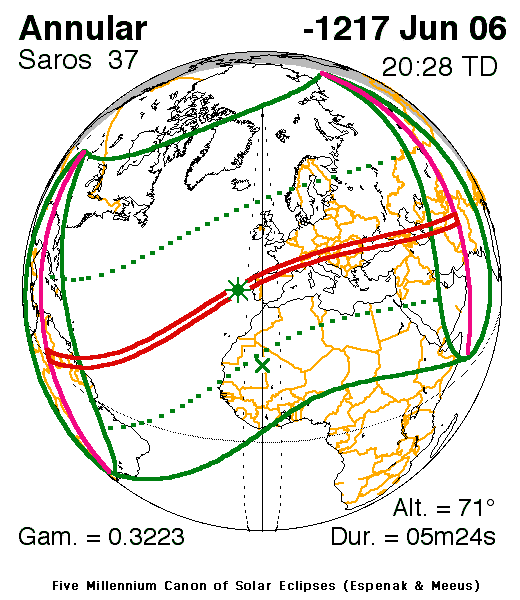
6. Solar eclipses

In 2008 two astronomers, Baikouzis and Magnasco, argued that a series of purported astronomical references in the Odyssey pointed to a date of 1178 BCE for Odysseus’ homecoming from the Trojan War (and therefore a date of 1188 for the fall of Troy). This is very much a fringe view, but it did provoke a certain amount of interest. I published a response that rejected the thesis unequivocally, showing that the argument was founded on several kinds of false assumptions, mistranslations, and cherry-picked data.

If you find their idea even faintly appealing, just take a moment before investigating to read the bit straight after Theoclymenus supposedly mentions this ‘eclipse’:
So (Theoclymenus) spoke, and then they all laughed sweetly at him.
Among them Eurymachus, Polybus’ son, led the talking:
‘He’s raving, this guest, this new arrival from abroad!
Come on, boys, throw him out of the house, outdoors
into the town square, since he says it’s like night in here.’
Odyssey 20.358–362
Path of solar eclipse in June 1218 BCE, suggested by Papamarinopoulos et al. as a supposed ‘eclipse’ in Iliad 17.366–377. (Hey, you missed one in Iliad 16.567!) Source: NASA Eclipse Web Site
In spite of this, a few other similar studies have popped up since 2008: 1, 2, 3, 4 (none written or co-authored by ancient historians, surprise surprise). They don’t fare any better. For the record, the first (Henriksson) dates the fall of Troy to 1312 BCE, the other three (Papamarinopoulos et al.) to 1217 BCE. Neither date is a match for either the end of either Troy VIh or Troy VIIa. The Henriksson article at least puts some effort in on the research front, but the others don’t even take a glance at previous research on the text and background of the Homeric poems. Baikouzis and Magnasco report that their research consisted of looking at footnotes in popular translations. Yes, seriously.

(Surprisingly, my own article has earned me a substantial section in the German Wikipedia article on Odysseus. Should I feel chuffed? Actually I do, kind of. It’s just that there’s no way the 2008 argument lives up to Wikipedia’s ‘notability’ standards, so really my response doesn’t either!)


An alternative perspective: literary traditions

Up to this point things are looking pretty negative. We’ve got Apollo, we’ve maybe got a kind of parallel to Paris (but with the Greek version of his name), and that’s about it. We have lots of possibilities but not much that is at all definite. What positive things can we say?

Things look very different if we stop agonising over historical events, with the question framed as ‘Was Homer based on fact?’, and instead ask a more literary-mythological question: ‘What kinds of influence from Bronze Age Anatolia can we see in Homer?’ Evidence becomes clearer and looks a lot more pertinent, and things fall into place more simply.

Earlier this year a new book appeared by the hittitologist-hellenist Mary Bachvarova (with whom I had the good fortune to co-teach a course several years ago), From Hittite to Homer (2016). Bachvarova synthesises a lot of material concerning not just historical events of the Late Bronze Age, but more importantly poetic traditions. Homer is no historical record, but literary influence from Bronze Age Near Eastern material is beyond any possible doubt. Mycenaean Greece and the Hittite world were certainly in contact —
  • We have about two dozen Hittite documents referencing Ahhiyawa, including one letter from an Ahhiyawan king to a Hittite king;
  • Physical evidence of trade across the Aegean, mainly with Miletus in south-western Anatolia (which was actually an Ahhiyawan city for much of the Late Bronze Age), but also to some extent in the north-west, and even a Mycenaean sword blade in the Hittite capital (Cline makes a big thing of this);
  • In Hittite sources it’s easy to trace a story of ongoing Ahhiyawan meddling in western Anatolian politics: we’ve alluded already to Ahhiyawan collusion with the rebel warlord Piyamaradu, and a dispute of some kind over Troy.
In addition, Greek poetry and mythology show heavy influence from the Near East. The masterwork on this topic is M. L. West’s The East Face of Helicon (1997). Some elements include
  • Story structures like the Succession Myth. Greek: the Ouranos-Kronos-Zeus succession that we see in several Theogonies; Hurrian-Hittite: the Kumarbi cycle and the Song of Ullikummi; Phoenician: Sanchouniathon’s Phoenician history (perhaps: we have no Phoenician source, only a late Greek source); Ugaritic: the Baal cycle; Babylonian: the Enuma elish.
  • Stories revolving around a city being destroyed by a spectacular device, often with direct divine involvement. Greek: the Trojan War; Hurrian-Hittite: the Song of Release, about the destruction of Ebla; Hebrew: the sack of Jericho in Joshua 6; Egyptian: the Sack of Joppa.
  • Other genres and incidental features, like a god fighting a chaos/water-monster (Zeus vs. Typhoeus, Marduk vs. Tiamat, Baal vs. Yamm); many of the tropes of wisdom poetry (Greek: the Works and Days; Ugaritic/Hittite: the Instruction of Shube’awilum(?) to Zurranku(?); Sumerian: the Instructions of Shuruppak; etc.); parallels in the Hymn to Hermes to a Sumerian story about Lugalbanda.
Note that we’re not talking about direct imitations. Hesiod didn’t have a copy of the Enuma elish in front of him. Rather, we’re talking about traditions: literary and mythological genres and tropes which spread because of their common appeal.

Bachvarova’s new book is tailored more specifically than West’s, and looks at how this influence was filtered through Hurrian-Hittite culture in Anatolia. The result is very compelling in places (though I don’t share her eagerness to latch onto figures like Alaksandu).

The most compelling example of influence in the poetic tradition is the argument made by the great linguist Calvert Watkins that Wilusa — and here we had better stop taking it for granted that Wilusa is Troy — had a place in a Luvian poetic tradition. A Hittite tablet describing cult songs at the religious site of Istanuwa lists the opening lines of several cult songs in Luvian. One hymn-opening reads:
ahha-ta-ta alati awienta Wilusati
When they came from steep Wilusa
CTH 772.1 (= KBo 4.11)
(Bachvarova 2016: 21 reproduces Starke’s transliteration, which has some technical differences.)

The especially striking thing is that the phrase alati ... Wilusati ‘(from) steep Wilusa’ has an identical meaning to three phrases that appear in Homer: Ilios aipeinē ‘steep Ilios’, Priamoio polin ... aipēn ‘Priam’s steep city’, and Ilion aipy ‘steep Ilios’.

If there’s a catch, it’s that the parallel is solely semantic: there’s no possibility of a formula in a shared linguistic tradition. The phrasing is different, and Luvian ala- is unrelated to Homeric aipys and aipeinos. (On the other hand, it is fairly likely that ala- does appear in the Homeric word ēlibatos ‘(steep?)-stepping’, used of high rocks.)


The upshot is that it’s pretty much futile to look for historical events in Homer, but in terms of mythological or poetic traditions there is a kind of continuity — very very indirect perhaps, but still traceable — between Bronze Age Anatolia and Archaic Greece. That continuity is perhaps more visible in Hesiod than in Homer.

And it is very indirect. Homer shows barely any trace of effort towards making his Trojans Anatolian. Their names are nearly all Greek: Hector, Deiphobus, Aeneas, Polyxena, Lycaon, Poulydamas, Anchises, Cassandra, Agenor, and many others are all built out of Greek roots, like Alexandros. Only a handful have non-Greek origins: Priam, Paris, Dardanus, and Assaracus. (I leave aside Ilus, Tros, and Troilus, since they’re based on place-names.) Priamos and Paris both appear to come from a Luvian root pariya- ‘outstanding’, and the name Pariyamuwa is attested in Kizzuwatna, the region of Anatolia to the north of Cyprus.

But the overall picture is of a Near Eastern poetic substrate shifting in the course of adapation, and being gradually remodelled as the centuries pass. Anatolian names like Paris get sidelined in favour of characters who are wholly Greek inventions, like Hector and Aeneas. Something comparable happened to the demographics of the real Troy throughout the Dark Age (Aslan and Hnila 2015): Wilusans kept on living there after the end of Troy VIIa and throughout Troy VIIb1, continuing to make Anatolian styles of pottery, but in Troy VIIb2–3 there are increasing signs of migration from Thrace and Bulgaria.

Eventually, when the first signs of Greek settlement start to appear in the mid-700s BCE, there must have been quite an ethnic mix. They were no longer Hittites, Arzawans, Sehans, or Mirans: the Anatolian groups mentioned in Homer are Lelegians, Maeonians, Mysians, and Phrygians. The only Trojan allies to show continuity with any Bronze Age group are the Lycians, from southern Turkey.

However, this ethnic melting pot would be an ideal setting for a legend about an ethnic conflict.

It’d be strange to imagine a 7th century Greek wanting to preserve a 500-year-old Luvian story faithfully. But a story about an ethnic conflict, in a place recently colonised by Greeks, where Greeks were running up against a diverse and entrenched non-Greek population ...?

That’s the situation in the Iliad, and it’s the situation of 8th–7th century Troy. Sure, we can trace elements from Bronze Age Anatolia (and Phoenicia, too: that’s where the Greeks got their alphabet, and the Odyssey is much more interested in Phoenicians than in Anatolians). But the Greeks took this age-old material and made it their own. The Troy of the Iliad is first and foremost an 8th–7th century construct.

References

  • Aslan, C. C.; Hnila, P. 2015. ‘Migration and integration at Troy from the end of the Late Bronze Age to the Iron Age.’ In: Stampolidis, N. Chr.; Maner, Ç.; Kopanias, K. (eds.). Nostoi. Indigenous culture, migration and integration in the Aegean islands and western Anatolia during the Late Bronze and Early Iron Ages. Istanbul: Koç University Press. 185–209.
  • Bachvarova, M. 2016. From Hittite to Homer. The Anatolian background of ancient Greek epic. Cambridge: Cambridge University Press.
  • Beckman, G.; Bryce, T.; Cline, E. 2011. The Ahhiyawa texts. Atlanta: SBL (Writings from the Ancient World vol. 28).
  • Beekes, R. 2010. Etymological dictionary of Greek. Leiden: Brill.
  • Cline, E. H. 2014. 1177 B.C. The year civilization collapsed. Princeton: Princeton University Press.
  • Gurney, O. R. 2002. ‘The authorship of the Tawagalawas letter.’ In: Taracha, P. (ed.). Silva Anatolica. Warsaw: Agade. 133–141.
Part 1. The consensus | Part 2. Homer | Part 3. Bronze Age evidence