Showing posts with label texts. Show all posts

28 December 2023

How fragmentary ancient texts are reconstructed (sometimes)

There’s something almost magical about how papyrologists and editors take tiny scraps of ancient papyrus and turn them into coherent texts. Here’s an example taken from the Hesiodic Catalogue of women.

P. Turner 1

Here’s a passage as it stands in one ancient papyrus, Turner papyrus 1, lines 17–24:

  ]θεαιεξεγενον[
  ]τ̣υ̣ρωνκαιαμη . . ν̣ο̣ε̣ργ̣[
  ]ι̣γ̣μονεϲορχη̣ϲ̣[
  ]ρ̣ατονειδοϲεχ̣[
  ]χθηοϲθειοιο
      ]ηϲετακ[. .]τ̣ι̣ν̣
      ]τ̣ο̣π̣ω̣λ[.]ν
    ]ι̣δεαδιομηδην
P. Oxy. 2822, fr. 2

And here’s the same passage as it appears in Oxyrhynchus papyrus 2822 fr. 2, lines 1–8:

    ] . . ρει̣ . [
     ]νοσου[
    ]ητεϲτε[
   ]θοϲδεκ[
    ]ηνκαλλ[
     ]τωνι̣[
    ]χα̣ιονε . [
    ]ειϲε . [

There’s no overlap between these two fragments. The Turner fragment has the ends of each line, the Oxyrhynchus fragment has bits of the first part of each line.

And yet modern editors have worked out not just that these two fragments are the same passage, but also how to reconstruct the entire text!

ἐξ ὧν οὔρειαι Νύμφαι θεαὶ ἐξεγένοντο
καὶ γένος οὐτιδανῶν Σατύρων καὶ ἀμηχανοέργων
Κουρῆτές τε θεοὶ φιλοπαίγμονες ὀρχηστῆρες.
Ξοῦ]θος δὲ Κ[ρείουσαν ἐπή]ρατον εἶδος ἔχ[ουσαν
κούρ]ην καλλ[ιπάρηον Ἐρε]χθῆος θείοιο
ἀθανά]των ἰ[ότητι φίλην ποι]ήσατ' ἄκ[οι]τιν,
ἥ οἱ Ἀ]χαιὸν ἐγ[είνατ' Ἰάονά τε κλυ]τόπωλ[ο]ν
μιχθ]εῖσ' ἐν [φιλότητι καὶ εὐε]ιδέα Διομήδην.

From them were born mountain Nymphs, goddesses,
and the race of Satyrs, good-for-nothings and wastrels,
and the Kouretes gods, who love fun and dancing.
And Xouthos married Kreiousa, who possessed lovely beauty,
the beautiful-cheeked daughter of divine Erechtheus;
by the will of the gods he made her his own wife.
She bore to him Achaios and Ion, famed for horses,
having sex with (Xouthos); and also beautiful Diomede.

Catalogue fr. 10.17–24 ed. Most (my translation)
(= fr. 10(a) M-W)

And I’ll tell you right now that this reconstruction is absolutely accurate. (Well, mostly. I’m slightly doubtful about φίλην in the sixth line: we’ll come back to that.)

How on earth? What is this wizardry?

Step 1. Strabo

The key to joining the two papyrus fragments lay in an ancient book that has survived intact, Strabo’s Geography. Strabo survived by being transmitted via the mediaeval manuscript tradition.

And by good luck, Strabo happens to quote the first three lines of this passage in full.

Ἠσίοδος μὲν γὰρ ἐκ Δώρου καὶ τῆς Φορωνέως θυγατρὸς πέντε γενέσθαι θυγατέρας φησίν,

ἐξ ὧν οὔρειαι Νύμφαι θεαὶ ἐξεγένοντο,
καὶ γένος οὐτιδανῶν Σατύρων καὶ ἀμηχανοεργῶν
Κουρῆτές τε θεοὶ φιλοπαίγμονες, ὀρχηστῆρες.

For Hesiod says that five daughters were born from Doros and Phoroneus’ daughter:

From them were born mountain Nymphs, goddesses,
and the race of Satyrs, good-for-nothings and wastrels,
and the Kouretes gods, who love fun and dancing.
Strabo 10.3.19

By splicing together the two papyrus fragments and the Strabo quotation, we get the following:

ἐξ ὧν οὔρειαι Νύμφαι θεαὶ ἐξεγένοντο
καὶ γένος οὐτιδανῶν Σατύρων καὶ ἀμηχανοέργων
Κουρῆτές τε θεοὶ φιλοπαίγμονες ὀρχηστῆρες.
   ]θοϲδεκ[. . . . . . . . . .]ρ̣ατονειδοϲεχ̣[
    ]ηνκαλλ[. . . . . . . . .]χθηοϲθειοιο
     ]τωνι̣[. . . . . . . . . . .]ηϲετακ[. .]τ̣ι̣ν̣
    ]χα̣ιονε . [. . . . . . . . . . . .]τ̣ο̣π̣ω̣λ[.]ν
    ]ειϲε . [. . . . . . . . . . . .]ι̣δεαδιομηδην

But remember, editors have reconstructed the entire passage. We’ve still got a way to go.

Step 2. Word breaks, punctuation

Ancient books didn’t have word spaces, and they usually didn’t have punctuation. Actual papyrologists probably don’t really need to go adding them in for their own reading, because they’re used to how text looks in ancient copies. But it’ll still be helpful to put them in here, to show that some of the word breaks are pretty obvious to anyone who knows the language. In a couple of places, some common words and names that go over the edge of the papyrus are also easy to fill in.

ἐξ ὧν οὔρειαι Νύμφαι θεαὶ ἐξεγένοντο
καὶ γένος οὐτιδανῶν Σατύρων καὶ ἀμηχανοέργων
Κουρῆτές τε θεοὶ φιλοπαίγμονες ὀρχηστῆρες.
   -]θοϲ δὲ κ[-. . . . . . . . . .-]ρ̣ατον εἶδος ἐχ̣[-
    -]ην καλλ[- . . . . . . . .-]χθῆος θείοιο
     -]των ι̣[-. . . . . . . . . . .-]ηϲετ’ ἄκ̣[οι]τ̣ι̣ν̣
   Ἀ]χα̣ιὸν ἐγ̣[-. . . . . . . . . . . .]τ̣ο̣π̣ω̣λ[.]ν
    ]ειϲε . [. . . . . . . . . . . .-]ι̣δεα Διομήδην

Step 3. Know your mythology

Thanks to Strabo, we already know that the passage is talking about Satyrs and goddesses. We’ve also already filled in the name ‘Achaios’ in line 7, and we’ve got Diomede in line 8. If you know your Greek mythology, or if you look it up, you know that Achaios and Diomede are brother and sister, and that they have a brother Ion. We can see the passage is talking about family — line 6 has the word ἄκοιτιν, ‘wife’.

Achaios, Ion, and Diomede are the children of Xouthos and Kreiousa. It so happens that line 4 gives us the snippet

-]θοϲ δὲ κ[-

which could very easily read ‘and (Xou)thos something something K(reiousa)’. It’ll be something like ‘Xouthos married Kreiousa’, so Kreiousa will be in the accusative case,

Ξοῦ]θος δὲ Κ[ρείουσαν

The end of line 6, with the word ‘wife’, will be the bit telling us that ‘he made her his wife’:

ποι]ήσατ’ ἄκ̣[οι]τ̣ι̣ν̣

(There’s a small emendation here: the papyrus reads -ηϲετ’, which is very obviously a verb ending. -ετο is a common verb ending, but in the first aorist, -ετο becomes -ατο. Modern students learning ancient Greek make the same kind of mistake all the time. I find it strange that no critical edition reports the reading that’s clearly visible on the papyrus, though, even if just to correct the error.)

In addition we know Kreiousa is the daughter of Erechtheus. It’s hard to think of any names other than ‘Erechtheus’ that could fit the end of line 5, ]χθῆος θείοιο, so that gives us ‘daughter of divine Erechtheus’:

κούρ]ην καλλ[-. . . . . . Ἐρε]χθῆος θείοιο

beautiful (something something) daughter of divine Erechtheus

These family links also allow us to fill in one more thing: if Xouthos and Kreiousa are having children, they’re going to have to have sex, and hexameter poetry isn’t shy about mentioning that. The last line is likely to mean something along the lines of ‘she had sex with him and gave birth to Diomede’:

μιχθ]εῖσ' ἐ-. [

where μιχθεῖσα means ‘(she) having had sex’.

Put all of these additions together and we get

ἐξ ὧν οὔρειαι Νύμφαι θεαὶ ἐξεγένοντο
καὶ γένος οὐτιδανῶν Σατύρων καὶ ἀμηχανοέργων
Κουρῆτές τε θεοὶ φιλοπαίγμονες ὀρχηστῆρες.
Ξοῦ]θος δὲ Κ[ρείουσαν . .-]ρ̣ατον εἶδος ἐχ̣[-
κούρ]ην καλλ[-. . . . . . Ἐρε]χθῆος θείοιο
     -]των ι̣[-. . . . . . . . . ποι]ήσατ’ ἄκ̣[οι]τ̣ι̣ν̣
   Ἀ]χα̣ιὸν ἐγ̣[-. . . . . . . . . . . .]τ̣ο̣π̣ω̣λ[.]ν
μιχθ]εῖσ' ἐ-. [. . . . . . . . . . . .-]ι̣δεα Διομήδην

Step 4. Metre and metrical formulas

This particular passage is outstandingly lucky. It’s very rare that there are so many ways of filling in gaps. Most papyri don’t overlap with one another or with surviving texts, have no mythological content, and aren’t in verse. This one really won the lottery.

Because poetic rhythm and poetic devices are also here to help us out. Metrical formulas are one type of building block that early hexameter poets used to construct their poetry. If a modern editor knows their way around the formulaic system, they can use these building blocks too.

For example, take the partial phrase in line 4, εἶδος ἐχ̣[, where the second word is going to be a form of the verb ἔχω: ‘possessing beauty’. If you do a simple search of extant hexameter poetry for the string ειδος εχ-, you’ll find the following lines (not counting the fragment we’re looking at):

Ἑρμιόνην ἣ εἶδος ἔχε χρυσῆς Ἀφροδίτης
Ὠκεανοῦ κούρη πολυήρατον εἶδος ἔχουσα
Δήμητρ' ἠύκομον, πολυήρατον εἶδος ἔχουσαν
ἀθανάτην βασίλειαν, ὑπείροχον εἶδος ἔχουσαν
ἐκπρεπὲς εἶδος ἔχουσαν ἐν ἀθανάτοισι θεοῖσι
               ]..ν πολυήρατον εἶδος ἔχουσ[αν]
γείνατο δ' Ἰφιάνειραν ἐπήρατον εἶδος ἔχουσα[ν]
Sources: Odyssey 4.14; Theogony 908; Hymn to Demeter 315; Hymn 12 (to Hera) 2; Hymn 32 (to Selene) 16; Catalogue fr. 13.7 ed. Most; Catalogue fr. 25.39 ed. Most.

Next notice that the papyrus has the letters -ατον before the word εἶδος. Four of these results have an exact match for that, too.

The upshot is that what we’ve got in line 4 of our passage is a formulaic phrase. It’s attested in the forms πολυήρατον εἶδος ἔχουσα, πολυήρατον εἶδος ἔχουσαν, and ἐπήρατον εἶδος ἔχουσαν. The poet chooses the variant based on metrical and syntactical context: ἔχουσα when the woman who ‘possesses beauty’ is in the nominative case, ἔχουσαν when she’s accusative; πολυήρατον after a penthemimeral caesura, ἐπήρατον after a tritotrochaic caesura. (If you want an explanation of these terms, see here from earlier this year.)

Ξοῦθος δὲ Κρείουσαν has (a) Kreiousa in the accusative case, and (b) a tritotrochaic caesura. So we can reconstruct the line very confidently:

Ξοῦ]θος δὲ Κ[ρείουσαν ἐπή]ρατον εἶδος ἔχ[ουσαν

Similar considerations apply in line 5. After κούρ]ην, there are only a few words and phrases starting καλλ- that could sensibly fit before Ἐρε]χθῆος. Some formulaic words are disqualified because they can only start in the second half of a foot (καλλιπλόκαμον, καλλίσφυρον, καλλίζωνον); another is ruled out because hexameter poetry always uses it to describe horses (καλλίτριχον). The reconstruction Ἐρε]χθῆος means we’re looking for a tritotrochaic caesura, so that rules out καλλίστην and καλλίκομον. κάλλεος εἵνεκα is too long.

Ruling out all of those narrows our choices down to one: καλλιπάρηον, ‘beautiful-cheeked’. καλλιπάρηον also happens to be the right length, in terms of number of letters, to occupy the space between the two parts of the line. So the correct supplementation of line 5 is

κούρην καλλ[ιπάρηον Ἐρε]χθῆος θείοιο

the beautiful-cheeked daughter of divine Erechtheus

And we do this for the rest of the passage. In line 7, ‘she gave birth to Achaios’ is going to mean supplementing Ἀ]χαιὸν ἐγ[είνατ(ο); that leaves exactly the right amount of space for Achaios’ brother, Ion, in the accusative form Ἰάονα. At the end of the line, κλυτόπωλος is an adjective that standardly appears at line-end (3× in the Iliad). In line 8, μιχθεῖσ' ἐν φιλότητι is standard formulaic phrasing for ‘after having sex’ (4× in the Theogony, 1× in the Hymns, 4× elsewhere in the Catalogue). εὐειδέα appears a few times elsewhere.

The only bit where I have doubts is the first half of line 6: ἀθανά]των ἰ[ότητι φίλην, according to the editions of Merkelbach and West (1990), Hirschberger (2004), and Most (2007). The formulaic adjective to use before ποιήσατ' ἄκοιτιν would be θαλερήν, not φίλην (θαλερὴν ποιήσατ' ἄκοιτιν: 4× Theogony, 5× elsewhere in the Catalogue, 1× in the Megalai Ehoiai). That is in fact how some scholars have supplemented the line.

However, θαλερήν doesn’t fit West’s reconstruction of the first part of the line, ἀθανά]των ἰ[ότητι. And Hirschberger’s commentary points out that Iliad 9.397 uses φίλην ποιήσομ' άκοιτιν (‘I shall make (her) my own wife’). I think there’s still room for doubt: I can just about imagine the line going

κούρ]ην καλλ[ιπάρηον Ἐρε]χθῆος θείοιο
ἀθανά]των ἴ[σου θαλερὴν ποι]ήσατ' ἄκ[οι]τιν

the beautiful-cheeked daughter of divine Erechtheus,
equal of the gods; he made her his fruitful wife.

It’s a little strange to expand on Erechtheus like that when he’s only being mentioned in passing. I’m prepared to accept that West’s reconstruction is the more likely — but it’s the one phrase in this passage that is not quite certain.


And there we have it — a complete passage. Like I said, this passage is unusually fortunate in having so many clues that allow us to reconstruct it. It may look like papyrologists are sorcerors.

Actually on reflection I guess they are pretty much sorcerors. But it’s the mechanical kind of sorcery! It isn’t like Doctor Strange doing any random magic that the writers happen to think of. It’s more like Dungeons & Dragons magic, with strict rules.

Sources

  • Hirschberger, M. 2004. Gynaikōn Katalogos und Megalai Ehoiai. Ein Kommentar zu den Fragmenten zweier hesiodeischer Epen. Munich/Leipzig.
  • Lobel, E. 1971. The Oxyrhynchus papyri vol. 37. London. [Internet Archive]
  • Merkelbach, R.; West, M. L. 1990. ‘Fragmenta selecta.’ In: Solmsen, F. (ed.) Hesiodi Theogonia Opera et dies Scutum, 3rd ed. Oxford. 109–246.
  • Most, G. W. 2007. Hesiod. The Shield, Catalogue of women, other fragments. Cambridge (MA)/London.

30 March 2023

Chrest or Christ

The Roman historian Tacitus mentions ‘Christians’ and ‘Christ’. He wrote his Annals in the 110s CE, so his account is one of the very earliest non-Christian reports of Christianity. But his spelling is funny.

Tacitus is talking about the fire of Rome in 64 CE. People wanted a scapegoat, and this was urgent because there were rumours (supposedly) that Nero himself had something to do with the fire. We don’t know if these rumours genuinely existed or were taken seriously, but that’s Tacitus’ story.

ergo abolendo rumori Nero subdidit reos et quaesitissimis poenis adfecit, quos per flagitia invisos vulgus Chrestianos appellabat. auctor nominis eius Christus Tiberio imperitante per procuratorem Pontium Pilatum supplicio adfectus erat ...

So to quash the rumour, Nero produced suspects, and inflicted the most exquisite punishments on them. These people were despised for their disgraces, and popularly known as Chrestians. The name came from one Christus: during Tiberius’ reign the procurator Pontius Pilate had put him to death.

Tacitus, Annals 15.44

This chapter has aroused a lot of debate. Where did Tacitus get his information from? Did Tacitus actually write this? Is it independent evidence that tells us something about the historical Jesus? And so on.

Here we’re just looking at spelling. (But just for reference, the answers are ‘we don’t really know’, ‘yes’, and ‘probably not’.)

To the uninitiated, it looks like we’re seeing two different names. I don’t mean the different endings — Chrestianos (‘Christians’, accusative plural) and Christus (‘Christ’, nominative singular). That’s just normal Latin. It’s the Chrest-/Christ- variation that’s curious.

Suetonius, Claudius 25.4 (cod. Paris. lat. 6115, 9th cent., fol. 78r): does the Chrestus named in this report of Jewish unrest in Rome have anything to do with Tacitus’ Chrestiani?

Something similar happens in the gossip-writer Suetonius, who was also active in the 110s CE. In his biography of the emperor Nero, Suetonius refers to Christians as Christiani (Nero 16.2). But elsewhere, when he talks about Claudius expelling Jews from Rome in the 40s or 50s CE, Suetonius mentions public unrest caused by someone called Chrestus (Claudius 25.4).

What’s going on? Why the inconsistency? Which spelling is the authentic one? Does the variation suggest that early Christianity is all fake?

Has someone tampered with the text of Tacitus?

In a sense, yes the text has had an alteration. But probably not the one you were expecting.

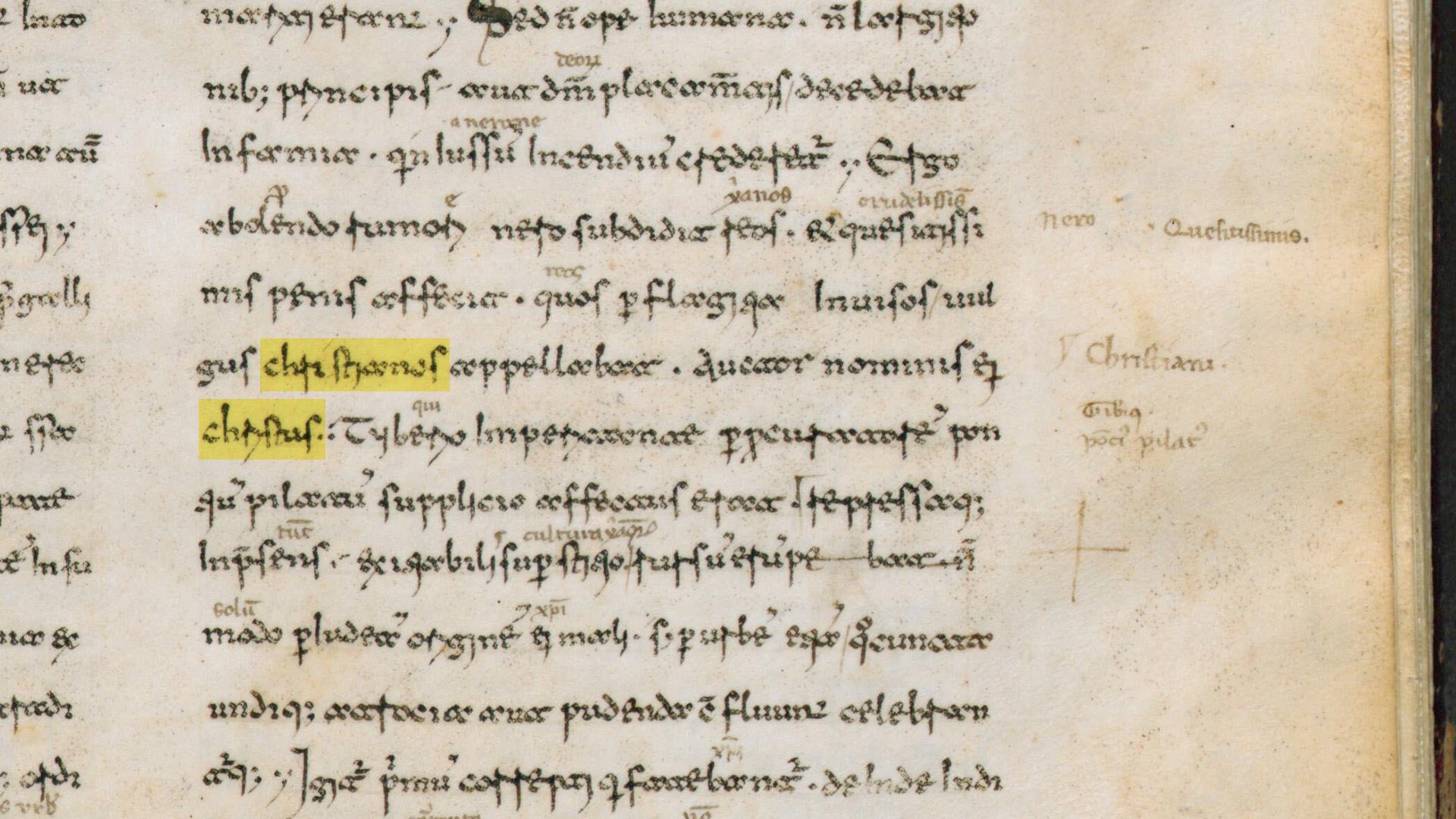
The form of the text that I quoted above is the best available reconstruction of what Tacitus actually wrote. It has a key difference from the manuscript as it exists today. At some point, someone scraped away most of the letter e in the manuscript, to turn Chrestianos into Christianos.

That is, Chrestianos is the original reading. It’s Christianos that’s the tampered version.

The manuscript of Tacitus, Annals 15.44: Biblioteca Laurenziana Plut.68.2, fol. 38r. Highlighted are the words Chrestianos (altered to read Christianos) and Christus.

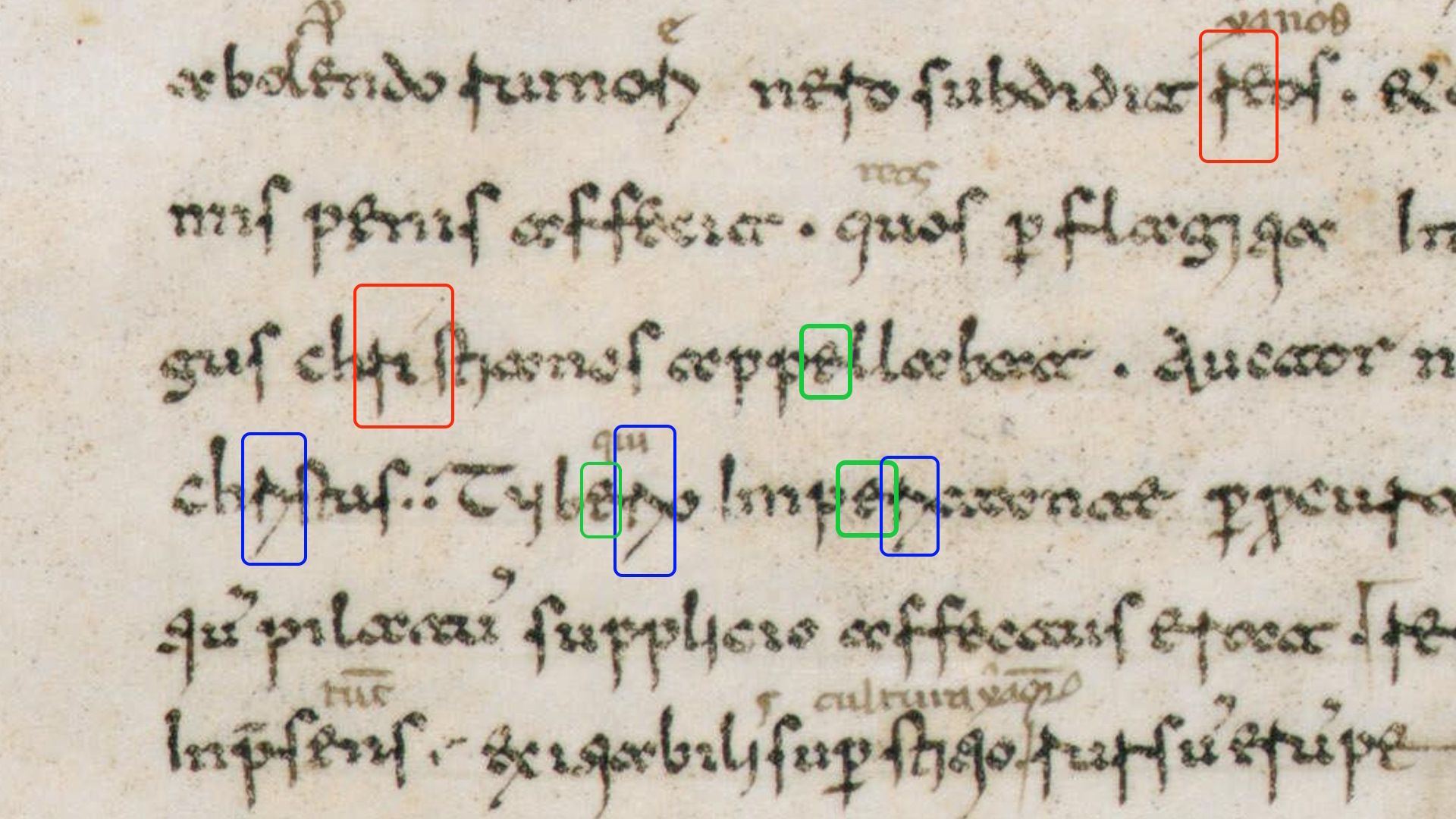
In the first highlighted line, the spacing and the letter forms indicate that the scribe initially wrote Chrestianos. There’s too much space for i to be the original text, and the letter sequence ri ought to look quite different (see image below). The letter form is consistent with the left vertical stroke of an e, however, and so is the spacing. The corrector must have believed they were fixing a spelling error: this manuscript is carefully made. Notice the glosses above the lines to explain Tacitus’ wording. In the margin, the deaths of Christian martyrs are commemorated with a large cross, using the same colour ink and pen weight as the glosses.

In the following line, by contrast, Christus is what the scribe meant all along: there’s only enough space for an i there.

Cod. Laurenziana Plut.68.2, fol. 38r, with some letters circled: (1) In blue, the ligatured letter sequence ri (Christus, Tyberio, imperitante). (2) In green, the unligatured letter e (appellabat, imperitante). (3) In red, the letter sequence re (reos, and the matching sequence in Chrestianos). Notice also that in the top line a gloss corrects rumori to rumore: scraping letters wouldn’t have worked there, because of the ri ligature.

It’s all Greek

Take a look at these ancient Christian funerary inscriptions.

Ἰησοῦ Χρειστὲ βοήθει τῷ γράψαντι πανοικί.

O Jesus Chreist, aid the person who wrote this and his whole household.

IG XII,3 suppl. 1238 (undated, Melos)

Ἀπ̣[ο]λ̣λώνι̣ο̣[ς, δοῦλος]
Ἰησ̣οῦ Χρησ̣[τοῦ].

Apollonio[s, slave]
of Jesus Chres[t.]

Les oasis d’Égypte 72,17 (undated, Kharga Oasis)

κοιμητή̣ρ̣ι̣ο̣ν̣ Ε̣ὐ̣τ̣υ̣-
χίου διδασκάλου Χρη-
στιανοῦ {Χρηστειανοῦ}
νεοφωτείστου ...

The resting place of Euty-
chios the teacher, a Chre-
stian Chresteian
newly baptised ...

IG X,2 1 397 (4th cent. or later, Macedonia)

(Underlinings are mine.)

Spelling rules for ancient Greek are a Byzantine and modern phenomenon, not ancient. According to the modern standards, the name ‘Christ’ should be written Χριστός (Christós). But in antiquity, people spelled phonetically. And from around the 1st century BCE onwards, ι, ει, and η all represented the sound /i/. As a result, people in that era swapped between them freely.

That’s why these inscriptions give us Χρειστός (Chreistós) and Χρηστός (Chrestós). For the word ‘Christian’, Χριστιανός (Christianós), the third of these inscriptions gives us two variations at once: Χρηστιανός (Chrestianós) and Χρηστειανός (Chresteianós).

Note. The curly brackets around Χρηστειανοῦ in the third inscription show that the editor wants to delete the word from the text as an error. Error or not, it’s what the inscriber wrote. Deciding that one version is ‘correct’ means applying anachronistic spelling conventions.

This kind of variation is widespread: it isn’t confined to words for ‘Christ’ and ‘Christian’. In Roman-era inscriptions we find Posidon as well as Poseidon, Aineas and Aineias, Epaphroditos and Epaphrodeitos. Spelling was phonetic.

Detail of the Tabula Iliaca Capitolina (late 1st cent. BCE/early 1st cent. CE; Rome, Musei Capitolini, Sala delle Colombe inv. 316). This detail, showing a 6 × 4.5 cm area of the tablet, shows scenes from Iliad book 14 (below) and 15 (above). Circled are the names ΑΙΝΗΑΣ (Ainéas; for Αἰνείας Aineías), ΚΛΙΤΟΣ (Klítos; for Κλεῖτος Kleítos), and ΠΟΣΙΔΩΝ (Posidón; for Ποσειδῶν Poseidón). Elsewhere the tablet refers to the wooden horse as the ΔΟΥΡΗΟΣ ΙΠΠΟΣ (doúreos hippos; for δούρειος ἵππος doúreios hippos).

The principle of phonetic spelling applies even for the best educated. The Cleopatra autograph — a papyrus with one word that may be written by the hand of Cleopatra herself (P. Berol. 25239) — has the Greek for ‘Let this happen’ written in her hand. Byzantine conventions dictate the spelling γινέσθω (ginéstho), but Cleopatra writes γινέσθωι (ginésthoi). Because she wrote phonetically. Both spellings had the same pronunciation.

Occasionally, a text actually requires a spelling that is non-standard according to modern conventions. A 1st century CE epigram attributed to Leonides of Alexandria draws on a literary device called ‘isopsephy’, where the numerical values of the letters in each couplet add up to the same total (Leonides 32 Page = Anth. Pal. 9.355: both couplets add up to 6,422). In line 1, the word for ‘image’ uses the spelling μείμημα, phonetically equivalent to the Byzantine standard μίμημα. The isopsephy depends on using ει rather than ι.

Sometime before the year 300 CE, a Christian acrostic was devised in which the first letter of each line spells out the phrase Ἰησοῦς Χρειστὸς Θεοῦ υἱὸς σωτὴρ σταυρός, ‘Jesus Chreist, son of God, saviour, cross’ (Sibylline oracles 8.217–250 = (ps.-)Constantine Oratio ad sanctos 18). The line with the ε of Χρειστός is syntactically necessary: again, the poem depends on ει for ι.

This kind of variation is omnipresent in Greek texts of the Roman era, but it’s especially prone to happen with a word like Christós, because it wasn’t normally written in full. Early Christians normally only wrote the first and last letter, Χς, out of respect for its sanctity. Modern palaeographers call this convention a nomen sacrum, ‘sacred name’. As a result, many ancient Christians would have to guess what the first vowel ought to be. How could they be expected to be consistent in spelling it when they only knew the pronunciation?

A nomen sacrum in the most important ancient copy of the New Testament, the codex Sinaiticus: 1 Corinthians 5.7 καὶ γὰρ τὸ πάσχα ἡ|μῶν ἐτύθη Χς (‘for our paschal lamb, Ch(ris)t, has been sacrificed’). (Cod. Sinait. fol. 269, 4th cent. CE)

The more familiar spelling conventions came along later. They were designed to reflect a form of classical Attic Greek from roughly the first half of the 4th century BCE. For someone like Plato, the letters ι, ει, and η represented three distinct sounds: ι was /i/ (as in machine), ει was /eɪ/ (as in eight), and η was /e:/ (as in wear).

Even that’s a simplification, because η actually represented a merging of at least three different archaic sounds — but that is another story and shall be told another time. The point is, by the second half of the 4th century BCE, epigraphic evidence shows that ι and ει started to be interchangeable, indicating that by that point they were merging into the sound /i/. η kept a separate sound for a bit longer (or rather, as a separate group of sounds).

What does this have to do with Tacitus and Suetonius? They were writing in Latin. And in Latin, i and e never got confused. There was never any point at which Chrestus and Christus could be interchangeable in Latin.

Unless, that is, you were taking a Greek name and turning it into Latin. There were standard Roman conventions for transliterating Greek names, and those conventions were established before Greek ι, ει, and η finished merging into /i/.

Here are the conventions. The Romans traditionally transliterated both ι and ει as i, as in Πίνδαρος > Pindarus and Χείρων > Chiron. But because η kept its separate sound for longer, the Roman convention was to transliterate η as e, as in Περικλῆς > Pericles.

To clarify, here’s a tabulation.

manuscript form expanded form pronunciation conventional Latin transliteration
Χς Χριστός /xris'tos/ Christus
Χς Χρειστός /xris'tos/ Christus
Χς Χρηστός /xris'tos/ Chrestus

As we’ve seen, manuscripts used the nomen sacrum in the first column. Inscriptions used any of the three spellings in the second column interchangeably, because they all represented the same sounds.

Phonetic transcription turned all three variants into Christus in Latin, because that’s how all three were pronounced. But if a Roman writer saw a written version of the name, the conventions for transliteration produced two variants. Χριστός or Χρειστός would become Christus in Latin, while Χρηστός would become Chrestus.

What this indicates, then, is that Tacitus is relying on at least two distinct written sources for his account of Christians in Annals 15.44. One of those written sources transliterated the Greek word Χρηστιανοί as Chrestiani. The other transliterated Χρειστός or Χριστός as Christus.

Simlarly with Suetonius there are fairly strong grounds for inferring that his report of Christians in his life of Nero, with the spelling Christiani, was based on a source that was transliterated from Greek Χρειστιανοί or Χριστιανοί, while his report of the Jewish expulsion in Claudius’ reign, with the spelling Chrestus, was based on a source with the spelling Χρηστός.

OK, yes, there’s some wiggle room for doubt that Suetonius’ Chrestus had anything to do with Christianity. But the New Testament texts Acts and Romans give good support to the idea of a robust Jewish-Christian community in Rome in the 50s. It looks like pretty good odds to me.

And to conclude: none of the spelling variations suggest there’s anything wrong with the modern conventional spelling Χριστός Christós. There’s never been any doubt that that name is based on a gerundive form of χρίω ‘anoint’, and that it originated as a translation into Greek of Hebrew māšīyaḥ ‘anointed one, Messiah’. The fact that there’s another fairly common word χρηστός (meaning ‘good’) is a coincidence. It’s possible that confusion with χρηστός helped to encourage the alternate spellings, if some people interpreted Χρειστός/Χρηστός/Χριστός as having a meaning related to χρηστός. But reinterpretations like that aren’t enough to undermine the most obvious origin for the name.

Further reading

  • Allen, W. S. 1968. Vox graeca. A guide to the pronunciation of classical Greek. Cambridge. [Internet Archive]
  • Potter, D. S. 2012. ‘Tacitus’ sources.’ In: Pagán, V. E. (ed.) A companion to Tacitus. Wiley-Blackwell. 125-140.
  • Klingner, F. 1958. ‘Tacitus und die Geschichtsschreiber des 1. Jahrhunterts n. Chr.’ Museum Helveticum 15: 194–206. [E-Periodica | JSTOR]
  • Syme, R. 1982. ‘Tacitus: some sources of his information.’ Journal of Roman Studies 72: 68–82. [DOI | JSTOR]

06 December 2022

Resources

I’ve made various resources available online over the years: the following is a static record of them. (There are disadvantages to announcing these things somewhere like Twitter: (a) the announcement will only be visible for a week or so; (b) if the Twitter account should happen to be closed the announcement will be deleted altogether.)

A searchable corpus of early Greek hexameter poetry

  • Iliad and Odyssey, edited by Helmut van Thiel (1991–2010; plain text, Beta Code, no diacritics or punctuation)
  • Non-Homeric hexameter, compiled by P. Gainsford (2015; plain text, Beta Code, no diacritics or punctuation)

Back in the 2000s the late Professor Dr Helmut van Thiel hosted the text of his editions of Homer on his homepage at the Universität Köln, making them freely available. He gave them as PDF files containing plain text versions of his edited texts, under the titles iliaspur, odysspur, and a combined version in one file, homerpur. Van Thiel’s homepage is long since gone. Following his death in 2014 it seems unlikely that the university will make these files available again. I have exported the text from the PDF files, and today I uploaded it to Zenodo.org.

A long time ago I realised that this format — plain text Beta Code, with no diacritics or punctuation, and with a text reference at the start of every line — was ideal for searching for metrical formulas, or indeed any kind of phrasing. But the absence of a comparable edition of other extant hexameter poetry was troubling. So in 2015 I released a plain text compilation of my own, using van Thiel’s Homer as a model.

In van Thiel’s Homer, each line is annotated from A1 to W804 (Iliad) and a1 to w548 (Odyssey).

My ‘non-Homeric hexameter’ has abbreviations listed at the start. It contains: the Hesiodic poems and fragments; the Homeric hymns; the contents of Bernabé’s PEG; Xenophanes; Parmenides; Terpander; epigraphic hexameters from Hansen’s CEG, Wachter’s Non-Attic Greek vase inscriptions, and other editions; early hexameters reported in Herodotos, the Lives of Homer, Pausanias, and Clement of Alexandria; oracles attributed to the Delphic Pythia; textual variants, where practical; and variants with and without standardised orthography. Spaces are added before and after every line to simplify use of regular expressions. Digamma and qoppa are encoded as additions to Beta Code (v and j respectively).

A feature-rich text editor such as Notepad++ is a powerful tool for analysing repeated phrases such as formulas. Notepad++ has commands for ‘Find All in current Doucment’ and ‘Find All in All Opened Documents’ which will produce a list of results in context, including the line reference. Each result is clickable and takes you to the full context. See the image below for an example. Notepad++ supports regular expressions. It is much faster than using the TLG, and far more powerful.

A Notepad++ window showing tabs for van Thiel’s Homer and my ‘non-Homeric hexameter’ compilation. In this screenshot, I have done a search of ‘all opened documents’ for the phrase Poseidawni anakti, Beta Code for Ποσειδάωνι ἄνακτι. The lower panel shows the search results: the search-term Poseidawni anakti is highlighted in its immediate context in each line; line-references are at the left. The upper panel shows the full context for the currently selected search result: Catalogue of women, Hesiodica fr. 136 Merkelbach-West, line 17. Note that the search results from ‘NAGVI’ (Wachter’s Non-Attic Greek vase inscriptions) are annotated as using standardised orthography: the original orthography (Π̣ο̣τ̣[ε?]ι̣δάνι ϝ[άνακτι], Ποτιδάϝονι ϝάνατ(τ)ι, etc.) is also in the file, given in Beta Code.

Early Greek hexameter inscriptions

While I was writing Early Greek hexameter poetry (Cambridge, 2015) I realised that there was no straightforward index of early hexameter inscriptions. Editions such as Hansen’s CEG do not normally have a metrical index.

I therefore realised it was necessary to create an index myself. The result appears on pp. 31–32 of the book. As part of the indexing process, I also made a full-text compilation of all available hexameter inscriptions. I uploaded this compilation to Zenodo.org in July 2019.

Unlike CEG, my compilation indicates long vowels with a macron (except where they already possess a circumflex). Cross-references are given between Hansen’s CEG; Wachter’s Non-Attic Greek vase inscriptions; Peek’s Griechische Vers-Inschriften; Pfohl’s Greek poems on stones; Inscriptiones graecae; Supplementum epigraphicum graecum; and versions with ionicised orthography in Friedländer’s Epigrammata.

The inscriptions are ordered roughly chronologically in fifty-year blocks, and are numbered 1 to 218.

Papyri

Work in progress. A simple list of links to online copies of published editions of Greek papyri. Most links are to The internet archive.

The list includes 84 volumes of The Oxyrhynchus papyri (1898–2019), three volumes of The Tebtunis papyri, and assorted volumes of papyri held at Hamburg, Michigan, and elsewhere. Suggestions for additions to the list would be welcome.

Inscriptions

Work in progress. A simple list of links to online copies of published editions of Greek inscriptions. Most links are to The internet archive.

The list includes 47 volumes of MDAI(A) (1876–1925), and assorted other volumes. As pointed out in the list, De.wikisource.org lists many volumes that I do not: that is because many of their links are not publicly available (Google Books, HathiTrust). Suggestions for additions to the list would be welcome.

22 November 2022

The library of Alexandria and its reputation

Many people are aware that the library of Alexandria is hugely overblown. Sure, there’ll always be people insisting that it was a magical place that held the secrets of Göbekli Tepe, Doggerland, and blond blue-eyed Europeans building pyramids in Mexico and Bolivia: there’s no point engaging with people like that. The thing is, pretty much everyone has heard of it.

Last week the History subreddit paid some attention to a piece I wrote in 2015 dispelling some myths about the Alexandrian library. Which is nice. Some people misread it and thought I was claiming it was true that ‘the burning of the library of Alexandria was “the most destructive fire in the history of human culture”’. That’s a pity, but understandable. (One reader was angry at my claiming to be a Kiwi and a hellenist: that was entertaining.)

On a more serious note, several readers pointed out that there were other library losses in history that were far more destructive. And that’s absolutely correct. Any time books are destroyed that don’t exist in other copies in other libraries, that’s a catastrophic and irreversible loss.

You can argue about whether specific incidents belong in this category. The destruction of the House of Wisdom in Baghdad in 1258 didn’t exactly put an end to the Abbasid knowledge economy and book culture, any more than the Alexandrian fire did in hellenised Egypt.

A genuine candidate for ‘most destructive fire in the history of human culture’: the Museu Nacional, Rio de Janeiro, 2 September 2018. (Photo: CBS News)

But some tragedies really are catastrophically destructive. The fire at the National Museum of Brazil in 2018 destroyed mountains of unique recordings of indigenous languages, irreplaceable archives of extinct languages, and physical artefacts. When a copy of a book gets burned, it can always be replaced if people care. But much of what was lost that day was lost for good. The fire of Rio de Janeiro was far more destructive than the incidents at Baghdad or Alexandria.

So why does the fire in Alexandria have such a vastly overinflated reputation? Why is it such a well known symbol?

Phase 1. Ancient book culture

Let’s revisit a papyrus I mentioned in the 2015 piece: one of Aristotle’s books, the Constitution of the Athenians. This text wasn’t transmitted via the mediaeval manuscript tradition. It survives only in a single papyrus copy, found in Egypt, and now held at the British Library (P. Lond. 131). Here are two interesting facts about the papyrus:

  1. It comes from Hermopolis.
  2. It was made on recycled papyrus (the papyrus was previously used for farming records).

The first fact is interesting because Hermopolis is about 400 km from Alexandria. The second fact is interesting because it shows that it was made on the cheap.

In other words, no one was making an 800 km round trip to Alexandria, on foot, to make this copy. It was made locally.

Hellenised Egypt had a thriving book trade. There were book collections and scribes all over the place. And the loss of one big library didn’t suddenly change that.

P. Lond. 131 f. 2r, one of four scrolls that comprise the Aristotle papyrus. The papyrus was originally used for accounts for a farm near Hermopolis in the 70s CE; the blank side was later used to make a copy of the Aristotle, around 80–100 CE.

Similarly, when scholars in Rome wanted to do research, they didn’t travel all the way to Egypt. After all there were libraries in Rome: the Palatine library, the Atrium Libertatis, the Portico of Octavia, the Ulpian library, the library by the temple of Peace, the libraries at the baths of Trajan, the baths of Caracalla, the baths of Diocletian, and more. Outside Rome, there were major libraries in cities like Athens, Pergamon, Ephesos. And we know about plenty of large privately built libraries in lower-profile centres too, like Como in northern Italy, Timgad in Algeria, Prusa in Turkey.

The books that survive today via the mediaeval tradition aren’t ones that were whisked out of a burning library in Alexandria. They’re ones that got copied and so survived the format shifts over the millennia: the shift from manuscript to print in the 15th century, from uncial script to minuscule script in the 9th–10th centuries, from scroll to codex in the 2nd–4th centuries. All of these, especially the transition from scroll to codex, had a far greater impact than any one library could. For any given book, a library fire destroys one copy: a format shift affects all copies everywhere.

Phase 2. ‘The vanity of learning’

Even in antiquity the fire of 48/47 BCE was a potent symbol. But it didn’t symbolise what it does today. Here’s how Seneca the Younger talks about it, writing in the mid-1st century CE (On tranquility of mind 9.5):

Forty thousand books burned at Alexandria. Let someone else praise that as a beautiful monument of royal elegance [elegantia]; like Livy, who says it was a tribute to the elegance of kings and the nobility of curation [cura]. It wasn’t elegance and it wasn’t curation. It was scholarly extravagance. Or rather, no, not even scholarly: since they didn't collect books for scholarship, but for show.

(The number of books varies a great deal in different sources: Seneca’s figure of ‘forty thousand’ is by far the lowest.)

The harbour fire of 48/47 BCE as depicted in Assassin’s creed origins (2017), with the Pharos lighthouse in the background. In the game, the library remains undamaged and can still be visited after the fire. Even more inaccurately, the library makes a cameo appearance in the follow-up Assassin’s creed odyssey (2018) — set a full century before the existence of Alexandria, let alone the library.

The subsequent history of the library’s reputation was mixed. The most famous fable about the library, about Caliph Omar burning the library during the Rashidun conquest around 640 CE, is in a similar vein:

And [‘Amr] received a letter from ‘Umar telling him: ‘As for the books you mention, if there is in it what complies with the Book of God, then it is already there and is not needed and if what is in these books contradict the Book of God there is no need for it. And you can then proceed in destroying them.’
Note. Al-Qifṭī, Ta‘rikh al-Ḥukama, trans. Emily Cottrell; published on Roger Pearse’s website, Sep. 2010.

This is pure morality fable, without an iota of credibility to it. Demetrios of Phaleron’s library went up in flames centuries earlier: the libraries that existed in Alexandria in the 600s CE were entirely new institutions. Still, in the Enlightenment period this fable became the single most influential story about the library of Alexandria.

It’d be easy to make the fable of Caliph Omar the basis for an islamophobic screed, slamming him for anti-intellectualism. That would be ignoring the fact that the Caliph has had plenty of western sympathisers. If Seneca could have lived to the 13th century — when the fable was invented — he would certainly have been among them.

Some later western writers did actively take the Caliph’s side, most notably Jean-Jacques Rousseau and Edward Gibbon. Here’s Rousseau’s Discourse on the sciences and arts (1750):

It is related that the Caliph Omar, being asked what should be done with the library at Alexandria, answered in these words. ‘If the books in the library contain anything contrary to the Alcoran, they are evil and ought to be burnt; if they contain only what the Alcoran teaches, they are superfluous.’ This reasoning has been cited by our men of letters as the height of absurdity; but if Gregory the Great had been in the place of Omar, and the Gospel in the place of the Alcoran, the library would still have been burnt, and it would have been perhaps the finest action of his life.

And here’s Gibbon’s Decline and fall of the Roman empire, volume 9 (1788):

... if the ponderous mass of Arian and Monophysite controversy were indeed consumed in the public baths, a philosopher may allow, with a smile, that [Caliph Omar's burning] was ultimately devoted to the benefit of mankind. I sincerely regret the more valuable libraries which have been involved in the ruin of the Roman empire ...

An important 1979 article by Jon Thiem calls this the ‘vanity of learning’ tradition. Up to the early 20th century, people’s opinions of the library’s destruction were fairly evenly divided between regret for its loss, and smug Schadenfreude that some ancient snobs got their comeuppance.

Gibbon had previously cast the library’s supposed destruction in 391 CE (how many times did he think the same books can get destroyed, exactly?) as evil Christians destroying ‘compositions of ancient genius’, in volume 5 of Decline and fall. Then when it comes to Caliph Omar, suddenly destroying libraries is a good thing. (In his case, this attitude is perhaps more about christianophobia than anything else.)

Rousseau and Gibbon are the most famous voices for ‘vanity of learning’, but they’re not alone. Thiem also points at Louis LeRoy’s De la vicissitude ou variété des choses (1575), and Thomas Browne’s Religio medici (1643) and Vulgar errors (1646); the utopian fictions of Sebastien Mercier’s L’an 2440 (1770) and Étienne Cabet’s Voyage en Icarie (1839), where making a better world depends on burning old books; and in the late 19th and early 20th centuries, writers like Jacob Burckhardt and George Bernard Shaw, who took the view that the library’s destruction allowed space for a better future, which could not otherwise have happened.

Phase 3. ‘The loss was incalculable’

Thiem’s article came out in 1979. This was a fortuitous time for an article on the library’s reputation, because the big reversal came the very next year. In late 1980 Carl Sagan released Cosmos, and reinvented the library’s reputation almost out of thin air.

To be sure, there had been voices in the intervening millennia that regarded the fire of 48/47 BCE — or alternatively Caliph Omar’s fictional deeds — as a bad thing. John Lydgate, for one, knew his Seneca and sharply disagreed with him (Fall of princes book 6, written in the 1430s):

Alle the vesselis wer dryue up with a flood
To gret damage of seide Tholome;
Iulius brente hem euene ther thei stood,
And a gret part beside of the cite.
And ther was brent, which was previous hit ful gret pite,
The famous librarie in Egipt of the kyng,
Ful fourti thousande volumys ther liggyng.
(All the ships were driven up by a high tide,
to Ptolemy’s great detriment;
Julius [Caesar] burned them right where they stood,
And also a large proportion of the city.
And there was burnt — this was an exceptionally great pity —
The famous library of the Egyptian king,
along with forty thousand books stored there.)

Richard de Bury wrote of how ‘the devouring flames consumed so many thousands of innocents’ (Philobiblon, 1345). Boccaccio very sensibly regards it as one library among thousands that were lost (Genealogy of the gentile gods, preface; 1360).

And in modern times, the Hollywood blockbuster Cleopatra (1963) has the queen’s advisor Sosigenes lamenting the loss of

Aristotle’s manuscripts! The Platonic commentaries, the plays, the histories! The testament of the Hebrew god! The book of books!

(It shouldn’t need pointing out, but maybe it does, that Aristotle, Plato, and the Hebrew Bible do in fact survive. The script writers evidently switched off their brains when they wrote this line.)

Cleopatra (1963): left, the city burns; right, Sosigenes of Alexandria (Hume Cronyn) laments the loss of books that survived safe and sound in hundreds of other libraries and private collections. By the way, so far as we know the real Sosigenes was neither Alexandrian nor Egyptian.

But the library’s reputation as a magical irreplaceable repository of unique items only became solidified after Carl Sagan said on a TV programme that was broadcast worldwide,

It’s as if an entire civilization had undergone a sort of self-inflicted radical brain surgery so that most of its memories, discoveries, ideas, and passions were irrevocably wiped out. The loss was incalculable. In some cases, we know only the tantalizing titles of books that had been destroyed. In most cases, we know neither the titles nor the authors.

(To be clear, where we do know titles of books that existed in the Alexandrian collection but do not survive today, it’s because they get mentioned by people who read them in lots of places, not just Alexandria, and usually later than the fire of 48/47 BCE. It is the sheerest folly to imagine that only one copy of any given book existed anywhere in the world. Or if this was the case, then the book was already doomed, because no ancient library has survived to the present.)

In eight minutes of television, Sagan invented out of thin air the myths

  • that the library was a unique institution, with no parallels;
  • that lots of knowledge was lost along with the library;
  • that Hypatia’s death had something to do with the library’s destruction;
  • for that matter, that Hypatia had anything at all to do with the library.

All of these are pure fiction, without any basis of any kind. Sagan also repeats a bunch of myths that he didn’t invent: that religion caused the onset of a ‘Dark Age’ and centuries of superstitious ignorance; even the idea that there was still a library in the temple of Serapis when it was destroyed in 391 CE, which is doubtful.

How influential is Cosmos? Insanely influential. I talked about this a little back in 2016, but it bears repeating. Many articles, books, documentaries, and videos about the history of science still have no hesitation over citing Cosmos as the only authority they need. This is crazy, because at least half of what Sagan says about history is outright false, but his authority is still seemingly unimpeachable today, forty-two years after the programme first aired.

This credit screen (right) shows the entirety of the historical research for an influential 2016 video about ancient science (left). As of November 2022, the video has been viewed nearly 25 million times on Facebook and YouTube combined. At least half of it is outright false, and every one of the falsehoods comes from Cosmos.

If you look at an Ngram analysis of the frequency of ‘library of Alexandria’ and related terms in English-language books, it’s easy to see the impact of Cosmos. Previously, the most common title for the institution had been ‘Alexandrian library’. Sagan made ‘Library of Alexandria’ a formal title. ‘Library of Alexandria’, with a capital L, took over as the most common title from 1984 onwards. Sagan also caused the rise of the phrasing 'Great Library of Alexandria', capital G and capital L, which hadn’t been a thing previously.

Google Books Ngram analysis of ‘Library of Alexandria’ and related phrases for the period 1965–2019: link. The Cosmos effect is obvious in other languages too: French, German, Italian, Russian, Spanish.

I’ve often suspected that the library’s popularity has had additional boosts from the Sid Meier’s Civilization games from the 1990s onwards, which have sold many millions of copies, and which feature ‘The Great Library’ as a wonder that a historical civilisation can build. But it isn’t possible to filter out the effects of Civilization among all the noise that Sagan created. Then again, the effect is far more pronounced after the year 2000 if you look at an Ngram analysis of just fiction books, so maybe there are good grounds for seeing the Civilization effect as a real thing too.

Addendum, 8 days later: On checking further into the Ngram of fiction books mentioned in the last paragraph, I see I was probably wrong to see the peak in the 2000s as caused by a Civilization effect. That peak apparently owes a lot to a ‘publisher’ called Library of Alexandria, which at the time was swiping as many out-of-copyright novels off Google Books as it could, and reprinting them, thereby taking them out of the public domain. For the record, publishers like that are harmful to the public good: please avoid them. In any case they do no actual editing, and their production values are atrocious.

References

  • Thiem, J. 1979. ‘The great library of Alexandria burnt: towards the history of a symbol.’ Journal of the history of ideas 40: 507–526. [JSTOR]

18 August 2022

Can we trust mediaeval copies of ancient books?

When you open up a modern copy of Plutarch’s Lives or Tacitus’ Annals, what you’re reading is based on a mediaeval manuscript. It’s a copy of a copy of a copy. Each time a text is copied, there’s a risk of transmission errors. So how much faith can we have in the texts we have? And what kind of faith?

Take Petronius’ bawdy novel, the Satyrica. We don’t have copies written by Petronius’ own hand — we don’t have that kind of thing for any ancient author. Our text for the episode of ‘Trimalchio’s dinner’ comes from a single copy made in 1423, known as codex Parisinus latinus 7989, starting at page 206. That’s over 1300 years after the novel was written. Suppose the text had to be copied every 200 years to survive that long: that means six layers of copying.

So, what should we think of mediaeval copies? Do we trust them, distrust them, or somewhere in between?

The answer isn’t binary, so strictly speaking it’s ‘somewhere in between’ — but it’s very close to ‘trust’. Here’s the standard position:

  1. It is presumed that the manuscript tradition is reliable.
  2. There are good reasons for this presumption.
  3. But it doesn’t take much to qualify or overrule the presumption, in a given passage of text.

Be careful with point 3: it’s easy to get bogged down in caveats. Transmission errors come in all shapes and sizes, and there are many reasons why they happen, so cataloguing them takes a while. That tends to create a false impression. So it’s important to emphasise that reliability is the norm.

We can always distrust a given reading in a given manuscript, but there always has to be some reason for doing so. You don’t ask, ‘How do we know this text is correct?’ You ask, ‘Is there any reason to think this text is incorrect?’

That is, the claim that a textual reading is wrong bears the burden of evidence. The evidence doesn’t have to be strong. But it does have to exist.

Addendum, written a day later: I have come to realise I have overstated my case, and I should have given a much more qualified statement of what ‘reliable’ means. Please also refer to my postscript I have added at the end. The examples I discuss below aren’t representative of all ancient texts: they’re indicative of certain types of texts, in certain genres, after a certain date. And even then, not all of them. The devil is in the details.

So yes, we do trust mediaeval manuscripts, and as I said there are good reasons for this. What remains is to explain the reasons.

  1. Copying, by definition, is a faithful process. The entire point of making a new copy of a manuscript is to produce reliable and conscientious copies. If you copied a computer file from one place to another six times, you’d be disappointed if the final copy turned out to be one bit different from the original. Same thing with manuscripts.
  2. Copying includes error-correction. It’s true that copying manuscripts by hand has a lower accuracy rate than many forms of automated copying. But first, that’s a matter of degree, not a different kind of process. Second, ancient and mediaeval scribes took pains to correct errors when they saw them. Mediaeval scribes corrected obvious errors. Often they copied from multiple manuscripts, so as to compare them. There are cases where a copyist made major alterations — for example, some prudish scribe bowdlerised Herodotos, Histories 1.199, resulting in the chapter being omitted in three manuscripts — but big alterations aren’t normally able to propagate throughout the entire manuscript tradition. Big alterations that did propagate successfully are phenomenally rare. On the scale of an entire chapter, there’s only one known example: the so-called ‘Testimonium Flavianum’, in Josephus’ Jewish antiquities 18.63–64, where a Christian altered or added two chapters about Jesus.
    Note. For discussions with bibliography see for example Olson 1999, 2013, arguing that the passage was added in the 3rd century CE; Goldberg 2021, arguing — implausibly — that the passage is authentic, and that Josephus himself adapted it from a Christian source. I’ve written about it briefly here.
  3. Modern editors have the explicit goals of gauging manuscripts’ reliability and amending errors, and they have a powerful arsenal of techniques for doing so. A short summary of these techniques would do them injustice, because of their complexity and their sensitivity to historical and linguistic context. For a more nuanced picture, below we’ll take a look at how they can work in practice. For a mid-length summary, see Reynolds and Wilson 1991: 207–241; for full book-length descriptions of the methodologies, see West 1973; Maas 1950, 1958.
  4. Where there are doubts over a text, modern editions give full documentation of those doubts. I don’t mean popular translations: the Penguin Classics series won’t tell you about manuscript errors. I mean critical editions. The entire point of a critical edition is to expose flaws, disagreements, and doubts in the manuscript tradition to the reader’s view, to maximise the reader’s understanding of the manuscripts and their genetic relationship to one another. See here for my own guide on how to read these annotations; video tutorial here.
  5. Where it is possible to check the accuracy of the manuscript tradition, its accuracy is high. Accuracy can’t be quantified, because transmission errors are very diverse. (For a taxonomy see Reynolds and Wilson 1991: 222–233.) What we can do is take an illustrative approach. We can check mediaeval manuscripts against ancient copies if we have either (a) an ancient copy of the text, or (b) a quotation in another surviving ancient text. These are always fragmentary, so even though we have thousands of each, they only account for a tiny proportion of the material. Still, that’s plenty to illustrate that mediaeval copies are overwhelmingly very reliable. The expected level of divergence is on the order of spelling variations; the occasional rare word being mistaken for a more familiar word; words being swapped around; and the like.

Points 1 and 2 here are obvious; for point 3 I’ve referred to multiple published expert accounts; and for point 4 I’ve referred to critical editions and my own tutorials on how to use them. So the point that still needs expansion is point 5, checking accuracy against ancient copies.

As I said, the best approach is illustrative. So let’s illustrate. We’ll look at some texts that survived intact via the manuscript tradition, which have also turned up in fragmentary ancient papyri found at Oxyrhynchus, in Egypt.

Example 1. A 3rd century copy of Lucian

The satirist Lucian (or Loukianós) was active in Syria in the 2nd century CE. Here’s a 1961 edition of his Dialogues of the gods, dialogue 10, with the text as transmitted by the mediaeval manuscript tradition, and an English translation.

And here’s a 3rd century papyrus with a fragment of the same dialogue: Oxyrhynchus papyrus 4738, first published in 2005.

Here’s the 2005 publication of the papyrus with a transcription. The papyrus preserves only 18 lines, and only the right hand edge of each line. But this is plenty to see that it’s the same as the mediaeval text, aside from certain standard conventions.

Mediaeval texts and ancient papyri have different orthographic conventions. The conventions used in modern editions were standardised in the Byzantine era, and standardised further in the modern era: punctuation; word-divisions; capitalisation; diacritics; and iota subscript (used in the 1961 edition linked above; ancient copies normally use iota adscript).

Note. Punctuation and diacritics do sometimes appear in ancient copies too, but not consistently, and not as thoroughly. For example, line 3 of this papyrus uses an interpunct to separate the end of Zeus’ speech from the start of Ganymede’s, between [δ]οκῶν and Ἄνθρω[πε].

Setting these aside, there are four differences between the papyrus and the 1961 edition:

  • line 5: papyrus [ε]ξ[ε]ρυηκε; transmitted text ἐξερρύηκε
  • line 6: papyrus μι[ρακιον]; transmitted text μειράκιον
  • line 10: papyrus [εϲτ]ηκει; transmitted text ἕστηκε
  • line 14: papyrus [φ]ηϲ; transmitted text φῄς (elsewhere the papyrus uses iota adscript)

Three of these — ἐξερρύηκε, μειράκιον, and φῄς — are still about orthographic conventions. The mediaeval text uses standardised Byzantine-era spelling, and the papyrus text uses the looser conventions of ancient Koine. They’re phonetically identical to one another. Modern editions normally follow the Byzantine standards.

The remaining difference is in line 10, where the papyrus has [εϲτ]ηκει, and the modern reading is ἕστηκε. There is a subtle distinction in meaning here: one is pluperfect (‘where the statue was placed’), the other is perfect (‘where the statue is placed’). But it turns out [εϲτ]ηκει also appears in one branch of the mediaeval tradition as ἕστηκει: branch γ of the manuscript tradition uses the pluperfect form, while branch β uses the perfect tense. In the 2005 publication of the papyrus, the editor recognises that the perfect form makes more sense, since the rest of the sentence uses present aspect.

So even though [εϲτ]ηκει is attested in antiquity, ἕστηκε is judged to be more authentic. ‘Older’ doesn’t necessarily mean ‘more reliable’. The implication is that the split in the manuscript tradition between branches β and γ occurred in antiquity, before this papyrus was made, within a century of Lucian composing the dialogue.

And that accounts for all the divergences. The result is that in its essentials the papyrus contains the same text that we already had. The mediaeval text stands as a reliable indication of what Lucian actually wrote. There is a question over which conventions to follow — should we really use Byzantine conventions for spelling and diacritics, when it’s likely that Lucian used looser Koine spelling and no diacritics? — but that’s a matter of policy, not accuracy.

Example 2. A 1st century BCE/CE copy of Meleager

The poet Meleager (or Meléagros), from Gadara in what is now Jordan, was active in the 1st century BCE. He compiled an anthology of short poems called the Garland. The Garland itself doesn’t survive, but it formed the basis of an expanded collection that survives in a 9th–10th century manuscript, now held in Heidelberg, known as codex Palatinus graecus 23. The collection is known as the Palatine anthology.

Here’s an edition from the 1910s with four epigrams by Meleagros about love: Palatine anthology 9.16, 5.190, 12.157, and 5.152.

And here’s Oxyrhynchus papyrus 3324, first published in 1980. It contains parts of 17 lines. The first line comes from an unknown poem; the rest are the four poems mentioned above. It may be that this is a copy of the Garland itself, but that can’t be certain (see the introduction to the 1980 publication for details).

This time we’ve got more than just orthographic variations. The papyrus shows that there are two actual errors in the mediaeval text. But the papyrus contains an error too. Here are the divergences:

  • line 3 (Anthology 9.16.2): papyrus οι]ϲτροβολουϲι = transmitted text οἰστροβολοῦσι; in the 1800s the editor C. J. Blomfield suggested altering to οἰστοβολοῦσι
  • line 4 (Anthology 9.16.3): papyrus κα]τηρτικεν; transmitted text κατήρισεν; Maximus Planudes reports κατήρυσεν; in the 1500s Scaliger suggested altering to κατήρτισεν
  • line 8 (Anthology 5.190.3): papyrus ανεινται; transmitted text ἀφεῖνται 
  • line 9 (Anthology 5.190.4): papyrus εϲοψομεθα; transmitted text and Planudes ἀποψόμεθα
  • line 16 (Anthology 5.152.3): papyrus ϲο; transmitted text σὺ

In line 3, it’s a modern editor who is at fault. The papyrus confirms that the mediaeval text, Desire ‘striking with a sting’, is correct; Blomfield’s alteration ‘strike with an arrow’ is wrong.

In line 4, the mediaeval text is wrong. In a sense this isn’t news: the mediaeval reading κατήρισεν isn’t a meaningful word. Scaliger suggested correcting it to ‘Desire equipped three bows’, using an aorist verb form. The papyrus confirms Scaliger’s choice of verb, but uses the perfect form, ‘Desire has equipped’.

In line 8, we can’t be certain which is correct. The line is ‘the rudders of my thoughts are set loose every which way’. The variation is between two compound verbs, both meaning ‘are set loose’. Perhaps at some point a scribe changed ἀνεῖνται to ἀφεῖνται to improve the euphony with φρενῶν (‘thoughts’) in the same line.

In line 9, the mediaeval text is wrong. Again we have two compounds of the same verb. The line is supposed to mean ‘Shall we ever again set eyes on tender Skylla?’, but the mediaeval reading ἀποψόμεθα means ‘look away from’; some modern editions already improved this to ἐποψόμεθα ‘set eyes on’. The papyrus appears to correct the text to ἐσοψόμεθα ‘look towards’.

In line 16 it’s the papyrus that is wrong: ϲο isn’t any kind of standard spelling. Perhaps the ancient scribe mistakenly started writing the word σοί (‘for you’) rather than σύ (‘you’).

This papyrus alerts us to a couple of errors in the mediaeval tradition, but it also illustrates the reliability of the mediaeval tradition in other respects. Moreover, the papyrus contains one clear error. Once again, older isn’t necessarily better — but more information always is better.

Example 3. A 2nd century copy of Strabo

The geographer Strabo (or Strábon), from Amaseia in Anatolia, was active in the late 1st century BCE and early 1st century CE. Book 9 of his Geography gives a description of Attica, Boiotia, and Thessaly: here’s an edition published in 1927 along with an English translation. The best mediaeval copy for this part of Strabo is a 10th century manuscript held at the Bibliothèque Nationale de France, known as codex Parisinus graecus 1397.

Oxyrhynchus papyrus 3447 is a copy of book 9 dating to the early 2nd century CE. Like the ones discussed above, it’s fragmentary. Unlike them, it’s a collection of many fragments: there are 103 fragments in total. It was first published in 1982.

We can’t discuss every variant reading individually here. Instead, here’s the editor of the papyrus counting the different categories of variants:

  • a number of variations in the spelling of proper names
  • three textual errors in the papyrus (all minor)
  • seven variants ‘of uncertain value’
  • four variants where the previously known text appears to be wrong
  • five places where ‘the reading of the papyrus is uncertain, but probably different from that of the [manuscripts]’
  • ten places where the papyrus agrees with the mediaeval text, and disagrees with another ancient copy, the Vatican palimpsest (Vaticanus graecus 2306 + 2061A).
  • two places where the papyrus agrees with the Vatican palimpsest, and disagrees with the mediaeval text

The four variants where the papyrus is right, and the previously known text is wrong, are as follows:

  • fr. 14.i.9 = Geography 9.2.35: a quotation from Homer, Iliad 2.507, given correctly in the papyrus as οἵ τε; incorrectly in the mediaeval text of Strabo as οἱ δέ; in Homer the correct text was always known to be οἵ τε; both variants have the same meaning, ‘and they who’
  • fr. 14.i.20 = Geography 9.2.35: papyrus οὐδ’ (‘nor’); transmitted text οὔτε (‘neither’; a 19th century editor had already corrected this to οὐδὲ)
  • fr. 14.ii + 15.i.7 = Geography 9.2.36: papyrus μὲν τοίνυν (‘well then, in the first place’); transmitted text τοίνυν (‘well then’)
  • fr. 38.9 = Geography 9.5.17: papyrus καὶ ταύτην (‘both this’); transmitted text καὶ (‘both’) + lacuna (it was always known that there is a gap in the text)

In regard to the disagreements between the papyrus and the 5th century Vatican palimpsest, the papyrus editor warns against the idea that they reflect a split between branches of the manuscript tradition. Rather, it’s that the Vatican palimpsest has more inaccuracies than other copies. This was something that had already been noticed by the modern editors of the palimpsest, which was first published in 1956.

In summary

It can be a bit overwhelming when you look into the nitty-gritty of ancient copies and their variations from mediaeval texts. The upshot is:

  1. Modern editors really know what they’re doing, and their expertise in sorting out the correct text deserves a huge amount of respect.
  2. Mediaeval copies are very accurate, with only minor discrepancies from their ancient counterparts.

Now, having said that, there are situations — or rather, literary genres — where we do expect much more discrepancies. Some ancient texts weren’t copied as such, but instead went through recensions and reworkings.

This is the case with, for example, the Aesopic fables. We don’t have any of the Fables as originally composed by Aesop in the 6th century BCE. No modern edition pretends that we do. What we do have is reworkings, reframings, retellings, by a variety of people in different periods: Greek and Latin prose versions attributed to Dositheos, Libanios, and Phaedrus; poetic versions by Babrios and Phaedrus. Sokrates himself is reported to have composed a verse version of one of the Fables. And there are several mediaeval fable compilations, which are different again.

Another example is the Alexander romance, a heavily fictionalised version of Alexander’s life, which exists in numerous recensions. There are four recensions in Greek ranging from 3rd to the 9th centuries; two in Latin; two in Armenian; and others in Hebrew, Syriac, Arabic, and Ethiopic. Some of them are closely related to one another, others less so.

In cases like these, it genuinely is futile to expect a mediaeval copy to be a close replica of an ancient text. But there’s an important difference between these and the examples we looked at above. When we look at a literary text attributed to a specific author, the text turns out to be very stable. It’s when a text gets excerpted, reorganised, or fully recomposed: that’s where the process of copying breaks down, and it becomes something quite different.

Postscript, a day later

I’ve realised that I greatly overstated my case. The three examples given here aren’t representative of all ancient texts: they’re indicative of certain types of texts, in certain languages, and certain genres, after a certain date — and even then, not all of them.

For balance, the closing discussion of literary genres where there’s more variance should have been much longer, and should have had more emphasis.

For example, our texts of Attic drama are significantly further away from the original plays. There are several reasons for this:

  1. There’s a much bigger time gap between the surviving papyri and the original texts.
  2. We know that the ongoing tradition of theatrical performance led to increased interpolations and substitutions in the text (actors adding their own lines, reorganising scenes, etc.).
  3. Orthographic and editorial conventions make a much more significant difference than in the case of Roman-era texts. The pre-Hellenistic classics suffered much more intrusive editorial practices in antiquity, and we don’t know all the details.
  4. Aischylos didn’t use the Ionic alphabet. That’s an alteration probably dating to the 4th century BCE. Aristophanes’ late plays, by contrast, possibly did.

So there are many intermediate situations — in between reliable replicas of the original texts, on the one hand, and the extreme variance I described at the end. In these intermediate situations, we can’t talk in terms of having ‘replicas’ of the originals. At the same time, it’s still reasonable to say that there’s a pretty good degree of resemblance with the lost originals.

All pre-Hellenistic literature goes into this intermediate category. We cannot possibly guess what the earliest written texts of Homer looked like. Even in Roman-era texts, there are cases where there’s more substantial variance than I talked about above. For example, the extant papyri of Josephus show a substantially higher degree of variance. Then there are texts that underwent ongoing remodelling, such as the Bible.

In short, I should have been much clearer about what the three examples I looked at above are representative of. There are many individual cases where much greater caution is needed.

References

  • Goldberg, G. J. 2021. ‘Josephus’s paraphrase style and the Testimonium Flavianum.’ Journal for the study of the historical Jesus 20.1: 1–32. [DOI]
  • Maas, P. 1950. Textkritik, 2nd edition. Leipzig. [Internet archive]
  • —— 1958. Textual criticism (= translation of Maas 1950). Oxford. [Internet archive]
  • Olson, K. A. 1999. ‘Eusebius and the Testimonium Flavianum.’ Catholic Biblical quarterly 61.2: 305–322. [JSTOR]
  • —— 2013. ‘A Eusebian reading of the Testimonium Flavianum.’ In: Johnson, A.; Schott, J. (eds.) Eusebius of Caesarea: tradition and innovations. Washington, DC. [Center for Hellenic studies]
  • Reynolds and Wilson 1991 [1968]. Scribes and scholars. A guide to the transmission of Greek and Latin literature, 3rd edition (see also 4th edition 2013). Oxford. [Internet archive]
  • West, M. L. 1973. Textual criticism and editorial technique. Oxford. [Internet archive]