30 March 2023

Chrest or Christ

The Roman historian Tacitus mentions ‘Christians’ and ‘Christ’. He wrote his Annals in the 110s CE, so his account is one of the very earliest non-Christian reports of Christianity. But his spelling is funny.

Tacitus is talking about the fire of Rome in 64 CE. People wanted a scapegoat, and this was urgent because there were rumours (supposedly) that Nero himself had something to do with the fire. We don’t know if these rumours genuinely existed or were taken seriously, but that’s Tacitus’ story.

ergo abolendo rumori Nero subdidit reos et quaesitissimis poenis adfecit, quos per flagitia invisos vulgus Chrestianos appellabat. auctor nominis eius Christus Tiberio imperitante per procuratorem Pontium Pilatum supplicio adfectus erat ...

So to quash the rumour, Nero produced suspects, and inflicted the most exquisite punishments on them. These people were despised for their disgraces, and popularly known as Chrestians. The name came from one Christus: during Tiberius’ reign the procurator Pontius Pilate had put him to death.

Tacitus, Annals 15.44

This chapter has aroused a lot of debate. Where did Tacitus get his information from? Did Tacitus actually write this? Is it independent evidence that tells us something about the historical Jesus? And so on.

Here we’re just looking at spelling. (But just for reference, the answers are ‘we don’t really know’, ‘yes’, and ‘probably not’.)

To the uninitiated, it looks like we’re seeing two different names. I don’t mean the different endings — Chrestianos (‘Christians’, accusative plural) and Christus (‘Christ’, nominative singular). That’s just normal Latin. It’s the Chrest-/Christ- variation that’s curious.

Suetonius, Claudius 25.4 (cod. Paris. lat. 6115, 9th cent., fol. 78r): does the Chrestus named in this report of Jewish unrest in Rome have anything to do with Tacitus’ Chrestiani?

Something similar happens in the gossip-writer Suetonius, who was also active in the 110s CE. In his biography of the emperor Nero, Suetonius refers to Christians as Christiani (Nero 16.2). But elsewhere, when he talks about Claudius expelling Jews from Rome in the 40s or 50s CE, Suetonius mentions public unrest caused by someone called Chrestus (Claudius 25.4).

What’s going on? Why the inconsistency? Which spelling is the authentic one? Does the variation suggest that early Christianity is all fake?

Has someone tampered with the text of Tacitus?

In a sense, yes the text has had an alteration. But probably not the one you were expecting.

The form of the text that I quoted above is the best available reconstruction of what Tacitus actually wrote. It has a key difference from the manuscript as it exists today. At some point, someone scraped away most of the letter e in the manuscript, to turn Chrestianos into Christianos.

That is, Chrestianos is the original reading. It’s Christianos that’s the tampered version.
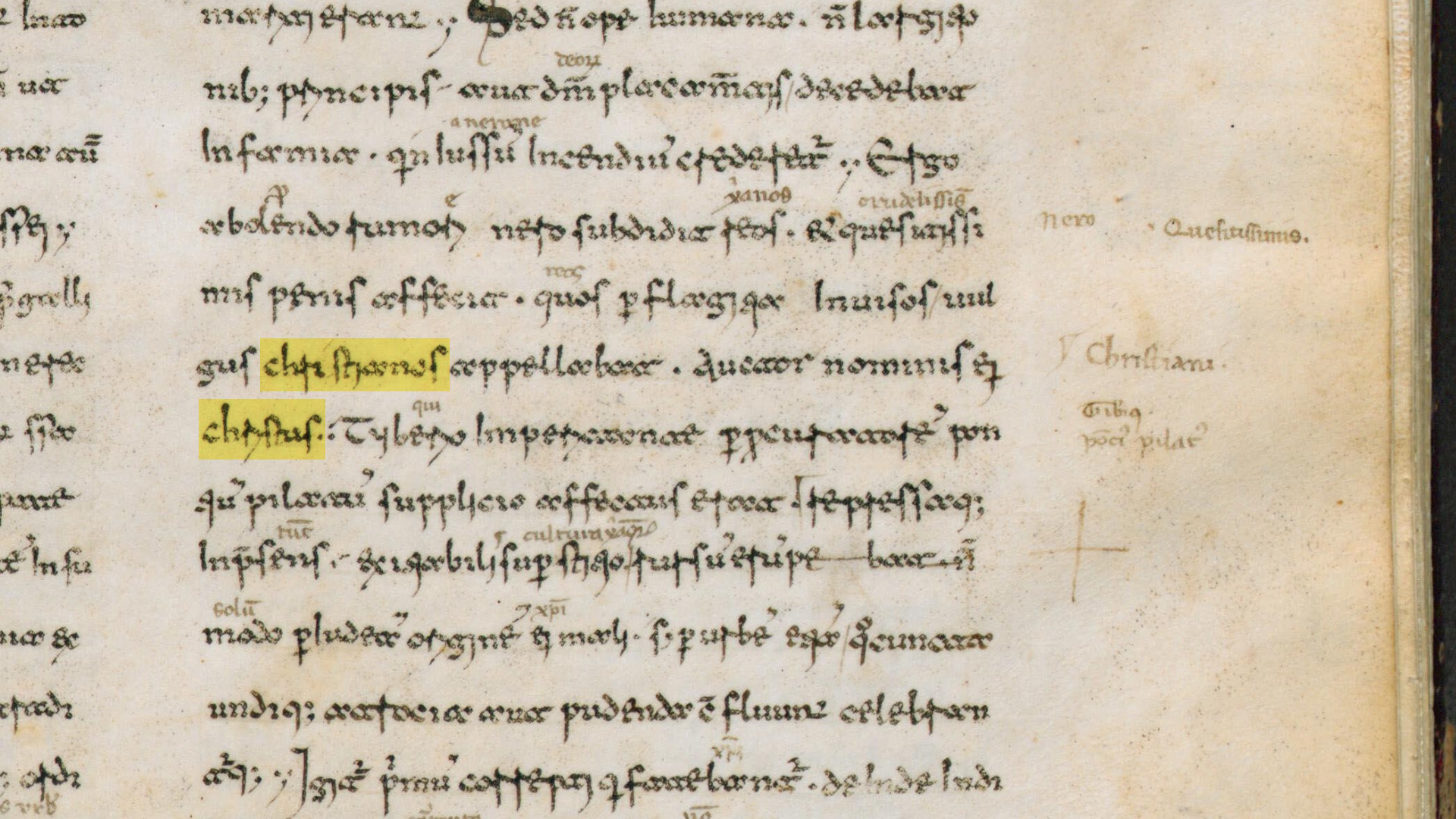
The manuscript of Tacitus, Annals 15.44: Biblioteca Laurenziana Plut.68.2, fol. 38r. Highlighted are the words Chrestianos (altered to read Christianos) and Christus.

In the first highlighted line, the spacing and the letter forms indicate that the scribe initially wrote Chrestianos. There’s too much space for i to be the original text, and the letter sequence ri ought to look quite different (see image below). The letter form is consistent with the left vertical stroke of an e, however, and so is the spacing. The corrector must have believed they were fixing a spelling error: this manuscript is carefully made. Notice the glosses above the lines to explain Tacitus’ wording. In the margin, the deaths of Christian martyrs are commemorated with a large cross, using the same colour ink and pen weight as the glosses.

In the following line, by contrast, Christus is what the scribe meant all along: there’s only enough space for an i there.
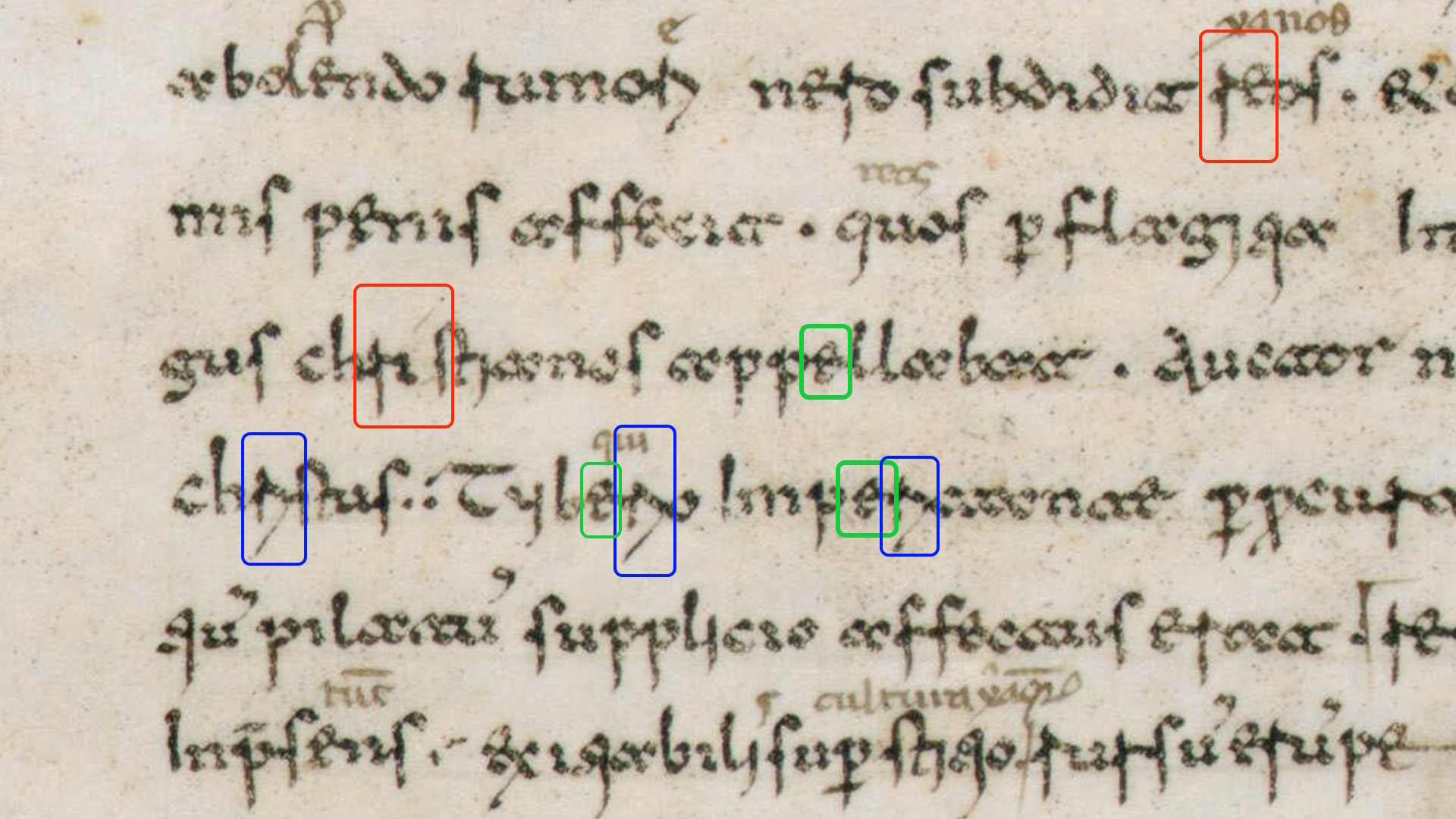
Cod. Laurenziana Plut.68.2, fol. 38r, with some letters circled: (1) In blue, the ligatured letter sequence ri (Christus, Tyberio, imperitante). (2) In green, the unligatured letter e (appellabat, imperitante). (3) In red, the letter sequence re (reos, and the matching sequence in Chrestianos). Notice also that in the top line a gloss corrects rumori to rumore: scraping letters wouldn’t have worked there, because of the ri ligature.

It’s all Greek

Take a look at these ancient Christian funerary inscriptions.

Ἰησοῦ Χρειστὲ βοήθει τῷ γράψαντι πανοικί.

O Jesus Chreist, aid the person who wrote this and his whole household.

IG XII,3 suppl. 1238 (undated, Melos)

Ἀπ̣[ο]λ̣λώνι̣ο̣[ς, δοῦλος]
Ἰησ̣οῦ Χρησ̣[τοῦ].

Apollonio[s, slave]
of Jesus Chres[t.]

Les oasis d’Égypte 72,17 (undated, Kharga Oasis)

κοιμητή̣ρ̣ι̣ο̣ν̣ Ε̣ὐ̣τ̣υ̣-
χίου διδασκάλου Χρη-
στιανοῦ {Χρηστειανοῦ}
νεοφωτείστου ...

The resting place of Euty-
chios the teacher, a Chre-
stian Chresteian
newly baptised ...

IG X,2 1 397 (4th cent. or later, Macedonia)

(Underlinings are mine.)

Spelling rules for ancient Greek are a Byzantine and modern phenomenon, not ancient. According to the modern standards, the name ‘Christ’ should be written Χριστός (Christós). But in antiquity, people spelled phonetically. And from around the 1st century BCE onwards, ι, ει, and η all represented the sound /i/. As a result, people in that era swapped between them freely.

That’s why these inscriptions give us Χρειστός (Chreistós) and Χρηστός (Chrestós). For the word ‘Christian’, Χριστιανός (Christianós), the third of these inscriptions gives us two variations at once: Χρηστιανός (Chrestianós) and Χρηστειανός (Chresteianós).

Note. The curly brackets around Χρηστειανοῦ in the third inscription show that the editor wants to delete the word from the text as an error. Error or not, it’s what the inscriber wrote. Deciding that one version is ‘correct’ means applying anachronistic spelling conventions.

This kind of variation is widespread: it isn’t confined to words for ‘Christ’ and ‘Christian’. In Roman-era inscriptions we find Posidon as well as Poseidon, Aineas and Aineias, Epaphroditos and Epaphrodeitos. Spelling was phonetic.

Detail of the Tabula Iliaca Capitolina (late 1st cent. BCE/early 1st cent. CE; Rome, Musei Capitolini, Sala delle Colombe inv. 316). This detail, showing a 6 × 4.5 cm area of the tablet, shows scenes from Iliad book 14 (below) and 15 (above). Circled are the names ΑΙΝΗΑΣ (Ainéas; for Αἰνείας Aineías), ΚΛΙΤΟΣ (Klítos; for Κλεῖτος Kleítos), and ΠΟΣΙΔΩΝ (Posidón; for Ποσειδῶν Poseidón). Elsewhere the tablet refers to the wooden horse as the ΔΟΥΡΗΟΣ ΙΠΠΟΣ (doúreos hippos; for δούρειος ἵππος doúreios hippos).

The principle of phonetic spelling applies even for the best educated. The Cleopatra autograph — a papyrus with one word that may be written by the hand of Cleopatra herself (P. Berol. 25239) — has the Greek for ‘Let this happen’ written in her hand. Byzantine conventions dictate the spelling γινέσθω (ginéstho), but Cleopatra writes γινέσθωι (ginésthoi). Because she wrote phonetically. Both spellings had the same pronunciation.

Occasionally, a text actually requires a spelling that is non-standard according to modern conventions. A 1st century CE epigram attributed to Leonides of Alexandria draws on a literary device called ‘isopsephy’, where the numerical values of the letters in each couplet add up to the same total (Leonides 32 Page = Anth. Pal. 9.355: both couplets add up to 6,422). In line 1, the word for ‘image’ uses the spelling μείμημα, phonetically equivalent to the Byzantine standard μίμημα. The isopsephy depends on using ει rather than ι.

Sometime before the year 300 CE, a Christian acrostic was devised in which the first letter of each line spells out the phrase Ἰησοῦς Χρειστὸς Θεοῦ υἱὸς σωτὴρ σταυρός, ‘Jesus Chreist, son of God, saviour, cross’ (Sibylline oracles 8.217–250 = (ps.-)Constantine Oratio ad sanctos 18). The line with the ε of Χρειστός is syntactically necessary: again, the poem depends on ει for ι.

This kind of variation is omnipresent in Greek texts of the Roman era, but it’s especially prone to happen with a word like Christós, because it wasn’t normally written in full. Early Christians normally only wrote the first and last letter, Χς, out of respect for its sanctity. Modern palaeographers call this convention a nomen sacrum, ‘sacred name’. As a result, many ancient Christians would have to guess what the first vowel ought to be. How could they be expected to be consistent in spelling it when they only knew the pronunciation?

A nomen sacrum in the most important ancient copy of the New Testament, the codex Sinaiticus: 1 Corinthians 5.7 καὶ γὰρ τὸ πάσχα ἡ|μῶν ἐτύθη Χς (‘for our paschal lamb, Ch(ris)t, has been sacrificed’). (Cod. Sinait. fol. 269, 4th cent. CE)

The more familiar spelling conventions came along later. They were designed to reflect a form of classical Attic Greek from roughly the first half of the 4th century BCE. For someone like Plato, the letters ι, ει, and η represented three distinct sounds: ι was /i/ (as in machine), ει was /eɪ/ (as in eight), and η was /e:/ (as in wear).

Even that’s a simplification, because η actually represented a merging of at least three different archaic sounds — but that is another story and shall be told another time. The point is, by the second half of the 4th century BCE, epigraphic evidence shows that ι and ει started to be interchangeable, indicating that by that point they were merging into the sound /i/. η kept a separate sound for a bit longer (or rather, as a separate group of sounds).

What does this have to do with Tacitus and Suetonius? They were writing in Latin. And in Latin, i and e never got confused. There was never any point at which Chrestus and Christus could be interchangeable in Latin.

Unless, that is, you were taking a Greek name and turning it into Latin. There were standard Roman conventions for transliterating Greek names, and those conventions were established before Greek ι, ει, and η finished merging into /i/.

Here are the conventions. The Romans traditionally transliterated both ι and ει as i, as in Πίνδαρος > Pindarus and Χείρων > Chiron. But because η kept its separate sound for longer, the Roman convention was to transliterate η as e, as in Περικλῆς > Pericles.

To clarify, here’s a tabulation.

manuscript form expanded form pronunciation conventional Latin transliteration
Χς Χριστός /xris'tos/ Christus
Χς Χρειστός /xris'tos/ Christus
Χς Χρηστός /xris'tos/ Chrestus

As we’ve seen, manuscripts used the nomen sacrum in the first column. Inscriptions used any of the three spellings in the second column interchangeably, because they all represented the same sounds.

Phonetic transcription turned all three variants into Christus in Latin, because that’s how all three were pronounced. But if a Roman writer saw a written version of the name, the conventions for transliteration produced two variants. Χριστός or Χρειστός would become Christus in Latin, while Χρηστός would become Chrestus.

What this indicates, then, is that Tacitus is relying on at least two distinct written sources for his account of Christians in Annals 15.44. One of those written sources transliterated the Greek word Χρηστιανοί as Chrestiani. The other transliterated Χρειστός or Χριστός as Christus.

Simlarly with Suetonius there are fairly strong grounds for inferring that his report of Christians in his life of Nero, with the spelling Christiani, was based on a source that was transliterated from Greek Χρειστιανοί or Χριστιανοί, while his report of the Jewish expulsion in Claudius’ reign, with the spelling Chrestus, was based on a source with the spelling Χρηστός.

OK, yes, there’s some wiggle room for doubt that Suetonius’ Chrestus had anything to do with Christianity. But the New Testament texts Acts and Romans give good support to the idea of a robust Jewish-Christian community in Rome in the 50s. It looks like pretty good odds to me.

And to conclude: none of the spelling variations suggest there’s anything wrong with the modern conventional spelling Χριστός Christós. There’s never been any doubt that that name is based on a gerundive form of χρίω ‘anoint’, and that it originated as a translation into Greek of Hebrew māšīyaḥ ‘anointed one, Messiah’. The fact that there’s another fairly common word χρηστός (meaning ‘good’) is a coincidence. It’s possible that confusion with χρηστός helped to encourage the alternate spellings, if some people interpreted Χρειστός/Χρηστός/Χριστός as having a meaning related to χρηστός. But reinterpretations like that aren’t enough to undermine the most obvious origin for the name.

Further reading

  • Allen, W. S. 1968. Vox graeca. A guide to the pronunciation of classical Greek. Cambridge. [Internet Archive]
  • Potter, D. S. 2012. ‘Tacitus’ sources.’ In: Pagán, V. E. (ed.) A companion to Tacitus. Wiley-Blackwell. 125-140.
  • Klingner, F. 1958. ‘Tacitus und die Geschichtsschreiber des 1. Jahrhunterts n. Chr.’ Museum Helveticum 15: 194–206. [E-Periodica | JSTOR]
  • Syme, R. 1982. ‘Tacitus: some sources of his information.’ Journal of Roman Studies 72: 68–82. [DOI | JSTOR]

08 March 2023

Homer's metre 3. Catalogue and glossary

An appendix to the last two posts on Homer’s hexameter. Contents:

  • A taxonomy of violations of Hermann’s Bridge
  • Glossary of technical terms relating to the hexameter
1. Structure of the hexameter | 2. Hermann’s Bridge | 3. Catalogue and glossary

A taxonomy of violations of Hermann’s Bridge

Seth Schein gives a convenient catalogue of violations in his book Homeric epic and its reception (2016: 114–115). He uses the following taxonomy:

  • violations following an enclitic (13× Iliad, 12× Odyssey)
  • violations without an enclitic (7× Iliad, 12× Odyssey)
  • not counted because of textual variance (1× Iliad)
  • Hesiodic violations (2× Theogony, 1× Works and days)
  • Homeric Hymns (1× H.Dionysos, 2× H.Demeter, 1× H.Apollo)
  • fragment of doubtful age, probably Roman-era (1× papyrus)

Mark Janse (2020) powerfully makes the point that it’s often subjective how you divide a line into its component phrases. A line like this does technically have a word break at the usual mid-line position:

κλέπτε νόωι, ἐπεὶ οὐ ⫶ παρελεύσεαι οὐδέ με πείσεις
Iliad 1.132

But it’s daft to treat a prepositive like οὐ as the end of a prosodic unit, as Janse points out (2020: 4). Yet that’s exactly how M. L. West analyses the line (1982: 36). West’s bizarre analysis, with οὐ at colon end, is driven by his theory that the hexameter originated as a hemiepes + paroemiac. An analysis following the four-colon model of Fränkel and Porter would produce something equally nonsensical.

In practice, this line obviously consists of three units, a combination with 3 + 5 + 4 beats. That is, the prosodic units end in the middle of the second foot, and at the end of the fourth foot.

κλέπτε νόωι, ⫶ ἐπεὶ οὐ παρελεύσεαι ⫶ οὐδέ με πείσεις
Iliad 1.132

The question is, which word breaks matter, and which ones don’t? And for our purposes, what kinds of word breaks count as a violation of Hermann’s Bridge? Janse proposes some good ‘operational criteria’ based on postpositives and information structure (2020: 15–23), but they don’t help in this specific context.

One criterion relates to one-syllable words. It’s conventionally understood that a word of one syllable doesn’t violate a bridge. But Schein, above, isn’t sure whether this includes enclitics, and that’s why he includes them in his catalogue of violations. Should we regard a phrase like ἐπεί κε as one word or two? I’ll include them here too, but I’ll let you know in advance that of the five types I outline below, I don’t think types a, b, and c are violations — or, at most, they’re minor violations. Only the fourteen lines in types d and e genuinely violate Hermann’s Bridge.

In all lines quoted below, ⫶ represents a mid-line colon break, and : represents a word break at Hermann’s Bridge.

Type a. Violations after an enclitic

Group 1. After ἐπεί + κε(ν)

Il. 1.168 ἔρχομ’ ἔχων ἐπὶ νῆας, ⫶ ἐπεί κε : κάμω πολεμίζων
Il. 2.475 ῥεῖα διακρίνωσιν ⫶ ἐπεί κε : νόμωι μιγέωσιν
Il. 21.575 ταρβεῖ οὐδὲ φοβεῖται, ⫶ ἐπεί κεν : ὑλαγμὸν ἀκουσηι
Od. 8.554 ἀλλ’ ἐπὶ πᾶσι τίθενται, ⫶ ἐπεί κε : τέκωσι, τοκῆες
Od. 18.150 μνηστῆρας καὶ κεῖνον, ⫶ ἐπεί κε : μέλαθρον ὑπέλθηι

Il. 21.575: schol. bT reports, Ἀρίσταρχός τινάς φησι γράφειν κυνυλαγμόν (West alters the accent and prints κυνύλαγμον). All manuscripts read κεν ὑλαγμὸν, including three ancient papyri, and implicitly so did Aristarchos.

Group 2. After ἐπεί/ἐπήν + enclitic personal pronoun

Il. 21.483 τοξοφόρωι περ ἐούσηι, ⫶ ἐπεί σε : λέοντα γυναιξίν || Ζεὺς θῆκεν
Il. 23.76 νίσομαι ἐξ Ἀΐδαο, ⫶ ἐπήν με : πυρὸς λελάχητε
Il. 24.423 καὶ νέκυός περ ἐόντος, ⫶ ἐπεί σφι : φίλος περὶ κῆρι
Od. 15.277 ἀλλά με νηὸς ἔφεσσαι, ⫶ ἐπεί σε : φυγὼν ἱκέτευσα

Il. 21.483 is also enjambed, another extremely rare phenomenon in Homer (object in line 483, subject and verb supplemented in 484).

Group 3. ὅσ(σ)ον τε γέγωνε βοήσας

Od. 5.400 ἀλλ’ ὅτε τόσσον ἀπῆν ⫶ ὅσσον τε : γέγωνε βοήσας
Od. 6.294 τόσσον ἀπὸ πτόλιος, ⫶ ὅσσον τε : γέγωνε βοήσας
Od. 9.473 ἀλλ’ ὅτε τόσσον ἀπῆν ⫶ ὅσσον τε : γέγωνε βοήσας
Od. 12.181 ἀλλ’ ὅτε τόσσον ἀπῆμεν, ⫶ ὅσον τε : γέγωνε βοήσας

Group 4. Correlative phrases

Od. 18.105 ἐνταυθοῖ νῦν ἧσο ⫶ κύνας τε : σύας τ’ ἀπέρυκαν
Od. 20.42 εἴ περ γὰρ κτείναιμι ⫶ Διός τε : σέθεν τε ἕκητι

Group 5. Participle phrases after περ/γε

Il. 2.246 Θερσῖτ’ ἀκριτόμυθε ⫶ λιγύς περ : ἐὼν ἀγορητής
Il. 5.571 Αἰνείας δ’ οὐ μεῖνε ⫶ θοός περ : ἐὼν πολεμιστής
Il. 10.549 μιμνάζειν παρὰ νηυσὶ ⫶ γέρων περ : ἐὼν πολεμιστής
Il. 15.585 Ἀντίλοχος δ’ οὐ μεῖνε ⫶ θοός περ : ἐὼν πολεμιστής
Il. 19.82 ἢ εἴποι; βλάβεται δὲ ⫶ λιγύς περ : ἐὼν ἀγορητής
Il. 23.306 Ἀντίλοχ’ ἤτοι μέν σε ⫶ νέον περ : ἐόντ’ ἐφίλησαν
Il. 24.35 τὸν νῦν οὐκ ἔτλητε ⫶ νέκυν περ : ἐόντα σαῶσαι
Od. 1.390 καί κεν τοῦτ’ ἐθέλοιμι ⫶ Διός γε : διδόντος ἀρέσθαι
Od. 19.253 νῦν μὲν δή μοι, ξεῖνε, ⫶ πάρος περ : ἐὼν ἐλεεινός
Od. 20.274 παύσαμεν ἐν μεγάροισι, ⫶ λιγύν περ : ἐόντ’ ἀγορητήν

Compare type b, below (participle phrases with no enclitic); this group represents an intersection between types a and b. Note that 9 out of these 10 use περ ἐών/ἐόντ-.

Additional. Non-Homeric hexameter

Hom.Hymn 1.5 ἄλλοι δ’ ἐν Θήβηισιν ⫶ ἄναξ, σε : λέγουσι γενέσθαι

Schein thinks that an enclitic at Hermann’s Bridge is only sort of a violation, and maybe not a violation at all. I agree. An enclitic is a short quasi-suffix that gets attached to the end of another word. You could compare them to the -n’t in English doesn’t, isn’t, wasn’t, except that enclitics also change the pronunciation of the word they’re attached to.

Schein isn’t quite sure what to make of violations after an enclitic (2016: 100). If you did treat an enclitic as an integral part of the preceding word, you might want to treat these violations as full-scale major violations of Hermann’s Bridge.

Θερσῖτ’ ἀκριτόμυθε, ⫶ λιγύς⁐περ : ἐών ἀγορητής
Iliad 2.246

Enclitics are however distinct words, and are always semantically optional. If the enclitic weren’t there, there’d be a perfectly ordinary hepthemimeral word break.

ἡδυεπὴς ἀνόρουσε, ⫶ λιγὺς Πυλίων ἀγορητής
Iliad 1.248

None of these groups is a major violation. But groups 4 and 5 cannot be regarded as any kind of violation, because the word(s) before the bridge are so closely linked to the line-end:

Od. 18.105: ἐνταυθοῖ νῦν ἧσο ⫶ κύνας τε : σύας τ’ ἀπέρυκαν
Il. 23.306: Ἀντίλοχ’ ἤτοι μέν σε ⫶ νέον περ : ἐόντ’ ἐφίλησαν

In Odyssey 18.105 (group 4), κύνας τε σύας τ’ is correlative: ‘to keep away both dogs and pigs’. In Iliad 23.306 (group 5), νέον περ ἐόντ’ is a discrete parenthesis: ‘they loved you, even though you are young’. Note that in group 5 the participle’s complement and the participle span the bridge, so there is no separation. In both groups, beats 6½ to 9 are spanned by the phrase. There is word break at beat 7½, but no colon break.

The upshot is that none of these subgroups give any reason to see the end of a prosodic unit at Hermann’s Bridge. Groups 1 to 3 might perhaps be considered to be minor violations, but very minor.

Type b. Other violations within participle phrases

Il. 16.627 Μηριόνη τί σὺ ταῦτα ⫶ καὶ ἐσθλὸς : ἐὼν ἀγορεύεις;
Od. 5.272 Πληϊάδας τ’ ἐσορῶντι ⫶ καὶ ὀψὲ : δύοντα Βοώτην
Od. 17.381 Ἀντίνο’, οὐ μὲν καλὰ ⫶ καὶ ἐσθλὸς : ἐὼν ἀγορεύεις
W&D 751 παῖδα δυωδεκαταῖον, ⫶ ὅτ’ ἀνέρ’ : ἀνήνορα ποιεῖ

Type a, group 5, above, already gave us some examples of participle phrases spanning Hermann’s Bridge; those ones included enclitics. Type b consists of the remaining participle phrases: three Homeric, one Hesiodic.

As in type a group 5, the bridge doesn’t fall between a substantive and a participle phrase: that would justifiably be treated as a major violation. Rather, the bridge falls between the participle’s complement and the participle.

All lines in this category also have a monosyllable at Varro’s Bridge (at the end of the third foot); that may or may not be significant. Cf. two lines in type d below.

Type c. Violations within prepositional phrases

Il. 9.482 μοῦνον τηλύγετον ⫶ πολλοῖσιν : ἐπὶ κτεάτεσσι
Od. 7.192 μνησόμεθ’, ὥς χ’ ὁ ξεῖνος ⫶ ἄνευθε : πόνου καὶ ἀνίης
Theog. 23 ἄρνας ποιμαίνονθ’ ⫶ Ἑλικῶνος : ὕπο ζαθέοιο

These follow similar principles to type b above. Since the phrases are governed by a word that comes immediately before or after the bridge (ἐπί, ἄνευθε, ὑπό), they cannot be construed as multiple phrases.

The Iliadic and Hesiodic examples structure the prepositional phrase with the preposition in between a substantive and its adjective; the Odyssey example has the preposition before the bridge.

Type d. Violations before a single 4½-beat word at line-end

Il. 10.317 αὐτὰρ ὃ μοῦνος ἔην ⫶ μετὰ πέντε : κασιγνήτοισι
Il. 23.760 ἄγχι μάλ’, ὡς ὅτε τίς τε ⫶ γυναικὸς : ἐϋζώνοιο
Il. 24.753 ἐς Σάμον ἔς τ’ Ἴμβρον ⫶ καὶ Λῆμνον : ἀμιχθαλόεσσαν
Od. 1.241 νῦν δέ μιν ἀκλειῶς ⫶ Ἅρπυιαι : ἀνηρείψαντο
Od. 14.371 νῦν δέ μιν ἀκλειῶς ⫶ Ἅρπυιαι : ἀνηρείψαντο
Od. 18.140 πατρί τ’ ἐμῶι πίσυνος ⫶ καὶ ἐμοῖσι : κασιγνήτοισι
Od. 20.77 τόφρα δὲ τὰς κούρας ⫶ Ἅρπυιαι : ἀνηρείψαντο
Od. 4.684 μὴ μνηστεύσαντες ⫶ μηδ’ ἄλλοθ’ : ὁμιλήσαντες
H.Apollo 36 Ἴμβρος ἐϋκτιμένη ⫶ καὶ Λῆμνος : ἀμιχθαλόεσσα

With type d we come to major violations (3× Iliad, 5× Odyssey, 1× non-Homeric). This is in spite of the fact that the violation is forced, in the sense that a five- or six-syllable word necessarily has an unusual impact on the colometry; and in spite of the fact that in half of them the bridge falls between a noun and its adjective (Il. 10.317, 23.670, 24.753; Od. 18.140).

Splitting a noun phrase like this could be considered artificial, but it is also perfectly justifiable to regard it as a noun or adjective followed by supplementation, that is, as a violation. This is where we bump up against the subjectivity Janse complains of. There’s no robust justification for treating a noun + adjective as a single intonational unit. Parsimony demands that we treat these lines as the violations that they can reasonably be construed as.

In this category κασιγνήτοισι, ἀμιχθαλόεσσα(ν), and ἀνηρείψαντο appear multiple times in the line-end colon; ἐϋζώνοιο and ὁμιλήσαντες appear once each. The two lines with Λῆμνος/-ον ἀμιχθαλόεσσα(ν) have a monosyllable at Varro’s Bridge (cf. type b above).

Type e. Other violations

Il. 6.2 πολλὰ δ’ ἄρ’ ἔνθα καὶ ἔνθ’ ⫶ ἴθυσε : μάχη πεδίοιο
Il. 24.60 θρέψά τε καὶ ἀτίτηλα ⫶ καὶ ἀνδρὶ : πόρον παράκοιτιν
Od. 10.415 δακρυόεντες ἔχυντο· ⫶ δόκησε δ’ : ἄρα σφίσι θυμὸς
Od. 12.47 ἀλλὰ παρὲξ ἐλάαν, ⫶ ἐπὶ δ’ οὔατ’ : ἀλεῖψαι ἑταίρων
Od. 17.399 μύθῳ ἀναγκαίῳ· ⫶ μὴ τοῦτο : θεὸς τελέσειε
Od. 20.344 μύθῳ ἀναγκαίῳ· ⫶ μὴ τοῦτο : θεὸς τελέσειε(ν)
Theog. 319 ἡ δὲ Χίμαιραν ἔτικτε ⫶ πνέουσαν : ἀμαιμάκετον πῦρ
H.Dem. 17 Νύσιον ἂμ πεδίον ⫶ τῆι ὄρουσεν : ἄναξ Πολυδέγμων
H.Dem. 452 ἑτήκει πανάφυλλον· ⫶ ἔκευθε δ’ : ἄρα κρῖ λευκόν

These are also major violations (2× Iliad, 4× Odyssey, 3× non-Homeric), with no mitigating factors. As in type d some of them could arguably be construed as a single phrase, but there are no robust principles to guarantee that as the correct approach.

Two of these are formulaic (Od. 17.399 ~ 20.344). In Theogony 319, note the Attic correption in ἔτικτε πνέουσαν. Schein cites one further example of unknown date from a hexameter papyrus, which appears in Bernabé’s edition of epic fragments as a fragmentum dubium:

PEG p. 85 dub., 11 [ . . . ἅ]μα καὶ νώτοισι : νέκυν οἵσωμ[εν]

This example is also unusual for having no colon break within the third foot.

Glossary of technical terms

  • Arsis. Literally ‘lifting’: an even-numbered beat. So named for the raising of a staff from the ground in keeping rhythm; similar to the modern musical term upbeat. Compare thesis.
  • Beat. See hemipes.
  • Bridge. A position in a poetic rhythm that is normally mid-colon. Equivalently: a position where colon-break is avoided. More loosely, a position where word-break is avoided.
  • Bucolic caesura. The result of a hexameter line having a four-beat colon at line-end: that is, a combination of 8 + 4 beats, 3 + 5 + 4 beats, etc. Equivalently: colon break after the eighth beat. The name is ancient, from Greek βουκολικὴ τομή (Bassett 1919: 353). (Obsolete term: ‘bucolic diaeresis’.)
  • Caesura. The end of one colon and the start of the next. More loosely, used to refer to any position with a word-break.
  • Colon. In Homeric metre, a prosodic unit that is well adapted to the hexameter rhythm. If a prosodic unit is used frequently, it tends to be attached more or less rigidly to a particular position in the line; in that case it is called a ‘formula’ or ‘metrical formula’. Any point in mid-colon is called a bridge; the start or end is called a caesura.
  • Dactyl. A foot with the rhythm — ⏑⏑.
  • Diaeresis. Obsolete term: word break after an even-numbered beat. The distinction between diaeresis and caesura (in the sense ‘word break’) comes from the scholastic preoccupation of treating a foot as prescriptive rather than descriptive, and so seeing word-break at foot-end as different from other positions.
  • Foot. A descriptive term for one sixth of the twelve-beat hexameter rhythm. Two further descriptive terms, dactyl and spondee, refer to the rhythms typically seen in each foot.
  • Gerhard’s Bridge. The principle that words ending with a natural long syllable are not positioned to end after beat 10 (at the end of the fifth foot).
  • Giseke’s Law. The principle that a word should not end after beat 4 if it starts in beats 1 or 2 (that is, in the first foot). Mostly applicable to post-Homeric hexameter. Also known as Giseke-Meyer’s Law, since this law is equivalent to part of Meyer’s First Law. Equivalently: words with the rhythms — ⏕ — ⏕ / ⏕ — ⏕ / ⏑ — ⏕ do not take a position starting in the first two beats.
  • Hemipes. The technical term for a beat. That is: either one long note or two short notes. The hexameter has twelve hemipedes, each lasting two morae. Odd-numbered hemipedes are (almost invariably) a single long note; the tenth is (usually) two short notes. (Historically, this term comes from pes, Latin for ‘foot’, a descriptive term; that doesn’t mean beats themselves are only descriptive, however.)
  • Hepthemimeral caesura. The result of a hexameter line having a five-beat colon at line-end: that is, a combination of 7 + 5 beats, 3 + 4 + 5, etc. Equivalently: colon break after the first syllable of the fourth foot. The name is ancient, from Greek ἑφθημιμερὴς τομή (Bassett 1919: 353).
  • Hermann’s Bridge. The bridge in the middle of beat 8. (Equivalently: a dactylic fourth foot has no colon break between its two short syllables.) Over 99.95% of Homeric lines observe Hermann’s Bridge. Related to Wernicke’s Law: a word ending in the fourth foot with the natural rhythm — ⏑ would violate either Wernicke’s Law (if the last syllable is lengthened by position) or Hermann’s Bridge (if it remains short).
  • Hexameter, more fully dactylic hexameter. The metre of Greco-Roman epic. The typical rhythm is: — ⏕ — ⏕ — ⏕ — ⏕ — ⏑⏑ — ×, with a variety of common colon rhythms, which result in commonly observed bridges and caesuras.
  • Long. A long note; a syllable lasting two morae.
  • Meyer’s Laws. These ‘laws’ apply primarily to post-Homeric hexameter (West 1987: 225–226 notes that Iliad 1.1 breaks all three laws). 1. Words that begin in the first foot do not end between the shorts of the second foot or at the end of the second foot. 2. Disyllabic words of the rhythm ⏑ – are avoided immediately before a penthemimeral caesura. 3. A line does not have word break after both the fifth and ninth beats, that is, in the middle of the third and fifth feet. See also Giseke’s Law; Nikanor’s Bridge; Tiedke-Meyer’s Law.
  • Mid-line caesura. An umbrella term that includes colons ending after either the fifth beat (penthemimeral caesura) or halfway through the sixth beat (tritotrochaic caesura). 98% of Homeric lines have a mid-line caesura.
  • Mora. In metre, a short note; in hexameter, half of a hemipes. (NB: in linguistics, a mora is a basic timing unit.)
  • Nikanor’s Bridge. A conditional bridge between the two short syllables of beat 4: a word should not end in this position if it starts in beats 1 or 2 (that is, in the first foot). Mostly applicable to post-Homeric hexameter. Also known as Nikanor-Meyer’s Law, since this bridge is equivalent to part of Meyer’s First Law. Equivalently: words with the rhythms — ⏕ — ⏑ / ⏕ — ⏑ / ⏑ — ⏑ do not take a position starting in the first two beats.
  • Penthemimeral caesura. The result of a line using a colon combination of 5 + 7 beats. Equivalently: colon break after the first syllable of the third foot. The name is ancient, from Greek πενθημιμερὴς τομή (Bassett 1919: 353).
  • Short. A short note; a syllable lasting one mora.
  • Spondee. A foot with the rhythm — —.
  • Thesis. Literally ‘placement’: an odd-numbered beat. So named for the placing of a staff on the ground in keeping rhythm; similar to the modern musical term downbeat. Compare arsis.
  • Tiedke-Meyer’s Law. A colon with the rhythm — ⏕ — is not placed to start on beat 7 and end on beat 9 (that is, starting at the beginning of the fourth foot). Sometimes known as ‘Meyer’s Fourth Law’.
  • Tritotrochaic caesura. The result of a hexameter line using a colon combination of 5½ + 6½ beats. Equivalently: colon break between the two short syllables of the third foot. The name is ancient, from Greek τρίτη τροχαικὴ τομή (Bassett 1919: 353).
  • Varro’s Bridge. A conditional bridge between beats 6 and 7, if there is also a mid-line caesura. Equivalently: avoidance of words with the rhythms — or ⏑ — ending on beat 6.
  • Wernicke’s Law. A word ending in the rhythm — — at the end of beat 8 (i.e. a spondaic fourth foot, immediately before a bucolic caesura) will normally have that spondaic rhythm naturally. That is, there will be no need to length the last syllable by position. Related to Hermann’s Bridge: a word in this position ending — ⏑ would violate either Wernicke’s Law (if the last syllable is lengthened by position) or Hermann’s Bridge (if it remains short).

References and further reading

  • Bassett, S. E. 1919. ‘The theory of the Homeric caesura according to the extant remains of the ancient doctrine.’ American journal of philology 40: 343–372. [JSTOR]
  • Hermann, G. 1805. Orphica. Leipzig. [Internet Archive]
  • Janse, M. 2020. ‘Phrasing Homer: a cognitive-linguistic approach to Homeric versification.’ Symbolae Osloenses 94: 2–32. [DOI]
  • van Leeuwen, J. 1890. ‘Homerica, IV. De caesura quae est post quartum trochaeum.’ Mnemosyne n.s. 18: 265–276. [JSTOR]
  • Schein, S. 2016. ‘A cognitive approach to Greek metre: Hermann’s Bridge in the Homeric hexameter and the interpretation of Iliad 24.’ In: Homeric epic and its reception. Oxford.
  • West, M. L. 1982. Greek metre. Oxford.
  • —— 1987. Introduction to Greek metre. Oxford.

07 March 2023

Homer's metre 2. Hermann’s Bridge

Hermann’s Bridge is a metrical feature in Homeric verse. Often it’s regarded as advanced — for specialists only. Well, hear this. If you’re educating someone about Homeric verse, you cannot neglect something as fundamental as Hermann’s Bridge is.

How fundamental? More fundamental than having a dactyl or spondee at the start of the line, that’s how fundamental.

1. Structure of the hexameter | 2. Hermann’s Bridge | 3. Catalogue and glossary
Gottfried Hermann, 1772–1848 (unknown artist)

Here’s how it’s traditionally defined.

[T]here cannot be a word end between the two short elements of the second half of the fourth foot.
De Decker 2017: 60

Here’s what this means in the twelve-beat rhythm we looked at last time. In the musical notation, Hermann’s Bridge is marked by the dotted line; in the metrical notation, it’s marked by the bracket. The point is that it’s always mid-word, never between words.

— ⏕ — ⏕ — ⏕ — ͜⏕ — ⏑⏑ — ×

A bridge is any position in a poetic rhythm where word break doesn’t usually happen. This particular bridge was observed over 200 years ago by Gottfried Hermann (1805: 692–693). Hermann’s Bridge is by far the strictest of its kind.

98% of Homeric lines have a word break in the third foot. Does that sound like a lot? Well, over 99.94% of lines observe Hermann’s Bridge.

This is no incidental feature. What it is, is an absolutely central feature of the Homeric hexameter. It isn’t any more ‘advanced’ than the mid-line caesura, it’s exactly the same kind of phenomenon. Caesuras happen because prosodic units have typical rhythms; bridges happen because there are some rhythms that prosodic units just don’t use.

The sample space

According to the definitions I’ll adopt below, there are fourteen violations of Hermann’s Bridge in Homer. That is, 0.050% of all 27,803 lines.

Note. The definitions adopted below are, briefly: (a) A bridge is mid-prosodic unit, rather than mid-word. (b) Monosyllabic words, including enclitics, don’t cause a violation.

Is that a fair claim, though? After all, a violation can only ever happen in lines with a dactylic fourth foot. Should we stipulate that our sample space should be confined to those lines?

It isn’t really necessary, but fine, let’s do that. How many lines have a dactylic fourth foot? Oswald (2014: 421) claims that it’s ‘19 out of 20’ lines, but that’s just wildly wrong: a glance at the text of Homer will show that.

Schoisswohl’s and Papakitsos’ tool Dactylo is able to perform automated scansion of over 96% of all Homeric lines. Their figures indicate the following (Schoisswohl and Papakitsos 2020: 170–171):

  Iliad Odyssey
full corpus, including unscanned lines (reported) 15,693 lines 12,110
unscanned lines, % of full corpus (reported) 3.7% 3.5%
scanned lines, % (calculated as proportion of sum of all reported figures) ~96.302% ~96.505%
lines scanned, actual (calculated) ~15,113 ~11,687
dactylic fourth foot, % of full corpus (sum of reported figures) 68.287% 67.548%
dactylic fourth foot, % of lines scanned (calculated) ~70.909% ~69.994%
dactylic fourth foot, actual (calculated) ~10,716 ~8,180

So about 70–71% of Homeric lines have a dactylic fourth foot. These figures give a total of about 18,896 eligible lines. (The real number of lines with a dactylic fourth foot will be slightly higher.)

With fourteen violations of Hermann’s Bridge, and 18,896 lines that could possibly have a violation, the proportion with violations rises from 0.050% to 0.074%. So in this restricted sample space, only 99.93% of dactylic fourth feet observe Hermann’s Bridge. (Only!)

Hermann’s Bridge is still stricter than starting the line with a long syllable. There are a bit over 50 lines in Homer that start with a short syllable. There are only 14 violations of Hermann’s Bridge.

Note. Homer tolerates a short initial syllable for certain words at line-beginning: amphibrachs with ἕως (20×) and τέως (1×); tribrachs with κλύθι/κλύτε (17×), ἴομεν (6×), and φίλε (3×); baccheics with ἐπεί δή/ἐπειδή (6×). This gives a total of 53: so at least 0.19% of Homer has a line-initial short. These are the examples cited by West (1967: 135–139); there may be others. Incidentally, these parallels strongly imply that ἕως should not be understood as preserving the trochaic rhythm of pre-Homeric *ἧος/ἆος.
Wrong bridge: Hermann Bridge, Missouri, demolished 2008. (Source: BridgeHunter.com)

Colon break, not word break

Previously, in part 1, I said caesuras are a side-effect of a deeper phenomenon. The same phenomenon is responsible for bridges. Colon breaks are the gaps between the trees: prosodic units, or cola, are the trees themselves. A bridge is a position that is normally full of tree.

So I’m adopting a refinement here. Word breaks aren’t as important as colon-breaks. A bridge is a position that is normally mid-colon. It’s a constraint on colon shape.

It would be perverse, after all, to imagine an archaic oral poet adopting a rule of the form ‘I will avoid ending a word at such-and-such a position.’ There are plenty of modern scholars who take the stance that a caesura isn’t the same thing as a ‘sense break’ (see Janse 2020: 10–13 for examples). A metrical principle operating on ‘caesura’ in that sense would be arbitrary.

(If you do want to base theories on caesuras defined as ‘word breaks’, say what you mean! Say ‘word break’, not ‘caesura’. Then it’ll be easier to see how absurd the theory is!)

Hermann’s Bridge is anything but arbitrary. When a violation happens, it isn’t because the poet has broken an abstract rule. It’s because there’s something uncommon about the prosodic units in that line.

When Hermann’s Bridge is violated, the real nature of the anomaly is that there’s a line-end colon shaped ⏑ — ⏑⏑ — ×.

More often, violations have been described in terms of the preceding colon (e.g. West 1982: 37–38). It so happens that all Homeric lines that violate Hermann’s Bridge have a mid-line caesura, so we can also say that in each line, the violation occurs because of a mid-line colon shaped ⏓ — ⏑.

Put this way, Hermann’s Bridge turns out to be equivalent to Wernicke’s Law. Wernicke’s Law is that when a word ends at the end of a spondaic fourth foot, that word is naturally spondaic: that is, its last syllable will be naturally long, without having to be lengthened by two consonants. If a word ending in the natural rhythm — ⏑ is put in the fourth foot, then it violates either Hermann’s Bridge (if its last syllable remains short) or Wernicke’s Law (if it is long by position).

So don’t think of this in terms of ‘trochaic caesura in the fourth foot’. That’s the wrong mental model. The true nature of Hermann’s Bridge (and, mutandis mutatis, Wernicke’s Law) is this:

It is extremely rare to find a word shaped ⏓ — ⏑ after the mid-line caesura.
(And ditto for ⏑ — ⏑⏑ — × at line-end.)

What makes this particular position so special? A trochaic phrase-end is apparently just fine in other positions of the line. Could it be that it’s really the line-end colon shape that matters after all, not the mid-line colon?

Maybe that’s part of the answer. But it’s independently known that a given word tends to stick like glue to certain positions in the line. O’Neill (1942) found that 90% of words in Homer appear in only a third of the positions where they could be rhythmical. Forstall and Scheirer (2012) have examined words with the rhythm — — in the Iliad and classified them into seven groups based on which position they ‘prefer’, and have found that each group is far stricter than even O’Neill realised. There is a strong likelihood that similar reasoning underlies the ‘specialness’ of the eighth beat.

Frequency profiles from Forstall and Scheirer (2012) for each of the seven classes of words with rhythm — —. Class 1 comprises words that appear most frequently at the first beat (annotated as position ‘110’), class 2 comprises words that appear most frequently at the second beat, and so on. Class 8 comprises words that are statistically ‘most distant’ from the nuclei of each of the first seven classes; the frequency profile for class 8 is similar to that of all classes combined (bottom right; I have adjusted the scale of the combined data to match that of the other figures). Note that (a) some possible positions have no affiliated words: there are no spondaic words that regularly begin on the 3rd, 5th, 9th, or 10th beats. (b) Some classes are more mobile than others: words that are attached to positions before the fourth foot may frequently also be transposed to line-end. (c) Class 6 bridges the position of the ‘bucolic caesura’, contraindicating Witte’s theory that the hexameter emerged from a combination of a tetrameter + adoneus.

This definition reduces the number of major violations

Reframing the bridge in terms of colon-shape means that the following lines can’t be regarded as major violations. I think they shouldn’t be regarded as violations at all. (Word breaks at Hermann’s Bridge are marked by a colon.)

  • Iliad 9.482 ... πολλοῖσιν : ἐπὶ κτεάτεσσι
  • Theogony 23 ... Ἑλικῶνος : ὕπο ζαθέοιο
  • Iliad 16.627 = Odyssey 17.381 ... καὶ ἐσθλὸς : ἐὼν ἀγορεύεις
  • Odyssey 5.272 ... καὶ ὀψὲ : δύοντα Βοώτην

Not all word breaks are equal. Yes, these lines have word breaks at the bridge, but there’s definitely no colon break or phrase break. The first two are prepositional phrases that can’t be separated; the last two are tightly linked participle phrases, with a participle and its complement spanning Hermann’s Bridge.

Note that this doesn’t reduce the importance of Hermann’s Bridge. On the contrary, it means that it’s even stricter.

With some word breaks, it’s a matter of judgement whether we should regard them as being mid-phrase or not.

  • Iliad 1.168: ἔρχομ’ ἔχων ἐπὶ νῆας, ἐπεί κε : κάμω πολεμίζων
  • Iliad 23.76: νίσομαι ἐξ Ἀΐδαο, ἐπήν με : πυρὸς λελάχητε
  • Odyssey 5.400: ἀλλ’ ὅτε τόσσον ἀπῆν ὅσσον τε : γέγωνε βοήσας

Here, the relatives introducing the second half of the line — ἐπεί, ἐπήν, ὅσσον — are linked to the following clauses, to an extent. But they’re not parts of a larger discrete phrase: their role is conjunctive — like syntactical mortar, rather than part of a brick.

In spite of that, these ones aren’t violations. The word break is caused by a one-syllable word, and it’s traditionally understood that one-syllable words don’t violate bridges.

Some violations are unquestionably more serious than others. Part 3 will give a catalogue and taxonomy of violations, in five categories, and give a glossary of technical terms.

References

  • de Decker, F. 2017. ‘Ὅμηρον ἐξ Ὁμήρου σαφηνίζειν: an analysis of augment use in Iliad 1.’ Journal of Indo-European studies 45: 58–171. [Universiteit Gent]
  • Forstall, C. W.; Scheirer, W. J. 2012. ‘Revealing hidden patterns in the meter of Homer’s Iliad.’ 2012 Chicago Colloquium on Digital Humanities and Computer Science, University of Chicago, 17–19 November 2012. [abstract | poster]
  • Hermann, G. 1805. Orphica. Leipzig. [Internet Archive]
  • Janse, M. 2020. ‘Phrasing Homer: a cognitive-linguistic approach to Homeric versification.’ Symbolae Osloenses 94: 2–32. [DOI]
  • O’Neill, E. G. 1942. ‘The localization of metrical wordtypes in the Greek hexameter.’ Yale classical studies 8: 105–178.
  • Oswald, S. 2014. ‘Metrical laws.’ In: Giannakis, Georgios K. (ed.) Encyclopedia of ancient Greek language and linguistics. Volume 2. G–O. Leiden. 419–423.
  • Schoisswohl, O.; Papakitsos, E. C. 2020. ‘Automated metric profiling and comparison of ancient Greek epics in hexameter.’ Linguistik online 103.3: 157–177. [DOI]
  • West, M. L. 1967. ‘Epica.’ Glotta 44: 135–148.
  • —— 1982. Greek metre. Oxford.