Showing posts with label reception. Show all posts

14 August 2026

Homeric details and other influences in Nolan's The Odyssey (2026)

There are already tons of reviews of The Odyssey (2026) out there, including many by classical scholars. I’m no movie expert, so this isn’t a review. But I can sometimes spot little details and recognise where they’ve come from.

Nolan’s film diverges from Homer in major respects, but there are also points of detail that it treats more carefully than it needs to. And the film doesn’t just draw on Homer: it also uses other ancient traditions, and other past screen adaptations of The Odyssey.

Warning: spoilers ahead.

Eurykleia recognises Odysseus (Attic red figure skyphos, ca. 430 BCE; Chiusi Museo Nazionale Etrusco inv. 1831; image source: Dan Diffendale, Flickr)

Homeric details

1. Odysseus grabs Eurycleia’s neck

This is the detail that suggested to me the idea of this compilation. As a courtesy to her disguised guest, Penelope assigns the enslaved Eurycleia to bathe Odysseus’ feet. Earlier in the film there was a flashback where Odysseus was wounded in the leg while hunting, and Eurycleia treated the wound: now she sees the scar, and immediately realises who the guest is.

In Homer the passage is Odyssey 19.386–502. The film has the tighter storytelling: the scar is a Chekhov’s Gun, planted ahead of time (in Homer it’s first introduced in this scene), and the film shows rather than tells (Homer has lots of dialogue between Odysseus and Eurykleia). In Homer, Eurykleia finds the scar, then (19.476–481) —

... [Eurykleia] turned her eyes towards Penelope,
intending to tell her that her husband was present in the house.
But Penelope wasn’t able to look that way or notice:
Athena turned her mind. Then Odysseus
reached and grabbed her neck in his right hand,
and with the other he pulled her closer and spoke ...

The film makes lots of well motivated changes, but still includes the minor detail of Odysseus grabbing her neck.

What the film does not do is address the morals of assaulting and endangering people like Eurycleia and Melantho who are enslaved. An informed understanding of Homer shouldn’t just understand that there’s slavery in it, but also what’s wrong with that.

Some films like Gone with the Wind or Song of the South infamously whitewash slavery as if it’s benevolent. Nolan’s The Odyssey goes further: it actively approves of brutality to slaves. When Penelope tosses Melantho into the slaughter of the suitors, that’s roughly equivalent to a modern CEO tossing a wage slave into a meat grinder for daring to apply for a job at a different company.

2. Divine interventions

Several times characters say ‘You have the eyes of Athena.’ This is slightly cringey dialogue, but it’s directly motivated by Homer’s text: it reflects incidents in the epic where Telemachos or Odysseus recognises Athena even though she’s disguised as a mortal character.

It also has the effect of incorporating the divine world into how people speak and interact. The film takes a relatively subtle approach to this: consider how it frames Athena as appearing to Odysseus in visions, rather than as a physical presence.

Zeus’ thunder works the same way. At various points the sound of rumbling thunder is heard, and on one occasion there’s a comment that Zeus apparently has an interest in the outcome of the bow contest. The divine isn’t directly present, but it’s there, hanging over the story. Compare Odyssey 21.410–413:

Taking [the bow] in his right hand, [Odysseus] tested the string:
it sang beautifully in accompaniment, like a swallow’s song.
Great fear broke out among the suitors, and all their skin
grew pale. And Zeus thundered loudly, giving an omen.

3. Approximations: the Cyclops, the ghost of Teiresias

The film’s Cyclops episode omits the dialogue between Odysseus and the Cyclops, and the ‘Nobody’ trick. It does follow Homer in a few other respects, though — though not strictly, and not realistically.

In ancient paintings, Odysseus and his men normally use a hot metal skewer to blind Polyphemos. That’s consistent with variants of this folktale in other cultures. Homer’s version is an innovation: he has them use a wooden stake, because his Cyclopes are so barbaric that they don’t cook their food. That creates a few anomalies. Homer’s wooden stake glows white-hot all the way through, it can pierce the Cyclops’ eyeball, and it’s hot enough to make it sizzle — things that would only make sense if it were, well, a metal spit. It’s a mistake. Nolan’s film faithfully reproduces Homer’s mistake.

On the metal spit, see Glenn 1971: 164–166. Page 1955: 9–12 points out some of the incongruities around the wooden stake.

Odysseus escaping underneath Polyphemus’ ram (Attic white-ground column krater, ca. 510 BCE, Sappho Painter; Karlsruhe, Badisches Landesmuseum 167; cf. Odyssey 9.415–460)

Less exact is the escape from the cave. As in Homer, the Cyclops reaches out to feel his sheep as they exit the cave, to stop Odysseus escaping. But in Homer they’re giant sheep, and the humans are tied to their bellies. On screen that would be laughably silly. So Nolan’s film settles for an approximation: the humans wear bundles of hay on their back.

The ‘underworld’ scene is another approximation. Odyssey 11 isn’t a descent to the underworld: that’s Vergil’s Aeneid, not Homer. Nolan faithfully shows Odysseus summoning the spirits of the dead above ground. Homer doesn’t say how the spirits arrive — he just says they start swarming around the pit of sheep’s blood — but Nolan’s film has them come up from the ground, emerging out of otherworldly black sand.

The setting envisaged in Homer is a nekyomanteion, or ‘oracle of the dead’. Real nekyomanteia were sacred places by a body of water, or in a cave, where visitors could commission a ritual to consult dead spirits as an oracle. There were four famous nekyomanteia: one at a purported ‘Acherousian lake’ on the river Acheron in Epeiros, Greece; one by lake Averno in Campania, Italy, near Cumae; and two in caves, at Heracleia Pontica and Cape Tainaron.

In the 1900s it was sometimes assumed that the lakeside nekyomanteia also had cave-based rituals: some archaeologists suggested identifying them with underground locations. That’s very doubtful, as Daniel Ogden shows. Certainly Aischylos’ play the Psychagogoi envisaged Odysseus’ consultation of Teiresias as taking place literally at the shore of a lake.

The four nekyomanteia and their locations: Ogden 2001: 17–28. Aeschylus’ lakeside psychagogia: fr. 273a ed. Radt. Sotírios Dákaris proposed localising the Acherousian nekyomanteion at a Hellenistic site with an underground crypt at Mesopotamo, Parga, about 4 km from the mouth of the Acheron; R. F. Paget tentatively suggested a cave complex in the hillside of Baiae for the Avernan nekyomanteion.

Homer equivocates between Acheron and Averno. Circe’s instructions refer to the rivers Kokytos and Acheron (10.513–514); but when Odysseus arrives, it sounds much more like Cumae — he’s next to the sea, and Cimmerians live there (11.13–21). Regardless, Nolan’s film faithully reads Odysseus’ consultation as taking place near a shore.

Ogden 2001: 61–74 argues in favour of a setting at Averno. Averno was the only nekyomanteion to have resident staff, including a group known as ‘Cimmerians’.

It’s standard in ancient vase paintings for spirits to come up out of the ground, including in paintings of Odysseus. That isn’t explicit in Homer, but Nolan’s film reproduces it anyway. In one vase painting, the ghost of Elpenor is surrounded by plants, indicating a setting above ground. (Elpenor isn’t in the film: he’s faintly ridiculous in Homer, so Nolan wisely replaces him with Sinon, creating a much weightier scene.)

Left: Odysseus and Elpenor. Right: Odysseus and Teiresias (only Teiresias’ head is above ground). (Left: Attic pelike, Lykaon Painter, ca. 440 BCE; Boston Mus. Fine Arts 34.79; cf. Odyssey 11.51–83. Right: south Italian kalyx krater, Dolon Painter?, ca. 370 BCE; Paris Bibl. Nat. Cab. de Méd. 422; cf. Odyssey 11.90–149). Both scenes have Odysseus accompanied by Hermes, who is not present in Homer. Hermes may possibly have been present in a lost Attic tragedy on the episode, notably Aischylos’ Psychagogoi, which was about Odysseus’ consultation of Teiresias: the Chorus addresses Hermes in Aischylos fr. 273a ed. Radt (cf. Sophokles fr. 748 ed. Radt, from an unknown play, which refers to the nekyomanteion at Averno).

Material from other ancient traditions

I’ve already mentioned the spirits coming up out of the ground, which isn’t in Homer’s text. Here are some more incidents where the film draws on material that is ancient, but not in Homer:

  • The suitor Eurymachus beats a staff on the ground while performing oral poetry. This is partially in accordance with ancient accounts of rhapsodic performance. Ancient rhapsodes beat in time to their chant (hence thesis and arsis, ‘placing’ and ‘lifting’, a literal downbeat and upbeat); Eurymachus beats his staff in between phrases, more like punctuation.
  • Sinon and Troy going up in flames aren’t Homeric stories. Sinon is a later addition to the legend, of uncertain date; the fire imagery is from Vergil’s Aeneid (and other later accounts). It’s basically compulsory for modern depictions of the fall of Troy to fill it with fire imagery: Vergil actually drew that motif from the Romans’ sack of Carthage in 146 BCE.
  • Clytemnestra killing Agamemnon in the bathtub is from Aischylos’ play Agamemnon (458 BCE) and from ancient vase paintings depicting the murder. In Homer, it’s Klytaimestra’s lover Aigisthos that kills Agamemnon, at a feast at Aigisthos’ house (Odyssey 11.405–426).
  • Odysseus’ exile isn’t in ancient epics (unless you believe Reinhold Merkelbach’s theories about the Telegony, 1969: 148–150). But it is in two (para-)mythographic sources. Both of them have a legal dispute between Odysseus and the suitors’ families, and Achilleus’ son Neoptolemos is called to act as arbitrator. In Plutarch’s Quaestiones graecae (Moralia 294c–d), Neoptolemos judges that the suitors’ families must pay annual damages to Odysseus, but in turn, Odysseus is exiled to Italy. In the pseudo-Apollodoran Library, epitome 7.40, Neoptolemos uses his position to gain control of Odysseus’ property on Kephallenia, and Odysseus is exiled to Aitolia (on the Greek mainland). Some scholars think that ‘Italy’ in the Plutarch passage is a textual corruption for ‘Aitolia’, but both stories reflect different traditions about Odysseus’ later life and burial place: some ancient sources put Odysseus’ grave in Thesprotia, others put it in Cortona, Italy.
  • Circe and her sister. In the film, Circe keeps her sister in bird form in a cage. A bit of irony here: one ancient source does give Kirke a sister, but in that source, the sister is none other than Kalypso. The source is a para-novelistic account of the Trojan War known as ‘Diktys of Crete’, a pseudonymous author who narrates an ‘eyewitness’ account of the war (the text actually dates to the late 1st or early 2nd century CE). In ‘Diktys’, Kirke and Kalypso are sisters who rule over neighbouring islands, as priestesses of Helios and Selene respectively. They hate each other, to the point where Kalypso keeps a standing army ready for war.
The ‘Latin Dictys’ doesn’t preserve the detail of Kirke and Kalypso being sisters: ‘Latin Dictys’ book 6 is only an epitome. This detail is preserved in several Byzantine adaptations that drew directly on the lost original: John Malalas, Chronographia 5.19 ed. Thurn (117–120 Dindorf); John of Antioch fr. 24.10 ed. Müller (part of fr. 48.2 Roberto); Georgios Kedrenos 232,21–23 (132d) ed. Bekker; Palatine Odyssey hypothesis 5,2–25 ed. Dindorf.

Material from other modern adaptations

Some elements in Nolan’s film are conspicuously based on other modern adaptations of The Odyssey.

Telemachus’ recognition of Odysseus

In Nolan’s film, Telemachus deduces Odysseus’ identity when he sees the aged dog Argos recognise his old master. Argos is so debilitated that all he can do is wag his tail. In Homer, Odysseus revealed himself to Telemachos earlier on, back at Eumaios’ farm.

The best boy of the 1954 film (name and breed not recorded)

Long-time fans of Odyssey films, though, will recall that this is a close imitation of the scene in the Kirk Douglas Ulysses from 1954. There, Ulysses talks to Argos (who is remarkably healthy for a 20+ year old dog) and reminds the dog of how they used to go hunting together. Telemachus overhears him and puts two and two together.

The arrangement of the axes

In both Homer and the film, the bow contest involves firing an arrow through twelve axes. I’ve seen a number of comments on social media complaining that the film gets this wrong: Odysseus is supposed to be firing through holes in the axe heads, or in the handles, or something, but the film has the axes arranged in six pairs, and the ‘holes’ he shoots through are the gaps between each pair of axes.

The vanity card for the film financing company TSG Entertainment is just one possible interpretation of how the axes are set up for the bow contest.

Different scholars have proposed a number of different arrangements for the axes. Most of them would make the feat impossible for one reason or another.

The reason for the doubt is that Homer doesn’t actually tell us how they’re arranged, and doesn’t mention any holes at all. He just says the task is to ‘shoot through the iron’; and that Odysseus’ arrow passes ‘through all the axes from the first shaft’. There’s no such thing as a version of this scene that’s faithful to Homer, because Homer doesn’t describe what’s going on.

Arrangements for the axes suggested by (1) Page 1973: 112 fig. 6; (2) Page 1973: 101 fig. 3; (3) Delebecque 1975: 59 fig. 3; (4) Pocock 1961: 349 fig. 1.

Personally I prefer Walter Burkert’s interpretation (1973), as I mentioned a few years ago: the arrow literally passes through the iron, just as Homer says, penetrating each iron axe head. Arrows can certainly penetrate sheets of metal, and there are depictions of New Kingdom Egyptian pharaohs shooting arrows through metal plates. Odysseus’ feat is simply a superhuman version of this. Remember the first part of the task is to string the bow: the bow contest is supposed to be a feat of extraordinary strength.

But Nolan’s set-up isn’t a new invention for the film. It’s actually borrowed from an anime series. Back in 1981–1982, in Ulysses 31, the titular space-age Ulysses travelled back in time to encounter his namesake, and participated in the bow contest in his place. And guess how the axes were arranged?

Still from Ulysses 31, episode 24 (1982)

References

  • Bekker, I. 1838. Georgius Cedrenus Ioannis Scylitzae ope, vol. 1. Bonn. [Internet Archive]
  • Burkert, W. 1973. ‘Von Amenophis II. Zur Bogenprobe des Odysseus.’ Grazer Beiträge 1: 69–78.
  • Delebecque, É. 1975. ‘Le jeu de l’arc de l’Odyssée.’ In: Bingen, J.; Cambier, G.; Nachtergael, G. (eds.) Le monde grec. Pensée, littérature, histoire, documents. Hommages à Claire Préaux. Brussels. 56–67.
  • Dindorf, L. 1881. Ioannis Malalae Chronographia. Bonn. [Internet Archive]
  • Dindorf, W. 1855. Scholia graeca in Homeri Odysseam, vol. 1. Oxford. [Internet Archive]
  • Glenn, J. 1971. ‘The Polyphemus folktale and Homer’s Kyklopeia.’ Transactions and Proceedings of the American Philological Association 102: 133–181. [JSTOR]
  • Merkelbach, R. 1969 [1959]. Untersuchungen zur Odyssee, 2nd edition. Munich.
  • Müller, K. 1851. Fragmenta historicorum graecorum, vol. 4. Paris. [Internet Archive]
  • Ogden, D. 2001. Greek and Roman necromancy. Princeton. [Internet Archive]
  • Page, D. L. 1955. The Homeric Odyssey. Oxford.
  • —— 1973. Folktales in Homer’s Odyssey. Cambridge, MA.
  • Pocock, L. G. 1961. ‘The arrow and the axe-heads in The Odyssey.’ American Journal of Philology 82.4: 346–357. [JSTOR]
  • Radt, S. 1977. Tragicorum graecorum fragmenta [TrGF]. Vol. 4. Sophocles. Göttingen.
  • —— 1985. Tragicorum graecorum fragmenta [TrGF]. Vol. 3. Aeschylus. Göttingen.
  • Roberto, U. 2005. Ioannis Antiocheni fragmenta ex Historia chronica. Berlin.
  • Thurn, H. 2000. Ioannis Malalae Chronographia. Berlin/New York.

31 July 2026

The cave of the Nymphs: Odyssey 13.96–112

The Phaiakes deliver Odysseus to his home island, Ithake, leaving him asleep on the shore. When he wakes up, he hides their gifts to him in a nearby cave:

At the head of the harbour is a long-leafed olive tree;
and near it, a cave, lovely and shaded,
sacred to Nymphs, who are called Naiads.
In it there are jars and amphoras
of stone; and bees store honey in them.
And there are stone looms, long, where Nymphs
weave cloths of shimmering sea-dye, a wonder to see;
and ever-flowing waters. And there are two entrances.
The one to the north is where humans gain access,
the one to the south is more divine: not that way
do men enter — that is the path for immortals.

The Neoplatonist philosopher Porphyry famously wrote an essay on this passage, interpreting it in allegorical terms (Lamberton 1983). There’s no good reason to think it’s a real cave: even Porphyry reports that no ancient geographical writer could identify it. And the Odyssey’s sense of geography is unrealistic at the best of times.

Real caves

That hasn’t stopped the modern trend for identifying real places as the setting for scenes in the Odyssey. Fans have identified the cave of the Nymphs with multiple real caves: Loizos’ Cave, at Polis Beach; Marmarospilia (‘marble cave’), near Vathi; and Lake Melissani on Kefalonia.

Ancient people left religious votive offerings in these caves, dedicated to a range of divinities, and in a few late cases they seem to have done so under the influence of the Odyssey. But that was centuries later. It doesn’t mean the Odyssey itself is thinking of realist landscapes: as we saw in looking at the wanderings, the Odyssey’s idea of prehistory is related to reality, but it’s a fictional alternate prehistoric reality.

Still, here are a few more details on these candidates.

Polis Beach, Ithaki. Until 1953 Loizos’ Cave was on the north side of the bay, at top. (Image source: DiscoverGreece.com)

Loizos’ Cave was destroyed by the 1953 earthquake, but in the 1930s it had been surveyed by the British School at Athens. This cave did have older votive offerings, some Iron Age, and a few from the Bronze Age. Where it’s possible to identify the divinities that votive offerings are dedicated to, they’re mostly Olympian gods, especially Hera and Artemis. Finds relating to nymphs or Odysseus are late: there are some Hellenistic-era nymph reliefs; and, among a hundred-odd clay masks found in the cave, there’s one mask of a female face, dating to the 2nd/1st century BCE, with ‘prayer to Odysseus’ written on the back. These don’t suggest the Odyssey had this cave in mind in the 7th century BCE: they suggest people in the Roman era were influenced by Homer. The main attraction of this cave as a candidate actually lies in twelve 9th century BCE bronze cauldrons, though they aren’t specific to any divinity, and the context suggests that if they were dedicated to a specific divinity it would most likely be Hera. See further Antonaccio 1995: 152–155. Note that some finds were apparently stolen by Schliemann, who visited the cave in the 1860s, and are presumably lost forever.

Marmarospilia near Vathi, Ithaki, photographed by Teun de Visser, July 2026. (Image source: Google Maps)

Marmarospilia (‘marble cave’) is signposted locally as ‘Cave of Nymphs’ (Σπήλαιο Νυμφών), with UNESCO endorsement — in spite of the fact that it’s 190 metres above sea level, more than a kilometre from the head of the bay where Vathi is located, and the entrance faces away from the bay. It is widely claimed — falsely — that there used to be a second entrance downhill by the bay: that’s wishful thinking, trying to make it sound more like the cave in Odyssey 13. In reality the cave extends about 25 m into the hillside, sloping upwards to the east. The identification with the Odyssey’s cave was proposed by Anna Petroheilou in 1971. The cave is normally closed because of damage done by archaeological excavations in 1998–2002, which left the cave unsafe, and reportedly destroyed many of the cave’s speleothems.

Map of Marmarospilia, rebranded as ‘Cave of Nymphs’: sign located at cave entrance, photographed by Teun de Visser, July 2026. The scale (at right) appears to be in decimetres: another part of the sign reports that the ‘big chamber’ is 10 by 13 metres. (Image source: Google Maps).

Melissani is actually an underground lake in a sinkhole, which was exposed when the roof collapsed in the 1953 earthquake. No scholars have identified it with Odysseus’ Nymph cave (so far as I know), but some tourism materials do, probably because it is extremely colourful with the roof gone. A cave on Kefalonia is under consideration thanks to the theory that ‘Homer’s Ithake’ shouldn’t be identified with modern Ithaki but with the Paliki peninsula of western Kefalonia (though Melissani is not on Paliki).

The Paliki theory is associated with Spiridon Marinatos and Robert Bittlestone. It’s motivated by two false assumptions: (1) Homer is always realist, and the job of modern researchers is to find the reality that corresponds to Homer; (2) geographical descriptions in the Odyssey are always rigorously accurate. Bittlestone, for reference, localises Odysseus’ cave at a hypothetical cave that he thinks must have once existed at Atheras Beach, which he calls ‘Phorcys Bay’ in anticipation of his own theory (Bittlestone 1998: 418–431).

Homeric allegories

When Porphyry wrote his essay on the cave, there was already a long-standing tradition of interpreting Homer allegorically. Where some modern fans like to pretend everything in Homer is literally real, the ancient allegorists liked to treat the poems as hidden knowledge in code. A notable work is Herakleitos’ Homeric problems (1st/2nd century CE), which sees all kinds of meteorological, psychological, and cosmogonic symbolism in Homer. But the tradition goes back centuries: way back in the 6th century BCE Theagenes of Rhegion was already interpreting Homer’s gods as metaphors for natural forces — Hera = air, Hephaistos = fire, and so on.

Herakleitos: see Russell and Konstan 2005. Theagenes: schol. B on Iliad 20.67 (= Porphyry, Homeric questions on the Iliad ad 20.67–75 ed. MacPhail).

In reality, the Odyssey is a fictional narrative designed to be transparent. A sane reading shouldn’t be either realist or allegorical.

Having said that, there are cases of symbolism in Homer. But to look for legitimate cases, we have to explain Homer from Homer. If there’s symbolism, we find it by comparing how Homer operates in other contexts.

For example, hospitality is genuinely symbolic. It’s a cipher for virtue or vice. We know this because it’s a common pattern: a character’s behaviour in a hospitality type scene shows whether they are a good civilised person (they welcome guests into their home properly, they behave well when they visit others) or an uncivilised threat that has to be eliminated (they abuse their host or their guests). Homer uses formulaic scenes to send very specific ethical messages.

What about the cave? Is there legitimately any coded symbolism, whether or not it agrees with Porphyry’s analysis? Well, let’s review the physical features of the cave:

  • located next to an olive tree at the head of a bay
  • stone ‘jars’ and ‘amphoras’ that act as beehives
  • stone ‘looms’ with colourful ‘cloths’
  • running water
  • two entrances, to north and south

We don’t need to imagine that this is realist in the sense of being a specific real cave on Ithaki; but individual features in isolation may be inspired by features that exist in real caves.

The text specifies that the Nymphs are Naiads: that implies that the running water is a freshwater spring. Some modern readers have reasonably interpreted the stone jars, amphoras, and looms as stalagmites or stalactites. That’s clearest in the case of the ‘looms’: the ‘cloths’ must surely be inspired by flowstone formations.

Flowstone: travertine drapery, also known as cave ‘bacon’, photographed by James St. John in Shenandoah Caverns, Virginia, USA. Pure travertine is white; the coloration here is produced by iron oxides. (Image source: Flickr.com)

No symbolism so far: this is just the text’s direct meaning. I don’t see any clear signs of symbolism in the olive tree, the speleothems, the bees, or the spring.

But the two entrances, one for mortals and one for gods? That’s definitely symbolic. Because it fits into a pattern that appears elsewhere in Homer and in other Archaic poetry.

Dualities: mortal and immortal, real and unreal

The closest parallel for the cave’s two entrances is in Penelope’s account of how dreams work (Odyssey 19.560–569).

Stranger, dreams are stories impossible to work out,
and not all of them work out for humans.
For fleeting dreams have have two gates:
one is made of horn, and the other of ivory.
The ones that come through the sawn ivory,
those ones cheat you: their words are irrelephant.
But the ones that come through the door of sawn horns,
truth is deer to them, whenever someone sees one of them.
I do not think my strange dream came from there,
though it would be good news for me and my son if it did.

By the way, the wordplays aren’t jokes: in Greek, the ‘ivory’ (elephas) dreams are cheaters (elephairontai), and the ‘horn’ (keras) dreams accomplish things (krainousi). In early Greek literature, wordplay is word magic.

Poems, dreams, and oracles are regularly cast in terms of two types of knowledge: truth and falsehood, divine and mortal, day and night, reality and opinion. The divine knowledge of the Muses is real, while mortal knowledge is just rumour or kleos (Iliad 2.484–486). At the same time, the Muses know both how to say false things that sound real, and also how to declare the truth (Theogony 27–28). Apollo warns that mortals who rely on valid omen birds will do well, but those who trust in vain birds will achieve nothing (Hymn to Hermes 543–549).

Gates and doorways are a particularly vivid bit of imagery for the two types of knowledge. In Penelope’s account, and in the cave of the Nymphs, one door is reserved for the mortal and the unreal. The other is for truth, the divine, and the real.

Compare how Parmenides passes the gates of Night and Day on his journey along the ‘road of the divinity’, travelling the path of knowledge:

Hastening to guide me to the light
the daughters of the Sun left the house of Night,
lifting the veils from their faces with their hands.
Here are the gates of the paths of Night and Day:
they have a lintel, and a stone threshold,
and the gates of aither fill the great doorframe.
Justice, goddess of payment, holds the keys of exchange.
Parmenides, On nature fr. B1.8–14

Rather than one gate for each type of knowledge, these gates are the barrier between day and night. Parmenides goes on to talk at length about the relationship between what is and what is not, and between truth and opinion. He does not name the goddess who instructs him in these things: the role of an oracle would typically be played by Night, as in the Derveni Theogony. When Justice allows him through the gates, it is ambiguous whether he is passing from day to night or from night to day; Hesiod, too, talks of Night and Day ‘exchanging’ as they pass the threshold of their house (Theogony 748–754).

Porphyry suggests that the mortal entrance to the cave of the Nymphs is for entering the cave, and the divine entrance for ‘those ascending to the gods’ (On the cave of the Nymphs 23). He singles out Parmenides, saying that Parmenides was thinking of Odysseus’ cave when he wrote about the gates of Night and Day. The symbolism is a bit more widespread than that. But Porphyry is certainly right in seeing that they’re related.

On the motif of ‘two types of knowledge’ see Gainsford 2015: 48–50. On mortal-immortal dualities in Parmenides, see Tor 2017: 227–250, with discussion of links to Porphyry and the cave of the Nymphs at 247–248.

References

  • Antonaccio, C. M. 1995. An archaeology of ancestors. Tomb cult and hero cult in early Greece. London.
  • Gainsford, P. 2015. Early Greek hexameter poetry. Cambridge. [Cambridge Core]
  • Lamberton, R. (tr.) 1983. Porphyry. On the cave of the Nymphs. Barrytown (NY). [Internet Archive]
  • Russell, D. A.; Konstan, D. (ed., tr.) 2005. Heraclitus: Homeric problems. Atlanta.
  • Tor, S. 2017. Mortal and divine in early Greek epistemology. Cambridge.

16 July 2026

The Odyssey on screen: a catalogue

A catalogue of onscreen versions of the Odyssey. This list includes metatheatrical versions, parodies, and adaptations of parodies (including James Joyce’s novel Ulysses).

Dan Renalds as Telemachus, Kelly B. Jones as Penelope, and Dylan Vox as Odysseus (Troy: the Odyssey, 2017)
Year Title Director / format Country Actors: ‘Odysseus’, ‘Penelope’, ‘Telemachos’
1905 L’île de Calypso – Ulysse et le géant Polyphème Georges Méliès (short film) France Georges Méliès, —, —
1909 Le retour d’Ulysse André Calmettes France Paul Mounet, Régina Badet, —
1911 L'Odissea Francesco Bertolini, Adolfo Padovan Italy Giuseppe De Liguoro, ?, ?
1918 Die Heimkehr des Odysseus (parody) Rudolf Biebrach Germany Bruno Decarli, Henny Porten, —
1922 Die Heimkehr des Odysseus Max Obal Germany (?)Luciano Albertini, (?)Claire Lotto, —
1954 Ulisse / Ulysses Mario Camerini Italy Kirk Douglas, Silvana Mangano, Franco Interlenghi
1962 Ulisse contro Ercole / Ulysses against the son of Hercules (parody) Mario Caiano Italy, France Georges Machal, —, —
1963 Le mépris / Contempt (meta) Jean-Luc Godard France Michel Piccoli, Brigitte Bardot, —
1965 Il ritorno di Ringo / The return of Ringo (alternate setting) Duccio Tessari Italy Giuliano Gemma, Hally Hammond, —
1967 Ulysses (Joyce adaptation) Joseph Strick Ireland, UK, USA Milo O’Shea, Barbara Jefford, Maurice Roëves
1968 L’Odissea TV series Italy Bekim Fehmiu, Irene Papas, Renaud Verley
1976 Ulise şi Penelopa TV series, animated Romania —, —, —
1978 Penelopa (meta) Štefan Uher Czechoslovakia —, Eva Kristínová, —
1979 Unterwegs mit Odysseus TV series, animated West Germany —, —, —
1982 宇宙伝説ユリシーズ31 / Ulysses 31 (alternate setting) TV series, anime France, Japan, Luxembourg Osamu Kobayashi, —, Yū Mizushima
1988 James Joyce’s ‘Ulysses’ (Joyce adaptation) TV episode (The modern world: ten great writers) UK, Ireland David Suchet, Sorcha Cusack, John Lynch
1989 Nostos: il ritorno / Nostos: the return Franco Piavoli Italy Luigi Mezzanotte, ?, ?
1993 Naked (meta) Mike Leigh UK David Thewlis, Lesley Sharp, —
1995 Το βλέμμα του Οδυσσέα / Ulysses’ gaze (meta) Th. Angelopoulos Greece Harvey Keitel, Maia Morgenstern, —
1995 Homer sweet Homer TV episode (Wishbone) USA Larry Brantley, —, —
1997 The Odyssey TV miniseries USA Armand Assante, Greta Scacchi, Alan Stenson
1997 Ulysses TV episode (Xena: Warrior Princess) New Zealand/USA John D’Aquino, Rachel Blakely, —
1998 Разрушение Трои и путешествие Одиссея (animated) Valentas Aškinis Lithuania ?, ?, ?
1998 Odiséjo nuotykiai / The Odyssey / The animated Odyssey re-release of the above as a TV series Lithuania ?, ?, ?
2000 O brother, where art thou? (alternate setting) Joel Coen, Ethan Coen USA George Clooney, Holly Hunter, —
2000 Sans plomb (parody) Muriel Téodori France Alexis Loret, Emma de Caunes, —
2003 Bloom (Joyce adaptation) Sean Walsh Ireland Stephen Rea, Angeline Ball, Hugh O’Connor
2003 Mission Odyssey TV series, animated France, Germany Cyrille Artaux, Sophie Arthuys, —
2008 Odysseus and the isle of mists TV movie USA Arnold Vosloo, Leah Gibson, —
2009 Penelopa Ben Ferris Australia, Croatia Frano Mašković, Natalie Finderle, —
2011 Keyhole (alternate setting) Guy Maddin Canada Jason Patric, Isabella Rosselini, —
2017 Troy: the Odyssey TV movie USA, Thailand Dylan Vox, Kelly B. Jones, Dan Renalds
2017 Prison break, season 5 (alternate setting) TV series USA Wentworth Miller, Sarah Wayne Callies, Christian Michael Cooper
2018 Odysseus TV episode (Superhelden) Germany not credited, —, —
2019 Calypso Luca Severi USA, Italy Alexander Roberts, —, —
2021 Les grands mythes, season 3 TV series, animated France —, —, —
2024 The return Uberto Pasolini Italy, Greece, UK Ralph Fiennes, Juliette Binoche, Charlie Plummer
2025 Calypso (short film) Zakhar Shestiaiev Ukraine Oleksiy Matviychuk, Milena Pasichnyk, Yevhenii Mykhailenko
2026 The Odyssey Christopher Nolan USA Matt Damon, Anne Hathaway, Tom Holland
Matt Damon as Odysseus (The Odyssey, 2026)

The highest-profile productions listed here are the Kirk Douglas Ulisse (1954); the fondly remembered Italian series L’Odissea (1968); the US miniseries The Odyssey (1997); and the most recent renditions, Pasolini’s The return (2024) and Nolan’s The Odyssey (2026).

Since ethnicity in the Odyssey is a hot topic at the moment, I’ll note that there is only one Greek actor in this list, Irene Papas as Penelope in L’Odissea (1968); she also played Odysseus’ mother Anticlea in The Odyssey (1997). Almost all the other actors represented here have northern and/or western European backgrounds. The exceptions are Osamu Kobayashi and Yū Mizushima, the original voice actors for Yurishizu and Teremaku in Ulysses 31 (1981–1982); Maia Morgenstern as the various women in A’s life in Ulysses’ Gaze (1995); and Kelly B. Jones as Penelope in Troy: the Odyssey (2017).

31 December 2023

Percy Jackson, episodes 1 to 3

The new Percy Jackson and the Olympians series has begun to come out — three episodes, at the time of writing. It makes many changes from Rick Riordan’s book, Percy Jackson and the lightning thief (2005). It adds many new classical references, but it also begins to address some serious problems with the book. Spoilers follow.

Percy (Walker Scobell) stands in front of Antonio Canova’s ‘Perseus with the head of Medusa’ (1804–1806) at the Metropolitan Museum of Art, New York. (Percy Jackson and the Olympians episode 1, 2023)

Medusa

One of the biggest changes is Medusa. Book Medusa is a monster through and through. As soon as she meets Percy, Grover, and Annabeth in chapter 11 she immediately tries to pose them in preparation for making them a statue group.

In the series the encounter still ends in a fight, but Medusa is a fleshed out character, with her own motivations. Her first action is to protect the three companions from Alecto, the Fury pursuing them. She makes a point of empathising with Percy’s mother, and offers him an alliance.

Her race has also changed. Book Medusa was caricatured as vaguely ‘Middle Eastern’: a loaded stereotype, four years after 9/11. Medusa’s mythological home is in Morocco or an island off the Atlantic coast (see here), and she has become a potent symbol in modern African American racial discourse. So it may be no accident that an actor of part African extraction, Jessica Parker Kennedy, has been cast to portray her.

Episode 1 laid groundwork for the encounter with Medusa, in a conversation between young Percy and his mother at the museum.

[Sally and young Percy stand in front of Antonio Canova’s ‘Perseus with the head of Medusa’ (refreshingly uncensored)]

Sally. What do you see?

Young Percy. Perseus. That’s me.

Sally. Mm-hm, that’s who you’re named after.

Percy. Is that why you named me after him? Because he was a hero?

Sally. (smiling) What makes you think he was a hero?

Percy. Because he kills monsters.

Sally. What makes you think she was a monster? ... Not everyone who looks like a hero is a hero. And not everyone who looks like a monster is a monster.

In episode 3 Medusa appears in person. After rescuing the companions, she tells them her own tragic background — to the disbelief of Annabeth, daughter of Athena. It’s only after Medusa takes Percy aside and offers to ‘help’ him by eliminating his companions — she points out, truthfully, that his friends will betray his real purpose, which is to rescue his mother — that hostilities break out.

Medusa (Jessica Parker Kennedy) smiles: ‘The gift the gods gave me is that I cannot be bullied any more.’ (Percy Jackson and the Olympians episode 3, 2023)

Medusa. Athena was everything to me. I worshiped her, I prayed to her, I made offerings. She never answered. Not even an omen to suggest she appreciated my love. (To Annabeth) I wasn’t like you, sweetheart, I was you. I would have worshiped her that way for a lifetime — in silence. But then one day another god came, and he broke that silence. (To Percy) Your father. The sea god told me that he loved me. I felt as though he saw me in a way I had never felt seen before. But then Athena declared that I had embarrassed her and I needed to be punished — not him: me. She decided that I would never be seen again by anyone who would live to tell the tale.

Annabeth. That isn’t what happened. My mother is just. Always.

Medusa. The gods want you to believe that — that they are infallible. But they only want what all bullies want. They want us to blame ourselves for their own shortcomings.

Annabeth. That is not what happened, and you are a liar.

On one level, Annabeth’s disbelief is simply because she’s in denial, or else because Medusa actually is lying. The series doesn’t pin that down.

But to someone who knows their way around the relevant ancient sources, there’s something a little more complicated going on. Medusa’s and Annabeth’s disagreement reflects different versions of her story in ancient sources.

  • Hesiodic Theogony 270–283 (Greek, ca. 700 BCE). Medusa and Poseidon have a sexual liaison in a meadow. Details aren’t specified; there’s no mention of a transformation.
  • pseudo-Apollodoros, Library 2.4.3 (Greek, perhaps 1st century BCE). ‘It is said by some’ that Athena commissioned Perseus to kill Medusa because she had dared to compare her beauty to Athena’s.
  • Ovid, Metamorphoses 4.790–803 (Roman, 1st century BCE). Medusa is raped by Neptune (~Poseidon) in the temple of Minerva (~Athena), and in response, Minerva curses Medusa.

(There are other ancient variants: these are just the most relevant ones.)

The story Medusa tells, that she was cursed as a punishment for Poesidon’s actions, is the one invented by Ovid. Medusa’s liaison with Poseidon is present in ancient sources all the way back to Hesiod. But it’s only Ovid that casts it as rape, and it’s only Ovid that talks about her being transformed.

Myths always depend on the authors who choose to write them. But it’s especially on the nose in this case, because Ovid is so transparently interfering with an existing story, more than reimagining it. The idea that Medusa is punished for being a rape victim is, in a sense, his fan-fiction; and Ovid is particularly known for his sexism.

Then again, Annabeth insists Medusa has been cursed, and the curse is Ovid’s invention too. The scene in the series doesn’t give enough details to clarify exactly what’s going on in Medusa’s and Annabeth’s minds. But for someone who’s familiar with these variants, it does a very good job of tantalising, surrounding Medusa with open questions.

The Greek god of disappointment

Percy. Is there a Greek god of disappointment? Maybe someone should ask him if he’s missing a kid.

Chris. Oizys ... but she’s a goddess ... and her whole thing isn’t really disappointment, it’s more like failure.

Yes, this is for real. Kind of. We have a single literary source that lists Oizys as one of the children of Night: the Hesiodic Theogony, possibly the earliest work of Greek literature (ca. 700 BCE).

Chris Rodriguez (Andrew Alvarez), son of Hermes, knows his Hesiod. (Percy Jackson and the Olympians episode 2, 2023)

Νὺξ δ’ ἔτεκεν στυγερόν τε Μόρον καὶ Κῆρα μέλαιναν
καὶ Θάνατον, τέκε δ᾽ Ὕπνον, ἔτικτε δὲ φῦλον Ὀνείρων.
δεύτερον αὖ Μῶμον καὶ Ὀϊζὺν ἀλγινόεσσαν ...

And Night bore hateful Doom and dark Fate
and Death, and she bore Sleep, and she bore the tribe of Dreams;
and again she bore Blame and painful Woe (Oizys) ...

Theogony 211–212, 214
Note. Line 213 is usually transposed after line 214, because it doesn’t work syntactically between lines 212 and 214. The result makes sense, but this arrangement of the text isn’t exactly secure. See West 1966: 227.

The names in this passage are all personifications: they’re standard Greek words. Nyx means ‘night’; thanatos and hypnos mean ‘death’ and ‘sleep’; and so on. And oizys means ‘woe’.

Thanatos (death) and Hypnos (sleep) are a famous pair, and they appeared in many other literary works, as well as in paintings and statues. But this is literally the only mention of Oizys. We know nothing about her outside these lines. Don’t go expecting temples, or paintings, or statues: there’s always a big gap between myths and actual religious practice. As with Ovid, above, mythical narratives are often more like fan-fiction than long-standing folktales.

Conspicuously non-Spartan shields

The demigods at Camp Half-blood have round shields with chevrons, obviously intended as an inverted letter lambda (Λ). This is based on the popular perception that classical Spartan aspides had a lambda on them, referencing the actual name of their city-state, which was Lakedaimōn.

Clarisse La Rue (Dior Goodjohn), daughter of Ares, prepares for war games alongside other demigods at Camp Half-blood. Notice the design on their shields. (Percy Jackson and the Olympians episode 2, 2023)

The lambda design is, uh ... problematic. In much the same way as a flag of the Confederate States of America is ‘problematic’. Its high profile stems from the film 300 (2006), where it’s carried by Spartan soldiers. Since then it has become emblematic of xenophobia and white supremacy, white Europeans fighting ‘nonwhite hordes’. (This is all total bollocks of course: apart from anything else, many more Greeks supported Xerxes’ invasion than resisted it. I discussed it a bit here a few years back; there are many other discussions out there.)

Members of an Arkansas-based Neo-Nazi group pose with ‘Spartan’ shields in 2017. (Source: ADL)

The evidence that ancient Spartan shields had a lambda on them is extremely sparse (see e.g. McDaniel 2021). On balance, though, it’s moderately likely to be true, at least sometimes. The only direct evidence is in the 9th century Lexicon of Photios, Patriarch of Constantinople, who claims that Spartan and Messenian aspides had the letter, and quotes a line from a lost 5th century BCE comic play,

ἐξεπλάγη γὰρ ἰδὼν στίλβοντα τὰ λάβδα

for he was terror-struck when he saw the gleaming lambdas

Eupolis fr. 394 K-A
(= Photios, Lexicon s.v. λάβδα, p. 200,7 ed. Theodoridis)

We don’t know for sure who ‘he’ was or what the circumstances were. It could be about the death of the Athenian general Kleon at the battle of Amphipolis in 422 BCE; but there were no Spartiates at Amphipolis, only helots, so who knows.

However, there is some corroboration to be found in an anecdote related by Xenophon, which has Sikyonian troops carrying shields with the letter sigma.

When the Spartan cavalry commander Pasimachos and his few cavalry saw that the Sikyonians were hard pressed, he bound the horses to trees and took their shields from them. They advanced against the Argives with volunteers. When the Argives saw the sigmas on the shields, they were unconcerned, thinking they were Sikyonians.
Xenophon, Hellenika 4.4.10

I’d say the ‘lambdas on Spartan shields’ story may have a certain amount of truth to it, but it’s far from definite.

Regardless of historicity, the lambda logo is now a symbol of racial violence — just as much as the Confederate flag, the ‘thin blue line’, or the number 1488. The shields in Percy Jackson could have had completely unrelated designs. But the inverted lambda at least rejects its racist symbolism, rather than embracing it.

The de-whitening thief

Yes, more about race. Because there’s an important speech — an appalling speech — in chapter 5 of The lightning thief which has thankfully been completely omitted in the series.

Chiron (Glynn Turman) no longer eulogises the marvellousness of ‘western civilisation’. (Percy Jackson and the Olympians episode 2, 2023)
‘Come now, Percy. What you call “Western civilization.” Do you think it’s just an abstract concept? No, it’s a living force. A collective consciousness that has burned bright for thousands of years. ... The fire started in Greece. Then ... the heart of the fire moved to Rome, and so did the gods. ... Did the West die? The gods simply moved, to Germany, to France, to Spain, for a while. Wherever the flame was brightest, the gods were there. ... And yes, Percy, of course they are now in your United States. ... Like it or not ... America is now the heart of the flame. It is the great power of the West. And so Olympus is here. And we are here.’
Chiron, The lightning thief (2005) chapter 5

The series does retain Mount Olympus’ migration to the Empire State Building — evoked by the art-deco closing credits, and we see Hermes delivering a certain package there at the end of episode 3 — but omits the colonialist and imperialist rationale. I say ‘omits’, rather than ‘rejects’, because the series hasn’t explicitly dealt with it at the time of writing.

I’d like to think this is because the author, Rick Riordan, is receptive to criticisms like that of the classicist Maxwell Paule in his 2020 essay ‘The whitening thief’.

So, we could pretend that it’s a coincidence that in a novel predicated on the Greek gods creating and shaping western civilization, the author chose as the site for one of the book’s most impressive battles a monument intrinsically linked to the concept of Manifest Destiny — that is, the notion that America’s westward expansion was divinely sanctioned. We could do that. ...

... but that would be neglecting the fact that

latent notions of white supremacy (which are everywhere) permeate modern narratives of classical antiquity, narratives which in turn justify actual goddamned Neo-Nazis who claim to be the ideological (or literal) heirs of Greece and Rome.
M. T. Paule, ‘The whitening thief’ (2020)

Paule’s words remind me of a very bad book that came out that year, by an American with a degree in classics, which referred to ‘our Greek ancestors and Founding Fathers’. (Yes, that’s a verbatim quotation.)

It isn’t that the phrase ‘western civilisation’ has been appropriated by white supremacists since 2005. It was white supremacism all along. It was just easier in the past to get away with not thinking about it.

Nowadays, if someone talks about ‘western civilisation’, and means it, look for the swastikas. You’ll find them.

I’m not aware that Riordan has ever publicly commnted on Paule’s criticisms or the substance of them. Riordan himself co-wrote episode 2. I’d like to think that his omission of the ‘western civilisation’ speech is a tacit acknowledgement. An omission, not a correction, but still. Riordan was certainly vocal, in 2022, in his own criticism of racist reactions to the casting of Leah Jeffries as Annabeth. (See also coverage on CNN and The LA Times.)

Reference

  • McDaniel, S. 2021. ‘Did Spartan shields really bear the letter lambda?’ Tales of Times Forgotten, 24 Nov 2021. [Internet Archive]
  • Paule, M. T. 2020. ‘The whitening thief. Latent white supremacy in Percy Jackson.’ Eidolon, 23 Jan 2020. [Internet Archive]

08 November 2023

Textual errors in Lassus' Prophetiae Sibyllarum

It isn’t often that I get to combine my interests as a choral singer and a classicist. Recently I got interested in the Prophetiae Sibyllarum or ‘Sibylline prophecies’ by Roland de Lassus, also known as Orlando di Lasso. These are twelve short pieces for unaccompanied choir, in Latin, composed around 1560.

This story is about how I noticed an error in the text.

Lassus’ pieces are startling, polytonal, chromatic compositions. They’re not often performed. Here’s a selection of scores on the International Music Score Library. And here’s a 1994 recording by the German group Cantus Cölln.

Roland de Lassus

Why Cantus Cölln, rather than one of the more recent recordings by De Labyrintho (2007), Vocalconsort Berlin (2015), or La Main Harmonique (2022)?

Because the Cantus Cölln recording is one of the few to use the correct text. The others all use a faulty text. So does every score hosted by the Choral Public Domain Library. But then, if everyone used the Bärenreiter edition (Schlötter 1990), we wouldn’t be having this conversation.

Dactylic hexameter

As I went through the Prophetiae, I slowly realised that the text uses an ancient verse form called dactylic hexameter, the same metre used in ancient epic and oracular verse. The poems that Lassus has set aren’t ancient: the text was written around 1500. Some neo-Latin poets in the modern era have used dactylic hexameter — John Milton, for example — but this was my first time hearing hexameter in Renaissance choral music.

It was in the fourth movement, the ‘Cimmerian Sibyl’, that things went horribly wrong.

In teneris annis facie insignis honore ...

Of tender years, with glorious face, in honour ...

This text is impossible.

Hexameter is supposed to have a steady — ⏑⏑ pulse (or in musical notation, 𝅘𝅥 𝅘𝅥𝅮𝅘𝅥𝅮). The problem is with the words facie insignis. At the place in the line where they sit, they ought to have the rhythm ⏑⏑ — — — ⏑. But they don’t. They can’t.

Latin hexameter has strict rules. One of those rules is that the last syllable of facie has to be abbreviated: faci’ insignis. The text of the Prophetiae Sibyllarum follows that rule rigidly elsewhere. But then facie insignis has the rhythm ⏑⏑ — — ⏑. And that isn’t hexameter.

Is it possible that most of the time the poet had a detailed, skilled knowledge of the intricacies of Latin dactylic hexameter, but when it came to this one line, everything suddenly went pear-shaped?

No, of course not. It’s a textual error. And it isn’t Lassus’ error: he got it right. It’s every edition from 1600 up until 1979 that got it wrong. I find it wild that in that period not a single editor noticed the problem.

The Sibylline oracles

It’d be wise to fill in some background here. There are real ancient poems called the Sibylline oracles, but these are not they. The poems set by Lassus are modern.

The ancient Oracles are a set of Judaeo-Christian poems ranging from the 2nd century BCE to the 4th century CE. They too are in dactylic hexameter, but the ancient poems are in Greek, and they’re hundreds of lines long. They’re fascinating poems in their own right. They present themselves as being prophecies spoken by actual oracles, prophesying Jewish history, the coming of Christ, the end times, and so on.

Michelangelo didn’t include the Cimmerian Sibyl on the Sistine Chapel ceiling: here’s the Libyan Sibyl instead, along with her counterpart in the 1505 edition. (sources: Barbieri ca. 1505, ch. 3; Wikimedia.org)

From late antiquity onward, Christian readers sometimes assumed the poems genuinely were oracular pronouncements. As a result, both the poems and the Sybils acquired a lot of Christian street cred. The Sibyls were reckoned among the virtuous heathen because they supposedly foretold the coming of Christ.

Some ancient Christian writers celebrated them, especially Lactantius, so their fame came to be independent of the Greek poems. Long after the ancient poems faded from public consciousness, the Sibyls continued to enjoy celebrity status.

This is why the legendary Sibyls appear among Michelangelo’s paintings on the ceiling of the Sistine Chapel, alongside prophets of the Hebrew Bible. They all get counted as forerunners to Christianity, preparing the way of the Lord.

In the late 1400s, a tract by the Italian humanist Filippo Barbieri gave a tally of twelve famous Sibyls. Barbieri’s tract was the occasion for the first appearance of the short Latin poems that Lassus ended up using in his choral setting. An article by Peter Bergquist (1979) traces the poems to an edition of Barbieri’s tract published around 1505, titled Quattuor hic compressa opuscula (‘four short works compiled here’). This 1505 edition has engravings of the twelve Sibyls, and adds the poems as captions, on facing pages.

Note. Some online facsimiles: Barberi ca. 1505; Birck 1555, an edition of the ancient Sibylline oracles which includes the Latin poems as an appendix; Lassus ca. 1560, the manuscript of Lassus’ choral settings, soprano alto tenor bass (the Prophetiae are around p. 50, with different pagination in each part); and Lassus 1600, the first publication of Lassus’ choral settings (soprano and bass parts). I haven’t been able to trace an online facsimile of Birck’s 1545 edition of the ancient Oracles, which reportedly contains the neo-Latin poems too: Google Books claims to have copies (1 2), but they’re mislabelled.

The unmetrical hexameter

Here’s the faulty text that is used in every copy on the CPDL website, and on nearly every recording: De Labyrintho (2007), Vocalconsort Berlin (2015), Trinity College Music Society (2021), and La Main Harmonique (2022). They all sing the text that Lassus didn’t write. Textual errors are underlined and in bold.

In teneris annis facie insignis honore
Militiae aeternae regem sacra virgo cibavit
Lacte suo, per quem gaudebunt pectore summo
Omnia, et Eoo lucebit sydus ab ore
Mirificum. Sua dona magi cum laude ferentes
Objicient puero myrrham, aurum, thura Sabaea.

And here’s the correct text, as Lassus wrote it (but with some punctuation added), based on the tenor part in the manuscript, with my translation.

In teneris annis facie praesignis honore
militiae aeternae regem sacra virgo cibabit
lacte suo, per quem gaudebunt pectore summo
omnia, et Eoo lucebit sydus ab orbe
mirificum. sua dona Magi cum laude ferentes
obijcient puero myrrham, aurum, thura Sabea.

Of tender years, with glorious face, in honour,
the sacred virgin will feed the king of the eternal host
with her milk. All things will rejoice in him
with uplifted heart, and from the eastern sphere will shine a star
of wonder. The Magi will bring their gifts with praise
and offer them to the boy: myrrh, gold, (and) Sabaean incense.

There are actually several textual errors. The simple ones are:

  • Line 2 cibavit: should be future tense cibabit (‘the virgin will feed’, not ‘has fed’).
  • Line 4 ore: should be orbe (‘from the eastern sphere’ (that is, the eastern sky), not ‘eastern face’).
  • Line 6 objicient: should be obijcient (same meaning, but different pronunciation with a Dutch diphthong).
  • Line 6 Sabaea: should be Sabea (this one is just a spelling variation).

Lassus’ manuscript is held in Vienna at the Österreichische Nationalbibliothek, Mus.Hs. 18744. All four parts have orbe in line 4 and obijcient in line 6. Cibavit is Lassus’ own error: he correctly wrote cibabit in the tenor part, but cibavit in the soprano, alto, and bass parts.

The variation objicient–obijcient is a feature of Dutch pronunciation, but could alternatively be regarded as a philosophical difference. Objicient is more linguistically sound, and it appears in the 1555 edition of the poem and in the Lassus texts of Bergquist (1979) and Schlötter (1990). But in the manuscript it’s clear that obijcient is the intended spelling, and is also what appears (correctly) in the 1600 edition. Most likely Lassus was using an edition that had obiicient, which is how the 1505 edition prints it.

But it’s line 1 facie insignis that set me on this trail. Take a look at the following scansions. Macron and breve marks (— and ⏑) represent long and short syllables in the hexameter (not the rhythms used in Lassus’ setting); the anceps mark at line-end (×) indicates indifferent syllable length.

(a) The rhythm of dactylic hexameter. (b) The first line from Lassus’ prelude movement, scanned, and illustrating elision on quae. (c) The faulty first line from the ‘Sibylla Cimmerica’ movement in two possible interpretations, one with hiatus, the other observing elision.

I also give the first line from Lassus’ prelude movement (‘The songs you hear, modulated with a chromatic tenor ...’) to illustrate how the words should correspond to the hexameter rhythm, and also to illustrate the correct observance of elision. The text of this opening movement is likely by Lassus himself. Notice incidentally that this line is what metrical stylists call a ‘golden line’, in the form noun A adjective B verb adjective A noun B. It’s clearly calculated to show off Lassus’ skill with Latin verse, as well as with music.

The scansion of the line from the fourth movement shows that the rhythm cannot possibly correspond to the hexameter rhythm, whether facie is elided or not.

The correct reading is facie praesignis, which is similar in meaning: ‘with exceptionally glorious face’, as opposed to insignis ‘with glorious face’. It doesn’t suffer from the problems with insignis:

  • Praesignis starts with a consonant, so there’s no need to worry about elision.
  • Another principle of hexameter is that any vowel followed by a consonant cluster is treated as metrically long. So before the pr- of praesignis, facie acquires a long final syllable, and the phrase has the correct metrical rhythm, ⏑⏑ — — — ⏑.
The manuscript of Lassus’ Prophetiae Sibyllarum, 4th movement, tenor part, with the correct readings clearly visible. (Vienna, Mus.Hs.18744 iii, p. 27)

There are other occasional differences between the text in Lassus’ manuscript and the poems as they appear in the 1505 and 1555 editions. Lassus’ title for his fourth movement is Sibylla Cymmeria (not Cimmeria). ‘Cimmerian Sibyl’ would be Sibylla Cimmerica, and that’s how it appears in the 1555 edition of the poem: Lassus’ title is literally just the words ‘Sibyl’ and ‘Cimmeria’, which is an infelicity. (The 1505 edition is worse: it prints Sibylla Chimeria in one place, Sibylla Chimicha in another.)

The best published text for Lassus’ settings is Bergquist’s (1979), which is also used in the Bärenreiter edition (Schlötter 1990). Even that doesn’t agree perfectly with the Lassus manuscript. Lassus uses forms like obijcient and eximij, rather than objicient and eximii, and he doesn’t usually capitalise the first letter of each hexameter line. You aren’t going to hear most of these things in performance, though objicient is audible.

The only recordings I’ve found that use the Bergquist–Bärenreiter text are the ones by Cantus Cölln (2002) and Gallicantus (2018). (The latter puts Lassus’ settings alongside some modern compositions — ‘Sibylla Clevelandiae’, ‘Sibylla Chicagonis’, and so on.) The Hilliard Ensemble recording (1998) does have the correct text, but their consonants are so under-enunciated that it takes some careful listening to tell.

References

  • Barbieri, F. circa 1505. Quattuor hic compressa opuscula. ... Venice. [Internet Archive]
  • Bergquist, P. 1979. ‘The poems of Orlando di Lasso’s Prophetiae Sibyllarum and their sources.’ Journal of the American Musicological Society 32.3: 516–538. [DOI | JSTOR]
  • Castellion, S. 1555. Σιβυλλιακῶν χρησμῶν λόγοι ὀκτώ. Sibyllinorum oraculorum libri viii. Ed. Sixt Birck (alias Xystus Betuleius), Sébastien Castellion (alias Sebastianus Castalio). Basel. [Internet Archive]
  • Lassus, R. circa 1560. Prophetiae Sibyllarum. Manuscript. Vienna Mus.Hs.18744. [Österreichische Nationalbibliothek]
  • Lassus, R. 1600. Prophetiae Sibyllarum. Ab Orlando de Lasso, piae memoriae (Cantus, Bassus). Munich. [IMSLP.org]
  • Schlötter, R. (ed.) 1990. Orlando di Lasso. Sämtliche Werke (Neue Reihe) 21. Prophetiae Sibyllarum. Kassel. [IMSLP (PDF)]

22 February 2023

Translating gender

It’ll be no surprise that modern translations can give a slanted impression of ancient texts. This goes for gender too. (Yes, the ancient world had transgender people, non-binary people, non-gendered people, and more.)

Many people take care to use appropriate pronouns these days, but as far as I know that care hasn’t yet become a major concern in published translations. If you don’t know the languages it can be hard to see what the questions are. Here we’ll look at some relatively familiar test cases.

Athena’s pronouns in Odyssey book 1

Recently, I had a decision to make. I was writing an introduction to Odyssey book 1, one of the bits of the Odyssey where the goddess Athena appears to people as a mortal.

Specifically, as a mortal man. What are the correct pronouns to use?

Marc Chagall, ‘Athena and Telemachus’ (1975)

Is this similar to the binary gender situation that Tolkien envisages for divinities in his fictional mythology?

[T]he Valar take upon them forms some as of male and some as of female; for that difference of temper they had even from their beginning, and it is but bodied forth in the choice of each, not made by the choice, even as with us male and female may be shown by the raiment but is not made thereby.
J. R. R. Tolkien, The Silmarillion (1977)

Tolkien’s phrasing doesn’t inevitably treat gender, phenotype, and sex organs as the same thing, but it does regard gender as an essential reality, something intrinsic. Manwë is always male, no matter what he’s doing, whether he’s using a physical body or not.

On one level the Odyssey would agree. The narrator consistently uses grammatically feminine vocabulary for Athena. Here’s part of the episode. Grammatically gendered vocabulary for Athena is in bold.

ὣς εἰποῦσ’ ὑπὸ ποσσὶν ἐδήσατο καλὰ πέδιλα . . .
βῆ δὲ κατ’ Οὐλύμποιο καρήνων ἀΐξασα,
στῆ δ’ Ἰθάκης ἐνὶ δήμωι ἐπὶ προθύροις Ὀδυσῆος,
οὐδοῦ ἔπ’ αὐλείου, παλάμηι δ’ ἔχε χάλκεον ἔγχος,
εἰδομένη ξείνωι, Ταφίων ἡγήτορι Μέντηι. . . .
τὴν δὲ πολὺ πρῶτος ἴδε Τηλέμαχος θεοειδής ...
So she spoke, and bound beautiful sandals beneath her feet . . .
she sped down the peaks of Olympos
and stood in the city of Ithaki, at Odysseus’ doorstep
on the threshold of the court, holding a bronze spear in hand;
she appeared like a male visitor, Mentes, leader of the Taphians. . . .
By far the first to see her was godlike Telemachos ...
Odyssey 1.96–113 (tr. Peter Gainsford)

The participles (εἰποῦσα, ἀΐξασα, εἰδομένη) and the pronoun in line 113 (τήν ‘her’) are all feminine. There’s one clash in line 105 where we’re told that she appeared (εἰδομένη, feminine) like a male visitor (ξείνωι, masculine). Overall, though, it looks like there’s an intrinsic femininity to the character.

But on another level, Athena isn’t a woman wearing drag. When Athena puts on male sexual organs, Athena intends to pass as male. Athena does pass as male. Other characters consistently identify Athena as male, and they aren’t making a mistake.

Just to give you an idea of the gulf separating a translation from Homer’s Greek, in this passage —

... καί μιν φωνήσας ἔπεα πτερόεντα προσηύδα·
‘χαῖρε, ξεῖνε, παρ’ ἄμμι φιλήσεαι· αὐτὰρ ἔπειτα
δείπνου πασσάμενος μυθήσεαι ὅττεό σε χρή.’
... and addressing them, [Telemachos] spoke winged words:
‘Greetings, male visitor, you are welcome among us. And later,
after malely eating a meal, you can discuss whatever you want.’
Odyssey 1.122–124 (tr. Peter Gainsford)

— modern translators do the exact opposite of what Homer does. They can’t resist using gendered vocabulary in line 122, and non-gendered vocabulary in 123–124.

... and let his words fly out to her.
                    ‘Good evening,
stranger, and welcome. Be our guest, come share
our dinner, and then tell us what you need.’
Odyssey 1.122–124 (tr. Emily Wilson)

In line 122 the narrator uses the gender-neutral μιν ‘them’; in 123–124 Telemachos uses masculine language. If the narrator had used a feminine τήν ‘her’ in 122 instead of μιν (which would be metrically equivalent), the mismatch would be more jarring: it’d be telegraphing that Telemachos is misgendering Athena. But Homer doesn’t do that. Telemachos isn’t making a mistake.

What to do? The important thing, I take it, is to avoid cisnormativity. When talking about the scene, I decided to use the non-binary singular pronouns that English has now adopted as standard — ‘they, their, them’ — and when translating, to use gendered language where Homer does.

It’s especially important to think about gender here, because in recent years Odyssey book 1 has become iconic for its portrayal of ancient Greek misogyny. The scene where Telemachos berates his mother Penelope for speaking isn’t just about depriving women of their voice: it’s also shocking for the way it ogles feminine distress. Penelope has guests in her home throw her grief in her face, she gets silenced by Telemachos, is sexually harassed by the suitors yelling about how they’d like to rape her, and finally she’s stalked by the narrator as she leaves and cries her eyes out in her room.

If we’re going to be honest and treat that scene as — to put it mildly — problematic, then we’d best be honest about Athena too.

My chapter is coming out later this year in the Oxford critical guide to the Odyssey edited by Joel Christensen.

Teiresias’ genders and phenotypes

Athena’s gender in Odyssey 1 isn’t an isolated situation. Ancient myths are full of figures and scenarios that translate into modern terms as transgender or non-binary.

In another myth, the seer Teiresias is changed from male to female by divine intervention, then from female to male. It’s quite clear that the idea is that changing phenotypes is the same thing as changing gender. When Teiresias is biologically male he’s a ‘he’, when she’s biologically female she’s a ‘she’.

For Teiresias gender isn’t a choice, it’s force majeure, as it is for most modern trans people. Note where the force majeure comes from: it isn’t Teiresias’ biology that imposes their gender changes, it’s the gods.

Literary treatments of Teiresias’ story vary a great deal in how they deal with gender. Tennyson basically ignores the gender changing: he essentially pretends it never happened. Ovid and Eliot explore the gender changes but are narrowly focused on the act of sex. Ovid equates Teiresias’ femininity with sexual pleasure; Eliot, with rape.

Note. Tennyson, Tiresias (1885); Ovid, Metamorphoses 3.316–338 (8 CE); Eliot, The waste land part 3 (1922).

Another kind of treatment, which focuses on the force majeure involved in the story, is the 2003 film Tiresia (dir. Bertrand Bonello). Tiresia (Clara Choveaux) is a MTF prostitute who gets imprisoned by a stalker, and deprived of access to her hormone therapy. As a result she develops a more masculine phenotype (played by Thiago Telès). The stalker rejects her, blinds her, and abandons her, as she begins to realise she has a gift of premonition.

Teiresias changes gender, yet in a sense they’re always cis. Their phenotype at any given moment is cis for how they identify, but from time to time the gods change both the phenotype and the gender identity. Something similar goes for Caeneus, who is FTM (again by divine intervention) and who identifies and presents as male. In supernatural scenarios like these it can be challenging to find an adequate way to talk about the relationship between sexual organs, sexual phenotype, and gender identity, in ways that are also sensitive to what the story is going to mean to modern people. That doesn’t mean we shouldn’t try.

Attis’ pronouns in Catullus 63

The Latin language tends to be sparser in its grammatical representation of gender. It has even fewer pronouns than ancient Greek — far fewer than modern English. Latin relies almost exclusively on participles and adjectives.

Beginners often read Catullus as their first Latin author. Poem 63 — one of his ‘long’ poems (not all that long: 93 lines) — tells the story of the semi-divine Attis, a mortal who becomes the consort of the Phrygian goddess Cybele.

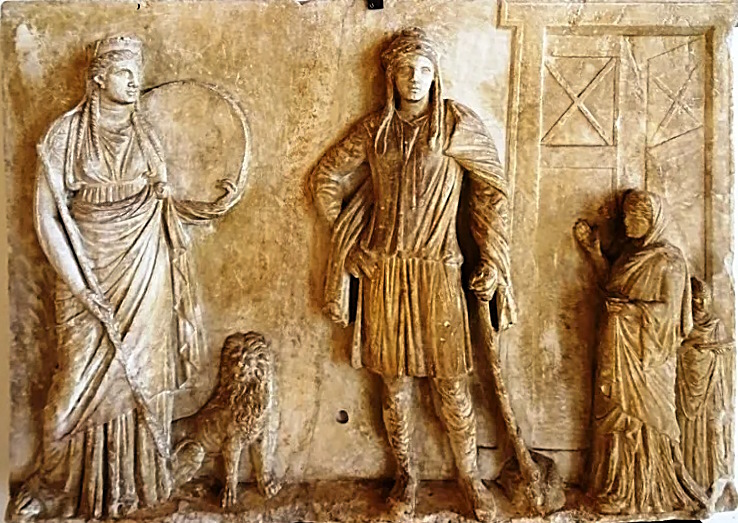
Cybele and Attis (Museo Archeologico Nazionale di Venezia)

The name ‘Attis’ has a feminine ring to it: compare Ovid’s feminine Caenis, masculine Caeneus. In Greek the name varies between Áttis (sounding feminine) and Áttēs (decidedly masculine). A late poem refers to ‘half-female Attis’ using a masculine article: τὸν ἡμίθηλυν Ἄττιν (Anakreontea 11.2). Occasionally modern readers have confused Áttis with Atthís, meaning ‘Athenian woman’, and also the name of one of Sappho’s lovers.

In Catullus, Attis starts out as Greek, mortal, and male, with grammatically masculine language. He travels across the sea to Phrygia. There they castrate themself, and subsequently Attis is grammatically feminine. As the poem continues her grammatical gender switches every now and then, apparently erratically, between masculine and feminine.

But these expressions of gender aren’t omnipresent, and modern translations have difficulty representing Catullus’ usage. They often have drastic mismatches in where the gendering appears.

Here are the opening lines, along with three published translations. Grammatically gendered language for Attis is in bold type. Notice how the translators all put the gendered language in different places.

Super alta vectus Attis celeri rate maria,
Phrygium ut nemus citato cupide pede tetigit
adiitque opaca silvis redimita loca deae,
stimulatus ibi furenti rabie, vagus animis,
devellit ili acuto sibi pondera silice,
itaque ut relicta sensit sibi membra sine viro,
etiam recente terrae sola sanguine maculans,
niveis citata cepit manibus leve typanum,
typanum tuum, Cybebe, tua, mater, initia,
quatiensque terga tauri teneris cava digitis
canere haec suis adorta est tremebunda comitibus.
Catullus 63.1–11
5 devellit Kokoszkiewicz CQ 61.2 (2011): devolvit MS, devolsit Haupt
Over deep seas Attis, carried on a rapid catamaran,
eagerly with hurrying footsteps sought that forest in Phrygia,
penetrated the tree-thick coverts, the goddess’ shadowy habitat,
and there, by furious madness driven, wits adrift in insanity,
seized a keen flint, slashed away the weight of his groin’s double complement;
and when she felt the members left her shorn of all their virility
dropping still a spatter of fresh-shed blood on the ground as she sped along,
quickly with snow white hand she seized the lightweight rat-a-tat tympanum —
yours the tympanum, o Cybebe, yours, great Mother, the mysteries —
and on the hollow drum-skin beat a tattoo with delicate fingertips,
making this passionate invocation, body convulsed, to her followers.
(tr. Peter Green, 2005)
Attis had hastened across towering seas on a raft.
Eagerly setting his swift foot in the Phrygian grove,
he entered the goddess’s dark, forest-encircled domain
and there was attacked by insanity’s goad. Blinded by passion,
he lightened the weight of his loins with a sharp fragment of flint.
When she ascertained what was left of her limbs, lacking the male,
trickling blood on the ground from her wound, freshly inflicted,
she excitedly took in her white hands a petite tambourine,
Cybele’s horn, tool of your sacrosanct rituals, mother.
Striking the tight hide of the bull with her delicate fingers,
she shivered and started to sing words such as these to her friends.
(tr. David Mulroy, 2002)
Borne in his swift bark over deep seas, Attis, when eagerly with speedy foot he reached the Phrygian woodland, and entered the goddess’s abodes, shadowy, forest-crowned; there, goaded by raging madness, bewildered in mind, he cast down from him with sharp flint-stone the burden of his members. So when she felt her limbs to have lost their manhood, still with fresh blood dabbling the face of the ground, swiftly with snowy hands she seized the light timbrel, timbrel, trumpet of Cybele, thy mysteries, Mother, and shaking with soft fingers the hollow ox-hide thus began she to sing to her companions tremulously.
(tr. Francis Warre Cornish, 1913)

First, note that Catullus’ Latin has no gendered pronouns at all in this passage. Gender is conveyed by participles (vectus, stimulatus, citata, adorta) and adjectives (vagus, tremebunda). Line 6 sine viro (‘shorn of virility’, ‘lacking the male’, ‘lost their manhood’) is explicit gendering, rather than grammatical gender.

In the translations, not many of the gendered pronouns correspond to gendered language in Catullus’ Latin. The most striking mismatch is the lines when Attis castrates themself, in lines 5 and 6. The translations all pack these lines with gendered pronouns — but the Latin has no grammatical gendering at all!

Here’s my own effort, with gendered pronouns confined to places where Catullus uses gendered language.

He sailed over the deep — Attis, over the seas in a swift skiff —
touched the Phrygian grove, touched it eagerly with swiftened foot,
and entered the dark places of the woods, property of the goddess.
He was driven by raging ecstasy there, he was changeful in spirit;
tore off the weight from the groin using a sharp stone;
then felt what parts were left, without the male,
while staining the soil of mother earth with fresh blood.
She swiftly took the light drum in snow-white hands —
your drum, Cybebe, your sacred mysteries, mother —
and pulsing the hollow bull’s hide with tender fingers
she trembled as she began this song to the entourage.
(tr. Peter Gainsford)
Notes.

1 vectus. Catullus introduces gendered language very early on, in the third word of the poem. Among the published translations above, only the oldest, Cornish, tries to reproduce this.

2 Phrygium ... nemus; 7 terrae sola. It strikes me that Catullus is playing with mismatches in grammatical gender, so it seems important to convey them in translation where feasible. In line 2 ‘Phrygian grove’ is neuter, but nemus has a masculine-looking ending: so my translation adds ‘it’ to make it more marked. In line 7 ‘soil of mother earth’, terrae (‘of earth’) is feminine and sola (‘soil’) is neuter: I add ‘mother’ as an indirect hint at the mismatch.

3 adiitque. Green has Attis ‘penetrating’ the grove. I find that tendentious: there’s nothing especially sexual about the Latin here.

4 vagus animis. The published translations all think this suggests impaired mental function (‘wits adrift in insanity’, ‘blinded by passion’, ‘bewildered in mind’). I disagree. vagus appears again at lines 13 and 25: it’s thematic. It indicates mobility, something shifting, without an anchor. Attis’ gender is about to change, and vagus is surely a piece of framing for that event. Later, in lines 13 and 25, vaga refers to groups who are congregating and moving towards a specific place: 13 vaga pecora (‘shifting cattle’), 25 vaga cohors (‘shifting company’). It may be significant that the word has a different grammatical gender each time: vagus Attis = masculine, 13 vaga pecora (‘cattle’) = neuter, 25 vaga cohors (‘company’) = feminine.

[Afterthought, three years on: given that vagus represents motion from A to B elsewhere in the poem, it now occurs to me that vagus animis definitely represents an inward motion in terms of gender identity. Difficult to convey. Something like ‘an egg at heart’ seems to represent the meaning accurately; but many cis readers over a certain age would be unfamiliar with that English expression.]