Showing posts with label Hittite. Show all posts

19 April 2026

Problems with Cline on The Trojan War. Ch. 4 ‘The Hittite texts’

Eric Cline’s book The Trojan War: a very short introduction (Oxford, 2013) argues that the classical Greek myth of the Trojan War is based on a historical conflict. Previously we looked at chapter 3, where Cline argues that the Homeric Iliad portrays Bronze Age events in a Bronze Age setting. As we saw, all the claims cited as evidence turned out to be unrepresentative, baseless, or simply untrue.

Chapter 4, ‘The Hittite texts: Assuwa, Ahhiyawa, and Alaksandu of Wilusa’, looks at Bronze Age evidence to argue that Mycenaean Greeks were involved in armed conflict in Anatolia in the 15th century BCE. Cline thinks this is the historical conflict that led to the Trojan War myth. This chapter is deeply flawed too, but in a less straightforward way. Cline doesn’t present outright falsehoods as fact here: but he takes a selective approach, keeping silent about some inconvenient points, and distorting others.

Wilusa (pp. 54–55), Ahhiyawa (pp. 56–57)

Cline gives an overview of Wilusa, on the edge of the Hittite empire, later called Ilios/Ilion in Greek; the name of one of its rulers, Alaksandu, which appears to be a hittitised form of a Greek name, Alexandros; and a state called Ahhiyawa somewhere in the west, which most scholars correctly identify as somewhere in the Greek-speaking world. (Note incidentally that it should never be assumed that Ahhiyawa referred to all of the Greek-speaking world.)

There are a couple of omissions here. Cline wants to equate the 13th century BCE Alaksandu with the character Alexandros (also called Paris) in the Iliad, and — like many scholars — thinks the names are unlikely to be a coincidence. Contrary to what Cline says, Alexandros in the Iliad is not Troy’s king. (The Homeric Paris is certainly not in a position to be committing Troy to being the vassal of another Anatolian state, as the historical Alaksandu did.)

The more important omission is: why does a king of Hittite-era Wilusa have a Greek name? This is a difficult question. But there is actually a potential answer, as explained by Bachvarova (2016: 333–342), to do with a Wilusan-Ahhiyawan dynastic marriage (which Cline mentions on p. 61, in a different context). Perhaps Cline does not try to link this marriage to Alaksandu himself because it would raise more questions than it answers: the Trojan War myth, where Alexandros is a full-blooded Trojan, is too dissimilar to what we know of this marriage to be convenient for Cline’s argument.

(Cline also never asks how it came about that Homer never mentions the historical Hittites, Mira, Seha, or Arzawa, and instead talks exclusively about 7th century BCE ethnic groups. But this objection is probably better aimed at chapter 3, on Homer.)

Madduwatta and Attarissiya (pp. 57–58)

Cline discusses a Hittite document known as the Indictment of Madduwatta (CTH 147; late 15th–early 14th century BCE). The Indictment discusses a warlord named Attarissiya, who becomes Cline’s archetype for a Greek leader attacking the west coast of Anatolia.

Cline claims:

  1. the Indictment describes Attarissiya as ‘“the ruler of Ahhiya” (Ahhiya being an early form of the word Ahhiyawa)’;
  2. Attarissiya ‘came to the western coast of Anatolia and fought against Hittite troops.’

Claim 1 is doubtful; claim 2 is half false. Attarissiya is an Anatolian name, not Greek; Ahhiya may not be Ahhiyawa; and the Indictment never puts Attarissiya anywhere near the west coast of Anatolia.

On claim 1: the Indictment does refer to Attarissiya as ‘ruler of Ahhiya’. But Cline omits three important facts.

  1. Attarissiya is a ruler (LÚ), but other Hittite documents consistently refer to rulers of Ahhiyawa — the Greek-speaking state — as a ‘king’ (LUGAL). Attarissiya was no king.
  2. The name ‘Attarissiya’ is linguistically Anatolian, probably specifically Lukkan, built out of elements seen in other names such as Attarimma (a town in Lukka) and Sarissiya (a mountain). These elements have no analogues in Greek names of any period.
  3. Hittite documents invariably classify Ahhiya as a city, using a city determinative transcribed URU (twice in CTH 147, once in CTH 571.2).

So Attarissiya isn’t a Greek king of Ahhiyawa the country: the text really seems to point to a Lukkan ruler of Ahhiya the city. (In practice URU does sometimes get used for countries as well, but it would be tendentious to assume in advance that that must have happened in both CTH 147 and 571.2.)

On claim 2: the Indictment states that Maduwatta’s territory is the valley of the ‘Siyanta’ river, an unknown location but somewhere in southern Anatolia. Madduwatta had at one point been attacked by Kupanta-Kurunta of Arzawa (§§8–9), and later by Attarissiya (§12). We know Arzawa was in western Anatolia. But for Attarissiya the only geographical reference point is in §36, which shows that Maduwatta and Attarissiya had both attacked Cyprus (Alasiya) at the same time. Cyprus is about 100 km south of the Anatolian coast, 100 km west of Ugarit, but 700 km from the west coast of Anatolia by sea, and 900–1,000 km from Troy or mainland Greece. The text certainly does not point to Attarissiya attacking western Anatolia.

If we were to interpret these points without the assumption that Ahhiya = Ahhiyawa, we would certainly conclude that Ahhiya was a Lukkan city, probably on the coast facing Cyprus. That would put it in or near what is now the Turkish province of Antalya (ca. 250 km from Cyprus). Interpreting Attarissiya as a Greek king attacking the west coast of Anatolia requires ignoring most of what the text actually says, and substituting an imaginary scenario in its place.

The Assuwa ‘rebellion’ and Tudhaliya’s sword (pp. 58–60)

In the late 1400s BCE, according to the Annals of the Hittite king Tudhaliya (CTH 142), Tudhaliya attacked western Anatolia. It was a fairly standard practice for powerful Bronze Age states to launch raids from the edge of their territories every now and then and head back home. It was a way of projecting power, to remind neighbours who not to attack. Following Tudhaliya’s war, many places in western Anatolia formed a defensive alliance to resist further Hittite aggression: the ‘Assuwa alliance’. Tudhaliya promptly came straight back and crushed the alliance.

Tudhaliya’s Annals name Wilusiya — Troy — as a member of the Assuwa alliance. But the alliance was probably centred on what would later become the heartland of Lydia, around the Küçük Menderes river: that is where later Greek sources put Asiē, a name derived from Assuwa. (So ‘Assuwa’ is also the origin of the modern continent name Asia.)

Cline relates these events very differently. In his account, Assuwa and its allies were not a defensive alliance but a ‘rebellion’ against lawful Hittite rule; the ‘rebellion’ was not prompted by Hittite aggression, but by Mycenaean agents provocateurs interfering in Anatolian affairs and rousing the peaceful Assuwans against their benevolent overlords; and Tudhaliya was forced to respond by fighting the Mycenaeans. This, Cline thinks, is the context for Mycenaean armed conflict in western Anatolia — with Hittites, not Trojans.

The catch is, he made all of that up. Certainly none of it is borne out by Tudhaliya’s Annals. The Assuwa alliance needed no external encouragement. It is perfectly clear that it was formed in response to Tudhaliya’s aggression. Saying the Assuwans ‘rebelled against Hittite overlordship’ is like describing NATO as rebelling against Soviet rule. This was a defensive agreement, not a rebellion. There was no need for Mycenaean interference.

Cline’s only excuse for wedging Mycenaeans into this made-up story is one artefact: a sword found at Hattusa in 1991, inscribed with a dedication commemorating Tudhaliya’s victory over Assuwa.

Pride of place in Cline’s argument: a sword with a dedicatory inscription, which supposedly demonstrates Mycenaean military action in northwest Anatolia in the 1400s BCE. In reality, the sword is Anatolian, not Mycenaean. (Image source: Genz 2017)

In 1996 Cline cautiously suggested that this sword might possibly be a variant of an Aegean type.

... it may well be a variant of an Aegean Type B sword, but might reflect only Mycenaean influence rather than outright manufacture.

However, the identification of the Hattušas sword as Aegean Type B is not as cut-and-dried ... and strenuous objections to such an identification have already been raised.

... a connection with the legendary earlier Mycenaean raids in Anatolia may certainly lie within the realm of possibility. ... If such were the case ...

It is certainly plausible to suggest that the Mycenaeans and the Trojans were at one time allies, not foes ...

Cline 1996: 137, 138, 149, 150 (my emphasis)

So the sword might be Greek; lots of scholars think it isn’t, but if it is, then it’s possible it might suggest a Mycenaean presence in Assuwa; and if there were Mycenaeans there, then it’s possible they might have been there as allies.

Cline’s tone changed drastically in the 2010s.

[T]his is not a typical sword for anyone to have been using in Anatolia at that time, for it appears to be a type of sword specifically made and used by the Mycenaeans of mainland Greece only during the late fifteenth century BCE.

Cline 2013: 59–60

[T]his is not a sword of local manufacture. The sword is of a type used primarily on mainland Greece during the fifteenth century BC.

Cline 2014: 36

The problem is that everyone else is perfectly clear that the sword isn’t Mycenaean. It’s Anatolian.

Taracha (2003) tidily sums up the evidence, a decade before Cline wrote the above statements.

  • The overall shape, tang, and riveting method have parallels in Aegean Type B swords.
  • However, the Aegean riveting method is in turn based on Syrian practice, with parallels in Cilicia (southeast Anatolia).
  • Tudhaliya’s sword has multiple ribs along the length of the blade, something not seen in Aegean swords. The closest parallel is actually found in Romania.
  • We have continuity of evidence for the development of early thrusting swords in Anatolia, but not in the Aegean; and that implies that, if anything, the influence was the other way round — the Aegean style was based on Anatolian techniques.

More recent commentators take it as read that the sword is Anatolian in origin (Bryce in Beckman et al. 2011: 138; Genz 2017: 87). Only Cline is keeping this myth alive.

Wilusa and Ahhiyawa in various Hittite texts (pp. 60–65)

In these sections Cline documents interaction between the Hittites, Wilusa, and Ahhiyawa continuing through the two centuries after Tudhaliya crushed the Assuwa alliance. In this section Cline mentions the Ahhiyawan marriage that Bachvarova draws on to explain the presence of a Greek name in the Wilusan royal family in the 1200s BCE (see above).

The problem here isn’t that any of this is false. It’s that Cline presents these interactions as if they support his argument. The sheer quantity of them is bound to impress general readers as if they are some kind of gotcha. But it isn’t exactly surprising to find international interactions at the boundary of Hittite territory: these texts are simply what ought to be expected from multiple cultures being in close proximity.

If any hittitologist were to name the main locus of Hittite-Ahhiyawan interaction in this period, they would never pick Troy. They would pick Miletos. The reason books get published on The Trojans and their neighbours, and not on Bronze Age Miletos, isn’t because Troy was more important. It’s because there is no famous classical Greek epic about a war at Miletos. Modern interest in Troy is driven by a 7th century Greek myth, not by 15th–13th century Anatolian history.

‘Steep Wilusa’ (pp. 65–67)

In the 1980s Calvert Watkins pointed to the phrase alati ... Wilušati, ‘(from) high/steep Wilusa’, in a collection of first lines of Luvian cult songs at Istanuwa (CTH 772.1). Some formulas in Homer have a similar meaning: Ἴλιος αἰπεινή, Ἴλιον αἰπύ ‘high/steep Ilios’; Πριάμοιο πόλιν ... αἰπήν ‘Priam’s high/steep city’. Cline cites this to suggest continuity between Hittite sources and Homer.

Many formulas in Homer go back a very long way, some perhaps even to pre-Greek poetic traditions. That doesn’t suggest that a given story with these phrases is describing a historical event. Phrases are literary devices, and it’s not very surprising to see literary devices persisting over time.

In this case, we would at best be talking about a calque, not an inherited formula. The phrases have similar meanings, but Greek αἰπύς is not linguistically related to Luvian ala-. Some Homer scholars have pointed out that the phrases are used differently: the Luvian phrase indicates motion away from a place, the Homeric formulas are linked to the city’s mythical destruction. This thematic link is sometimes in the context of another formula, αἰπὺς ὄλεθρος ‘steep destruction’.

Note. Sale 1987: 35–36 n. 28; Létoublon (no date) n. 21. On αἰπὺς ὄλεθρος see Létoublon in the section ‘αἰπεινή “lofty”’.

For a robust and general treatment of the relationship between Hittite and Greek poetic devices, it isn’t enough to depend on a single phrase. The fullest treatment is by Mary Bachvarova (2016). She shows that the clearest continuity between Bronze Age Hittite texts and Homer is to be found in Near Eastern story patterns about the fall of a city, not in records of specific events — that is, in fiction tropes, not in history (2016: 354–356).

Conclusions

Cline imagines a 15th century conflict prompting a stream of stories about Mycenaean conflicts in Anatolia over 750 years, reframing and recontextualising the conflicts, but always set at Wilusa/Ilios. But proximate explanations are always going to be more robust. The Greeks did imagine their story taking place in the spot where Hittite Wilusa had once stood. But as we saw in talking about Chapter 3, the Troy of the Iliad is the Greek colony of the 600s BCE. (Remember, Hittite Wilusa had no cult of Athena Ilias.)

I will not write a separate critique of Chapter 5, since it spends more time presenting material evidence than interpreting it. But I will observe that, like many scholars, Cline is overly prone to talking about Troy’s ‘destruction’.

Troy was never ‘destroyed’. That is simply a thing that never happened. No one would say San Francisco was ‘destroyed’ by the Oakland fires of 1991! In every alleged ‘destruction’ event, there was continuity of population and culture, and immediate rebuilding. Stephan Blum, a researcher on the Troia Projekt at Tübingen, recently wrote (2026):

[Architectural reorganisation at Troy] simply reflects the everyday reality of a settlement’s history: building, use, maintenance or levelling, rebuilding and repetition.

Instead, I argue that Troy’s archaeological record reveals centuries of architectural continuity, stable coastal occupation and trade networks stretching from Mesopotamia to the Aegean and the Balkans — a geography of connection rather than conflict.

It is perhaps worth mentioning in passing that while modern retellings emphasise Troy being consumed by flames, that isn’t a Greek motif. The fire imagery comes from Vergil’s Aeneid, where it is modelled on the Romans’ sack of Carthage in 146 BCE. There is no link to Bronze Age Wilusa.

The real Bronze Age Troy persisted through accidents and hiccups, as any city does. After the collapse of the early 1100s BCE, some cities in the Aegean world prospered, including Miletos and Ephesos; others were abandoned; others were somewhere in between. Troy is one of the ‘in between’ group. Its inhabitants lingered; new immigrants arrived; but the population declined, and peacefully drifted away 250 years later. Another 200 years after that, Greeks colonised the site. And they created a just-so story about Troy: a story to explain why there had been an abandoned city there, and to rationalise their claim to the site, ahead of other competing ethnic groups in the area.

That story became famous. So did Troy. The city was at its height in the Hellenistic and early Roman periods: it was never powerful, but it was frequented by the powerful and the famous. It declined again after a devastating earthquake in about 500 CE. People carried on living there for a long time, but the site was again peacefully abandoned by the time the Ottomans arrived in the early 1300s. Since then there has been no urban settlement, though there has been an unbroken stream of tourists.

In the 1790s a story began to circulate that ‘Homer’s Troy’ had been in a different location. It was discredited, but it left a degree of confusion, with the result that Richard Jebb argued ferociously against Schliemann’s and Dörpfeld’s findings in the 1870s. As a result, many people today have come to think that Troy itself was once regarded as fictional, and that its discovery proved a myth true.

That has never been the case. Myths are regularly set in a real place, but they never have to be based on a real event. Not a single Greek myth is based on a historical event, so far as we know.

A myth isn’t proven by the fact that it mentions real places. It also can’t be proven by a book that relies on selective treatment of the facts, on distortions, and on false claims. It surprises me that Oxford University Press allowed such a book to go to print. It is regrettable if anyone relies on it.

References

  • Bachvarova, M. 2016. From Hittite to Homer. The Anatolian background of ancient Greek epic. Cambridge.
  • Beckman, G.; Bryce, T. R.; Cline, E. H. 2011. The Ahhiyawa texts. SBL ‘Writings from the Ancient World’ 28. Atlanta. [SBL]
  • Blum, S. 2026. ‘Rethinking Troy: how years of careful peace, not epic war, shaped this Bronze Age city.’ The Conversation 29 Jan 2026. [Internet Archive]
  • Cline, E. H. 1996. ‘Aššuwa and the Achaeans: the “Mycenaean” dword at Hattušas and its possible implications.’ Annual of the British School at Athens 91: 137–151. [JSTOR]
  • —— 2013. The Trojan War. A very short introduction. Oxford.
  • —— 2014. 1177 B.C. The year civilization collapsed. Princeton.
  • Genz, H. 2017. ‘Regional or international? The origin and development of Hittite weapons and military technologies.’ In: Schachner, A. (ed) Innovation versus Beharrung. Was macht den Unterschied des hethitischen Reichs im Anatolien des 2. Jahrtausends v. Chr. Istanbul. 84–103.
  • Létoublon, F. (no date). ‘The Trojan formulaic theater.’ Classics@ Journal 14. [Harvard University]
  • Sale, W. M. 1987. ‘The formularity of the place phrases of the Iliad.’ Transactions of the American Philological Association 117: 21–50. [DOI | JSTOR]
  • Taracha, P. 2003. ‘Is Tutḫaliya’s sword really Aegean?’ In: Beckman, G.; Beal, R.; McMahon, G. (eds.) Hittite studies in honor of Harry A. Hoffner Jr. on the occasion of his 65th birthday. Winona Lake (IN). 367–376.

12 December 2016

Salting the earth

At the end of that space, a second Scipio, the son of Paulus Aemilius, the conqueror of Perseus, took the city by storm, and destroyed it, razing it to the ground, passing the ploughshare over its site, and sowing salt in the furrows, the emblem of barrenness and annihilation.
The New American Cyclopaedia, vol. 4 (1858) p. 479

The setting: the Romans are sacking Carthage in 146 BCE. Supposedly the Roman general Scipio Aemilianus salts the earth to eradicate Carthage for good, making a fertile land into desert.

The destruction wrought by the Romans was absolutely real, and truly horrific: Appian’s account of it is real nightmare fuel. The salting-the-earth story, though, is pure myth. There isn’t a shred of ancient evidence to suggest that it happened. The story didn’t appear until the 1800s.

The myth evaporates easily enough. But it’s still a very interesting topic. For one thing, there was such a thing as ploughing over a city and salting the earth — it’s just that it didn’t happen to Carthage.

For another thing: when we look closely, it turns out ‘salting the earth’ isn’t about destroying fertile land and turning it into desert. Oh no. The salt is actually meant to be a fertiliser.

Confused? Read on.

Giovanni Battista Tiepolo, The capture of Carthage (1729; NY Met)

Even some professional ancient historians believed the salt myth until the late 1980s, when it got torn to shreds by a cluster of articles in the American journal Classical Philology. First, in 1986, an article by R. T. Ridley dismantled the myth and criticised scholars who had helped perpetuate it. The earliest example Ridley could find was in a volume of the Cambridge Ancient History from 1930. In 1988 another three authors — including one Ridley had criticised, B. H. Warmington — added afterthoughts to Ridley’s article (plus an apology in Warmington’s case). Between them, they managed to push the date of the salt myth back to an essay published in 1905.

One of them, S. T. Stevens, argued that the myth was an extension of the symbolic act of ploughing the land when founding a city (widely attested) or destroying it (attested in one Greco-Roman source). Long before the salt myth came along, it had been widely believed that Carthage had been ploughed over. Now, the ploughing myth has no foundation either. But it pops up in some eminent historians in the late 1800s; it also appeared in the 3rd edition of the Encyclopaedia Britannica, vol. 4 p. 215, in 1797, and was repeated verbatim until at least the 6th edition in 1823.

In fact the ploughing myth goes back a lot further. In 1299 Pope Boniface VIII personally reported how he demolished the city of Palestrina, as part of his feud with the Colonna family, as follows: ‘I subjected it to the plough, following the example of Carthage of old in Africa’. He goes on, ‘we also made salt in it, and commanded that it be sown over, so that it should have neither the condition, nor name, nor title of a city.’ There are strong connections between the ploughing myth and the salt myth: we’ll see more about these connections below.

So the ploughing myth goes back at least to the 13th century. What about the salt myth? Moving on to the internet age, and Wikipedia, we find that it has now been pushed back to 1863. In fact it’s a little older still: its earliest appearance is indeed in Ripley and Dana’s New American Cyclopaedia, but the volume with the ‘Carthage’ article dates to 1858 (see link at top).

Most observers agree that the modern idea of salting the earth is inspired by an incident in the Hebrew Bible, in Judges 9:45, where the Israelite king Abimelech ‘razed the city and sowed it with salt’ at Shechem.

Cover of the 2012 album Salt the Earth by Carthage, a deathcore band based in Maryland

In 2007 The Straight Dope covered the myth. There, Cecil Adams tried to estimate how much salt you’d actually need to make land effectively infertile. His estimate: 31 tons per acre. This works out to 7 kg per square metre, or a coating of about 6 mm. In the 3rd edition Britannica and the New American Cyclopaedia, Carthage’s walls supposedly had a perimeter of 23 miles (37 km). I haven’t tried to find out where they got this factoid from. But assuming they’re right, that limits its area to 109 square km. The amount of salt required to make it infertile, then, could be up to 7.63 × 10⁸ kg, or 763,210 tonnes. Standard Roman merchant ships in the Republican era could carry between 70 and 150 tonnes. So to transport this much salt you’d need a fleet of somewhere between 5000 and 10,000 ships, all packed to the brim with salt.

Here endeth the myth. All nice and tidy. There is a little more to talk about, though. And you know what happens when we get into the details ...

First: given that you’d need such a vast quantity of salt to make a place infertile, why then do we find ‘salting the earth’ going on in the bible, and in Pope Boniface’s misdeeds at Palestrina? And second: if it turns out that they’re not literally making the area devoid of life, what is really going on?

Ploughing and salting in the ancient Near East

Parts of the answer to the first question can be found in the Wikipedia article I already cited. There’s a handful of parallels in mediaeval accounts. But much more interestingly, there’s a whole set of parallels for ploughing over cities and salting the earth in several ancient Near Eastern sources. Here they are, all reported by Ridley (1986: 145):

  • a record of the proto-Hittite king Anitta of Nesa (ca. 1720 BCE), who destroyed the city of Hattusa and sowed it with weeds (‘and in its place I sowed weeds’, pe-e-di-is-si-ma ZÀ.AH-LI-an a-ne-e-nu-un; source. Dörfler et al. 2011: 113-14 interpret the weeds as a bioweapon, suggesting that they might have been bearded darnel, which can devastate wheat production, or greater dodder, which destroys legumes and survives for years in fallow soil);
  • an inscription where the Assyrian king Adadnirari I (early 1200s BCE) destroys the city of Taidu and strews something called kudimmu over it, a plant whose identity is unknown but which may be linked with salt somehow;
  • another Assyrian inscription where Shalmaneser I (mid-1200s BCE) destroys Arinu and strews kudimmu over it;
  • another (Grayson, Assyrian Royal Inscriptions vol. 2 no. 238) where Tiglath-Pileser I (early 1000s BCE) destroys Hunusa and strews something called sipu-stones over it;
  • another where Ashurbanipal (600s BCE) destroys Elam and scatters it with salt and sahlu seeds, where sahlu is an unknown plant;
  • the Hebrew bible, Judges 9:45, written in the 7th century BCE, reporting how Abimelech destroyed the city of Shechem: ‘he razed the city and sowed it with salt’;
  • and the latest parallel, again in the Hebrew bible, Jeremiah 26:18: ‘Zion shall be ploughed as a field; Jerusalem shall become a heap of ruins, and the mountain of the house a wooded height.’

Most of the mediaeval and modern examples owe a lot to the incident in Judges 9. But the blend of salting and ploughing is not a modern invention. It wasn’t invented by Pope Boniface VIII either.

Salt = fertiliser

In the Hebrew bible, salt is regularly a symbol of barrenness: see Deuteronomy 29:23, Jeremiah 17:6, and Psalm 107:34. Yet in the other ancient testimony cited above, it’s strikingly clear that the salt is not meant to make the soil infertile. Ashurbanipal uses both salt and seeds; Judges 9:45 specifies that the salt is sown (וַיִּזְרָעֶהָ), not dumped in a layer.

Boniface, too, clearly meant his ploughing-and-salting at Palestrina to have fertile results. His exact words were

ac salem in ea etiam fecimus & mandavimus seminari

and we also made salt in it, and commanded that it be sown over

In the 21st century, and back in the 20th century too, most of us are accustomed to thinking of salt as something that eradicates life. If soil is too saline, nothing will grow in it. This is going to be especially on your mind if you’re thinking of places like the Dead Sea, or the Bonneville Salt Flats in Utah: both of them salty as all hell, both iconically barren places.

Will Smith drags an alien across the Bonneville Salt Flats (Independence Day, 1996)

In fact, salt was regularly used as a fertiliser in the past. You have to be much more careful with it than with other fertilisers — too much will kill off the plants, it only works for some plants, and you don’t put it on the roots (according to ancient sources, at least) — but within those limits, it has been used regularly and, it may well be, very effectively. Plants need salt too. Even in the modern era, there were many experiments with salt as a fertiliser in the 1800s (examples: 1, 2, 3, 4). And yes, we’re talking specifically about sodium chloride, not Epsom salt or saltpetre.

Nowadays salt has mostly gone out of fashion. Soil salinity is a real problem. Growers in the past may have had success with salt, but it is really really easy to overdo it. It does still see some use: some cattle farmers use it for growing feed, as cows need a lot of salt. Some organic farmers use it too. But before you try this in your own garden, check the salinity of your soil first.

On to the actual testimony. Greco-Roman witnesses have a fair amount to say on the subject. First, Theophrastus’ On effects in plants:

Still, saline water is beneficial even for some vegetables, as cabbage, beet, rue and rocket, ... This improvement occurs, and in a word salinity is good for these vegetables, because they have a certain bitterness in their natures, and the salt water, by penetrating the plants and as it were opening outlets, extracts it (which is why cabbage is best in briny soil) ...
Theophrastus De causis 2.5.3-4 (tr. Einarson and Link)

And again:

We said earlier that salinity is also suited to some vegetables, and that soda is used with others. And so it seems we must accept the salinity here too [in pomegranate and almond trees] as appropriate to the plants, since it is evident that the sweetness of these vegetables comes from the saline water and the food.
Theophrastus De causis 3.17.8

Elsewhere he repeats that cabbage and purslane grow sweet and have little bitterness in saline soil (De causis 6.10.8); and he claims Egyptian olive oil isn’t as good as the Greek stuff because it doesn’t get enough salt (Historia plantarum 4.2.9).

But he really goes all out when it comes to date palms. Ancient date growers didn’t just add a few grains of salt, according to Theophrastus. To borrow a phrase from Quentin Tarantino, they drowned ’em in that shit.

(The date palm) likes a soil which contains salt; wherefore, where such soil is not available, the growers sprinkle salt about it; and this must not be done around the actual roots: one must keep the salt some way off and sprinkle about a hēmiekton (i.e. about 4.3 litres; ca. 5 kg). ... When the tree is a year old, they transplant it and give plenty of salt, and this treatment is repeated when it is two years old, for it delights greatly in being transplanted.
Theophrastus Historia plantarum 2.6.2-3 (tr. Hort, adjusted)

Elsewhere he mentions that Babylonian date growers use salt but no manure for their fertiliser, and that another method of application is manually applying lumps of salt to the trees (De causis 3.17.1-4; also Historia 4.3.5). Theophrastus’ experience must have been with very salt-starved soil. Modern research has shown that date palms do tolerate relatively high salinity, but as with anything, that tolerance has limits. According to this 2015 study, the limit is around 9 to 12.8 dS m-1 (roughly 6-8 g per litre of soil). Modern date growers don’t use salt as a fertiliser, even in the region that was once Babylonia.

Theophrastus’ enthusiasm about salt isn’t quite as visible in other ancient sources. They do mention it though. Pliny the Elder comes up with a rather imaginative explanation — he obviously doesn’t have as much growing experience as Theophrastus —

salsaeque terrae multa melius creduntur, tutiora a vitiis innascentium animalium.

And many (plants) are better entrusted to salted earth, as they are safer from being harmed by animals breeding there.

Pliny is also aware that cattle, sheep, and yoke animals love salty pastures, and that the salt improves their milk and cheese (Nat. hist. 31.88).

A much more striking allusion is in the New Testament, in the gospel of Luke

καλὸν οὖν τὸ ἅλας· ἐὰν δὲ καὶ τὸ ἅλας μωρανθῇ, ἐν τίνι ἀρτυθήσεται; οὔτε εἰς γῆν οὔτε εἰς κοπρίαν εὔθετόν ἐστιν· ἔξω βάλλουσιν αὐτό.

Salt is good; but if the salt goes bad, in what how will it be used for seasoning? It isn’t suitable for the ground or for a manure heap. They throw it away.

Luke 14:34-35 (my translation)

As with almost anything in the New Testament, I need to add a caution. These verses are paralleled in Mark 9:50 and Matthew 5:13, but those passages aren’t as clear about the use of salt as a fertiliser. As a result, New Testament scholars tend to debate the meaning of the passage in Luke.

Digression: there are two other translation problems here, though neither of them has an impact on the bit about using salt as a fertiliser. I mention them because they are bugging me.

  1. ἐὰν ... τὸ ἅλας μωρανθῇ is more conventionally translated as ‘if the salt loses its taste’. That translation is driven by the parallel in Mark, which does mean something like that: ἐὰν δὲ τὸ ἅλας ἄναλον γένηται, ‘if the salt becomes unsalty’. But Matthew and Luke use the verb μωραίνω, in the passive, which elsewhere always means ‘become μῶρος, become foolish, be stupefied’. There are no parallels to suggest it can ever mean anything like ‘lose its taste’. (μωραίνω is a moderately common word; just within the NT cf. Romans 1:22, 1 Corinthians 1:20.)
  2. ἐν τίνι ἀρτυθήσεται is obscure. The verb ἀρτύω means ‘to prepare, season, salt’, so literally the phrase means ‘With what will (the salt) be seasoned?’ My translation above, which takes ἀρτύω as ‘to use as a seasoning’, strains the syntax a bit. However, the conventional translation ‘how can its saltiness be restored?’ (NRSV) is much more of a stretch: interpreting ἀρτύω as ‘to restore the taste of’ is a strain on meaning, not just syntax.

The salt-as-fertiliser reading does however expose another allusion in the parallel in Matthew 5:13 ‘You are the salt of the earth’ (ὑμεῖς ἐστε τὸ ἅλας τῆς γῆς). The idea there isn’t just that people are flavoursome, and good for preserving foods — they’re also good for growing things!

So no, Carthage wasn’t ploughed and salted, but some other places throughout history have been. It was indeed ecological warfare: the idea was indeed to eradicate a city forever. But not by eradicating all life. Rather, the idea was to turn a once-bustling city into a green space, covered in weeds. And for that purpose, you don’t need an outrageous amount of salt at all.

References

  • Dörfler, W; Herking, C.; Neef, R.; Pasternak, R.; von den Driesch, A. 2011. ‘Environment and economy in Hittite Anatolia.’ In: Genz, H.; Mielke, D. P. (eds.) Insights into Hittite history and archaeology. Leuven: Peeters. 99-124.
  • Ridley, R. T. 1986. ‘To be taken with a pinch of salt: the destruction of Carthage.’ Classical Philology 81: 140-6. [JSTOR]
  • Stevens, S. T. 1988. ‘A legend of the destruction of Carthage.’ Classical Philology 83: 39-41. [JSTOR]
  • Visonà, P. 1988. ‘Passing the salt: on the destruction of Carthage again.’ Classical Philology 83: 41-2. [JSTOR]
  • Warmington, B. H. 1988. ‘The destruction of Carthage: a retractatio.’ Classical Philology 83: 308-10. [JSTOR]

27 September 2016

The Trojan War #3: Bronze Age evidence

Part 1. The consensus | Part 2. Homer | Part 3. Bronze Age evidence

Previously we’ve touched on the current state of scholarship concerning the Trojan War, and some points that suggest the Iliad was composed firmly from a seventh-century perspective. But when people argue for a historical Trojan War, it’s evidence from the Bronze Age that carries the most weight — where the ‘Bronze Age’ means about 1200 BCE and earlier. So that’s what we’ll look at today.

Here I’ll be taking it as read that the Homeric name for Troy, Ilios, is a Greek rendering of the Hittite name Wilusa. That equation isn’t rock-solid. There are reputable scholars who doubt it (examples: 1, 2, 3). But I’m not going to be relying on that equation to argue in favour of a historical Trojan War; so if you’ll permit, let’s say I’m allowing that equation to play advantage.

The Alaksandu Treaty: treaty between a 13th century BCE Hittite king and king Alaksandu of Wilusa
Who were the Hittites? This is an important piece of context. The Hittite empire flourished in the second half of the 1000s BCE. By the 1200s they covered most of Turkey, and large parts of Syria and Lebanon. We have a selection of texts from Hittite archives, especially at their capital, Hattusa in central Turkey, as well as diplomatic correspondence at various sites. In the decades after 1200 — the ‘Bronze Age Collapse’ — many Hittite centres were abandoned or destroyed, including the capital, Hattusa, and the empire disappeared except for a remnant in the south-east.

The empire was built out of a combination of military force and one-sided treaties. One such treaty was with king Alaksandu of Troy: it formally incorporated Troy within the Hittite realm as a vassal state and as a part of the Arzawa region. Arzawa was a group of states on the west coast of Anatolia. The treaty dates to the early 1200s BCE.

Troy’s formal position within Arzawa and the Hittite empire roughly corresponds to the period in between Bronze Age Troy at its wealthiest (Troy VIh) and post-Bronze-Age-Collapse Troy (Troy VIIb2, VIIb3) — that is, the archaeological phases known as Troy VIIa and Troy VIIb1. There are no discontinuities between these phases in terms of population or material culture, or anything like that: rather, the dividing lines are disasters which affected the architecture and layout of the citadel. Troy VIh and VIIa are separated by a major earthquake, and Troy VIIa and VIIb1 by a fire.
Timeline of Late Bronze Age/Iron Age Troy and some potentially related events
So: what does Bronze Age evidence have to tell us? Let’s look through the most popular notions: most of them are red herrings.

1. Fire in Troy VIIa

Archaeological evidence shows that the citadel of Troy was destroyed by fire ca. 1190–1180 BCE. One potential cause of fire is human agency; and if the fire was caused by human agency, military hostilities are a possible inference.

The date has a tidy correspondence with Eratosthenes’ guesstimate for the fall of Troy, but as we saw last time, that was just one guesstimate among many, and none of the ancient Greeks who give us these dates had access to any evidence that we don’t also have. 3rd century BCE testimony has zero value.

If the fire was caused by human agency (and that’s not a trivial if: Jürgen Seeher, the director of excavation at Hattusa in 1994–2005, has commented that archaeologists are overly prone to inferring military conflict from fire), even so we have no idea who started it. If it was military hostility, there’s nothing to indicate who the hypothetical enemy was. The Troy VIIa fire gives us a possible scenario for a Trojan War, but nothing that confirms anything.

One reason this fire is so attractive is because classical poems about the fall of Troy put a lot of emphasis on fire. In those poems, though, fire emphasises the point that the city is being eradicated. The real city wasn’t eradicated at all. Troy VIIb1 was a direct continuation from Troy VIIa, and the city continued to be inhabited for nearly 250 years after it supposedly went up in flames.

Troy survived after this fire for longer than the USA has existed.

2. Earthquake in Troy VIh

With the earthquake, Trojan-War-hunters have two main options: (1) Greek myth might have reimagined the earthquake as something to do with Poseidon, who was both an earthquake god and a horse god — and a horse features rather prominently in the Greek legend; (2) the earthquake might have weakened Troy’s defences to the point where Greeks attacked and destroyed the city.

The first option is the most speculative kind of Euhemerism, and even at its best Euhemerism has never been a reliable or even a useful methodology. It’s a game of speculation, not a traceable history.

The ‘weakened defences’ option is at least not ridiculous, but it’s still speculative. If we didn’t have the classical Greek legend, no one would have any reason at all to suspect hostile military action. If there was military action, then — as with the Troy VIIa fire — still we have no clues as to who the hypothetical enemy was.

3. The Tawagalawa letter

One letter in the Hittite text archives, written by a Hittite king and addressed to the king of Ahhiyawa, mentions a dispute over Troy. Most scholars nowadays accept that Ahhiyawa is a hittitised form of the Greek Achaia (or of a Bronze Age form *Achaïwi-).

Conflict involving Greeks and Troy? Must be the Trojan War! Here’s the relevant passage, in Gary Beckman’s translation (Beckman, Bryce, and Cline 2011: 114–117):
(I, the Hittite king, want you to send this message to Piyamaradu:) ‘The King of Hatti has persuaded me (i.e. the Ahhiyawan king) about the matter of Wilusa concerning which he and I were hostile to one another, and we have made peace. Now(?) hostility is not appropriate between us.’ [Send that] to him. ...
... And concerning the matter [of Wilusa] about which we were hostile — [because we have made peace], what then? If [a certain ally] confesses an offense before his ally, [because he confesses] the offense before his [ally], he does not reject [him. Because] I have confessed [my offense] before my brother, [ ... And] let it [ ... ] no further to my brother.
CTH 181 (the ‘Tawagalawa letter’), iv.7–10 and 18–26
Here are the problems: (1) This dispute wasn’t between Trojans and Greeks, it was between Hittites and Greeks. (2) The Hittite king makes it crystal-clear that the Hittites were the aggressors, not the Greeks, and he’s trying very hard to apologise. (3) There’s no powerful reason to interpret the dispute as a war. Here’s the commentary on the passage by the hittitologist Trevor Bryce:
Hostilities had apparently broken out between them over the country called Wilusa ... This is the only occasion in the Ahhiyawa corpus where there is a reference to what appears to have been direct conflict between Hatti and Ahhiyawa. In all other cases, hostile action by Ahhiyawa against Hatti appears to have been limited to support for the activities of local insurrectionists like Piyamaradu. However, we do not know what the nature or the scale of the hostilities was on this occasion, whether it amounted to outright war, a skirmish or two, or merely a verbal dispute conducted through diplomatic channels. (The verb ku-ru-ri-iḫ-ḫu-e-en used in this context could mean any of these things.)
Beckman, Bryce, and Cline 2011: 121
There are potential quibbles over the date of the letter too — Gurney argued in 2002 that it could be as early as the 1290s, Singer has more recently argued for a date in the mid-1200s: either way, it definitely had nothing to do with the fire of Troy VIIa! Whatever the nature of the dispute, it’s not a great match for the legend.

4. The name game

Various names that pop up in Hittite records have tempting similarities to names that we know from classical-era Greek stories. We’ve already seen Wilusa = ‘Ilios’, and Ahhiyawa = ‘Achaia’.

Another interesting one is Alaksandu, the king of Troy who was made to agree to the ‘Alaksandu Treaty’. His name may well be Greek: it looks awfully similar to Greek Alexandros, and Alexandros is absolutely fundamentally Greek: it’s made out of Greek roots (it means ‘man-defender’). Alexandros is also an alternate name for Paris, the legendary Trojan prince. (Again, this is way too early for a Trojan War in Troy VIIa: the Alaksandu Treaty dates to the early 1200s.)

If Alaksandu = Alexandros, though, it just raises more questions. (1) In the legend, Troy was no vassal but an independent city. (2) Paris/Alexandros never became king. Alexandros was a common name (Paris isn’t even the best-known Alexander of antiquity!), so we don’t have a strong case for linking him directly to the legendary character. (3) What on earth is a Trojan king doing with a Greek name? We don’t know the ethnicity of the Late Bronze Age Trojans, but their political and material cultures were rooted in Anatolia, not the Greek world. So, whether you think Alaksandu has anything to do with Paris or not, we have a serious problem here. How on earth did an ethnic Greek get to be king of a thoroughly non-Greek Hittite vassal city? This is a damned good question, and no one has a very tidy answer.

Next up: Attarissiya ‘of the city of Ahhiya’ is named in the ‘indictment of Madduwatta’ (CTH 147) as having attacked a Hittite vassal. If you squint just right, this may look a little bit like ‘Atreus’, Agamemnon’s father in the Greek legend. At least that’s what Emil Forrer suggested in the 1920s.

Ahhiya is certainly an early form of Ahhiyawa, so it does look like Attarissiya was genuinely Greek. (It’s disconcerting that the text uses a city determinative on ‘Ahhiya’, though.) The timeframe is a bad fit: Attarissiya lived in the early 1300s BCE, during the reign of the Hittite king Tudhaliya I/II, three or four generations before the end of Troy VIh (let alone Troy VIIa). But it’s his name that’s the real problem. The similarity, if you can call it that, isn’t nearly as good as Alaksandu or Wilusa ... and it looks like it’s not Greek. Both elements of the name pop up in Hittite names (Attarimma, Sarissiya), and a prehistoric form of ‘Atreus’ should have sounded something like *Atrew(o)-. Forrer’s idea pre-dates the decipherment of Linear B, and linguists don’t buy it these days.

Next is *Akagamuna. A letter from an Ahhiyawan king to a Hittite king (CTH 183) supposedly mentions an Ahhiyawan leader of this name, and it kind of looks a bit like ‘Agamemnon’, the Greek commander in the Iliad. This one’s just based on obsolete information. The initial a- is an old misreading of a damaged determinative sign; the name is really ‘Kagamuna’; and the text is damaged, so we can’t tell whether Kagamuna was Ahhiyawan or Assuwan. He might not even be Greek!

Popular accounts still sometimes try to link Piyamaradu to the legendary king Priam. This one’s just silly. There’s no getting Priamos out of Piyamaradu — ‘Priam’ is indeed a Luvian name, but it comes from an unrelated root, pariya- ‘outstanding’ — and Piyamaradu wasn’t a king of Troy who fought the Greeks, he was a warlord who made a base at Miletus and colluded with the Ahhiyawans against the Hittites.

Last but not least: Appaliuna, a god associated with Troy/Wilusa in the Alaksandu Treaty, definitely is linked to the Greek Apollo (Apollōn), the most important god favouring the Trojans in the Iliad (see especially Bachvarova 2016: 243–250). Out of the names in this list, Appaliuna is by far the strongest link between Homer and Bronze Age Troy. The link is confirmed by a text describing an Arzawan purification ritual, CTH 456, which mentions Appaluwa as a plague god.

Even here some care is needed. In the Archaic period the chief civic cult of Troy was that of Ilian Athena, not Apollo (Il. 6.269–311; Hdt. 7.43; copious later textual, epigraphic, and numismatic evidence). The cult of Apollo was based at Thymbra, nearby, though its location is uncertain (possibly a 6th–5th century BCE site 7 km to the southeast, on the river Kemer). Even so, Thymbra gave Apollo a special relationship with Troy.

(For the linguistic connection between Arzawan Appaluwa, Trojan Appaliuna, and Greek Apollōn see Bachvarova 2016: 246–247: the variation in -l-, -li-, -ll- is explained by Beekes’ conjecture of a palatalised l in pre-Greek, *ly, which also gave rise e.g. to both Ἀχιλεύς and Ἀχιλλεύς. Cf. dialectal forms of Apollo: Doric Ἀπέλλων, Cypriot Ἀπείλων < *Apelyōn. Beekes, aware of Appaliuna but not Appaluwa, reconstructs the proto-form *Apalyun (2010: 119). Personally I’m not convinced that the reconstructed *ly shows Appaliuna/Appaluwa was an import from the Greek world, as Bachvarova argues: we still don’t have Apollo in Mycenaean.)

The Merneptah Stele, Egyptian Museum, Cairo: Merneptah’s campaigns against the Sea Peoples, 1208/7 BCE

5. The Sea Peoples

Popular accounts often link the Bronze Age Collapse to Egyptian reports of conflicts with Sea Peoples. The relevant records are from the reigns of the pharaohs Merneptah (1213–1203 BCE) and Ramesses III (1186–1155 BCE). Sometimes these Sea Peoples get blamed for the downfall of the Mycenaeans and the Hittites.

The catch is that we only have reason to think of the Bronze Age Collapse and the Sea Peoples as firmly connected to one another in the region of Lebanon-Israel. Contrary to popular belief, the Bronze Age Collapse was not a continent-wide catastrophe afflicting all civilisations from Greece to India: the name refers to a political, economic, and demographic upheaval in mainland Greece, Crete, Turkey, Cyprus, Syria, Lebanon, and Israel. The New Kingdom of Egypt purred along for another hundred years; the Assyrian empire was untouched.

Egyptian monuments link the Sea Peoples to events specifically in Egypt, Israel, and potentially as far afield as Cyprus (if we take Merneptah’s propaganda at face value). Now, even granting that Cyprus was a hotspot of Sea Peoples activity, that’s still a loooong way from Greece or Troy (and, in 1208/7, two decades too early for the burning of Troy VIIa).

‘Ah, but the archaeologist Eric Cline wrote a book on how the Sea Peoples ended civilisation in 1177!’ Well, that’s certainly what the title of the book suggests, and there’s no doubt about Cline’s high scholarly standards. But if you actually read the book, you’ll find he’s actually very cautious about this. He specifically argues, in fact, that no single factor caused the collapse, and that there is no powerful reason to see the Sea Peoples as active in Greece and Turkey.

In both stories — the Bronze Age Collapse, and the Sea Peoples — Troy is peripheral. Plenty of Mycenaean and Hittite sites were abandoned, some violently destroyed, at the end of the Late Bronze Age (Mycenae, Tiryns, Gla, Pylos, Hattusa, Ugarit, etc. etc.); others suffered a downturn but survived (Thebes, Knossos). Troy belongs firmly to the second group. Along the more than 1000 km of coastline between Troy and Cyprus — where the Sea Peoples were active — some of the most important sites suffered only a downturn (Miletus), like Troy, or no downturn at all (Ephesus, Tarsus).

6. Solar eclipses

In 2008 two astronomers, Baikouzis and Magnasco, argued that a series of purported astronomical references in the Odyssey pointed to a date of 1178 BCE for Odysseus’ homecoming from the Trojan War (and therefore a date of 1188 for the fall of Troy). This is very much a fringe view, but it did provoke a certain amount of interest. I published a response that rejected the thesis unequivocally, showing that the argument was founded on several kinds of false assumptions, mistranslations, and cherry-picked data.

If you find their idea even faintly appealing, just take a moment before investigating to read the bit straight after Theoclymenus supposedly mentions this ‘eclipse’:
So (Theoclymenus) spoke, and then they all laughed sweetly at him.
Among them Eurymachus, Polybus’ son, led the talking:
‘He’s raving, this guest, this new arrival from abroad!
Come on, boys, throw him out of the house, outdoors
into the town square, since he says it’s like night in here.’
Odyssey 20.358–362
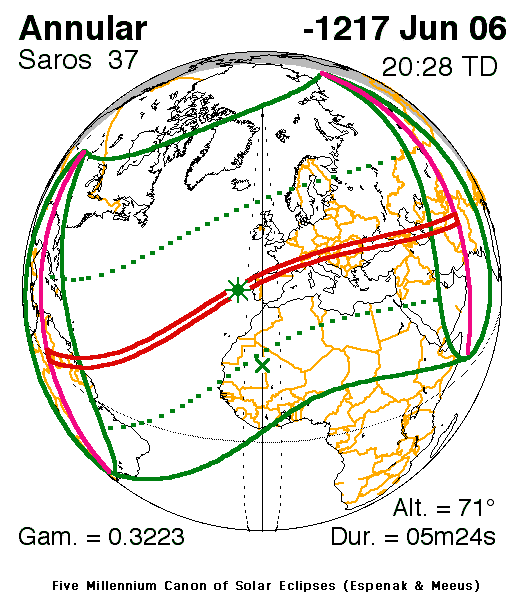
Path of solar eclipse in June 1218 BCE, suggested by Papamarinopoulos et al. as a supposed ‘eclipse’ in Iliad 17.366–377. (Hey, you missed one in Iliad 16.567!) Source: NASA Eclipse Web Site
In spite of this, a few other similar studies have popped up since 2008: 1, 2, 3, 4 (none written or co-authored by ancient historians, surprise surprise). They don’t fare any better. For the record, the first (Henriksson) dates the fall of Troy to 1312 BCE, the other three (Papamarinopoulos et al.) to 1217 BCE. Neither date is a match for either the end of either Troy VIh or Troy VIIa. The Henriksson article at least puts some effort in on the research front, but the others don’t even take a glance at previous research on the text and background of the Homeric poems. Baikouzis and Magnasco report that their research consisted of looking at footnotes in popular translations. Yes, seriously.

(Surprisingly, my own article has earned me a substantial section in the German Wikipedia article on Odysseus. Should I feel chuffed? Actually I do, kind of. It’s just that there’s no way the 2008 argument lives up to Wikipedia’s ‘notability’ standards, so really my response doesn’t either!)


An alternative perspective: literary traditions

Up to this point things are looking pretty negative. We’ve got Apollo, we’ve maybe got a kind of parallel to Paris (but with the Greek version of his name), and that’s about it. We have lots of possibilities but not much that is at all definite. What positive things can we say?

Things look very different if we stop agonising over historical events, with the question framed as ‘Was Homer based on fact?’, and instead ask a more literary-mythological question: ‘What kinds of influence from Bronze Age Anatolia can we see in Homer?’ Evidence becomes clearer and looks a lot more pertinent, and things fall into place more simply.

Earlier this year a new book appeared by the hittitologist-hellenist Mary Bachvarova (with whom I had the good fortune to co-teach a course several years ago), From Hittite to Homer (2016). Bachvarova synthesises a lot of material concerning not just historical events of the Late Bronze Age, but more importantly poetic traditions. Homer is no historical record, but literary influence from Bronze Age Near Eastern material is beyond any possible doubt. Mycenaean Greece and the Hittite world were certainly in contact —
  • We have about two dozen Hittite documents referencing Ahhiyawa, including one letter from an Ahhiyawan king to a Hittite king;
  • Physical evidence of trade across the Aegean, mainly with Miletus in south-western Anatolia (which was actually an Ahhiyawan city for much of the Late Bronze Age), but also to some extent in the north-west, and even a Mycenaean sword blade in the Hittite capital (Cline makes a big thing of this);
  • In Hittite sources it’s easy to trace a story of ongoing Ahhiyawan meddling in western Anatolian politics: we’ve alluded already to Ahhiyawan collusion with the rebel warlord Piyamaradu, and a dispute of some kind over Troy.
In addition, Greek poetry and mythology show heavy influence from the Near East. The masterwork on this topic is M. L. West’s The East Face of Helicon (1997). Some elements include
  • Story structures like the Succession Myth. Greek: the Ouranos-Kronos-Zeus succession that we see in several Theogonies; Hurrian-Hittite: the Kumarbi cycle and the Song of Ullikummi; Phoenician: Sanchouniathon’s Phoenician history (perhaps: we have no Phoenician source, only a late Greek source); Ugaritic: the Baal cycle; Babylonian: the Enuma elish.
  • Stories revolving around a city being destroyed by a spectacular device, often with direct divine involvement. Greek: the Trojan War; Hurrian-Hittite: the Song of Release, about the destruction of Ebla; Hebrew: the sack of Jericho in Joshua 6; Egyptian: the Sack of Joppa.
  • Other genres and incidental features, like a god fighting a chaos/water-monster (Zeus vs. Typhoeus, Marduk vs. Tiamat, Baal vs. Yamm); many of the tropes of wisdom poetry (Greek: the Works and Days; Ugaritic/Hittite: the Instruction of Shube’awilum(?) to Zurranku(?); Sumerian: the Instructions of Shuruppak; etc.); parallels in the Hymn to Hermes to a Sumerian story about Lugalbanda.
Note that we’re not talking about direct imitations. Hesiod didn’t have a copy of the Enuma elish in front of him. Rather, we’re talking about traditions: literary and mythological genres and tropes which spread because of their common appeal.

Bachvarova’s new book is tailored more specifically than West’s, and looks at how this influence was filtered through Hurrian-Hittite culture in Anatolia. The result is very compelling in places (though I don’t share her eagerness to latch onto figures like Alaksandu).

The most compelling example of influence in the poetic tradition is the argument made by the great linguist Calvert Watkins that Wilusa — and here we had better stop taking it for granted that Wilusa is Troy — had a place in a Luvian poetic tradition. A Hittite tablet describing cult songs at the religious site of Istanuwa lists the opening lines of several cult songs in Luvian. One hymn-opening reads:
ahha-ta-ta alati awienta Wilusati
When they came from steep Wilusa
CTH 772.1 (= KBo 4.11)
(Bachvarova 2016: 21 reproduces Starke’s transliteration, which has some technical differences.)

The especially striking thing is that the phrase alati ... Wilusati ‘(from) steep Wilusa’ has an identical meaning to three phrases that appear in Homer: Ilios aipeinē ‘steep Ilios’, Priamoio polin ... aipēn ‘Priam’s steep city’, and Ilion aipy ‘steep Ilios’.

If there’s a catch, it’s that the parallel is solely semantic: there’s no possibility of a formula in a shared linguistic tradition. The phrasing is different, and Luvian ala- is unrelated to Homeric aipys and aipeinos. (On the other hand, it is fairly likely that ala- does appear in the Homeric word ēlibatos ‘(steep?)-stepping’, used of high rocks.)


The upshot is that it’s pretty much futile to look for historical events in Homer, but in terms of mythological or poetic traditions there is a kind of continuity — very very indirect perhaps, but still traceable — between Bronze Age Anatolia and Archaic Greece. That continuity is perhaps more visible in Hesiod than in Homer.

And it is very indirect. Homer shows barely any trace of effort towards making his Trojans Anatolian. Their names are nearly all Greek: Hector, Deiphobus, Aeneas, Polyxena, Lycaon, Poulydamas, Anchises, Cassandra, Agenor, and many others are all built out of Greek roots, like Alexandros. Only a handful have non-Greek origins: Priam, Paris, Dardanus, and Assaracus. (I leave aside Ilus, Tros, and Troilus, since they’re based on place-names.) Priamos and Paris both appear to come from a Luvian root pariya- ‘outstanding’, and the name Pariyamuwa is attested in Kizzuwatna, the region of Anatolia to the north of Cyprus.

But the overall picture is of a Near Eastern poetic substrate shifting in the course of adapation, and being gradually remodelled as the centuries pass. Anatolian names like Paris get sidelined in favour of characters who are wholly Greek inventions, like Hector and Aeneas. Something comparable happened to the demographics of the real Troy throughout the Dark Age (Aslan and Hnila 2015): Wilusans kept on living there after the end of Troy VIIa and throughout Troy VIIb1, continuing to make Anatolian styles of pottery, but in Troy VIIb2–3 there are increasing signs of migration from Thrace and Bulgaria.

Eventually, when the first signs of Greek settlement start to appear in the mid-700s BCE, there must have been quite an ethnic mix. They were no longer Hittites, Arzawans, Sehans, or Mirans: the Anatolian groups mentioned in Homer are Lelegians, Maeonians, Mysians, and Phrygians. The only Trojan allies to show continuity with any Bronze Age group are the Lycians, from southern Turkey.

However, this ethnic melting pot would be an ideal setting for a legend about an ethnic conflict.

It’d be strange to imagine a 7th century Greek wanting to preserve a 500-year-old Luvian story faithfully. But a story about an ethnic conflict, in a place recently colonised by Greeks, where Greeks were running up against a diverse and entrenched non-Greek population ...?

That’s the situation in the Iliad, and it’s the situation of 8th–7th century Troy. Sure, we can trace elements from Bronze Age Anatolia (and Phoenicia, too: that’s where the Greeks got their alphabet, and the Odyssey is much more interested in Phoenicians than in Anatolians). But the Greeks took this age-old material and made it their own. The Troy of the Iliad is first and foremost an 8th–7th century construct.

References

  • Aslan, C. C.; Hnila, P. 2015. ‘Migration and integration at Troy from the end of the Late Bronze Age to the Iron Age.’ In: Stampolidis, N. Chr.; Maner, Ç.; Kopanias, K. (eds.). Nostoi. Indigenous culture, migration and integration in the Aegean islands and western Anatolia during the Late Bronze and Early Iron Ages. Istanbul: Koç University Press. 185–209.
  • Bachvarova, M. 2016. From Hittite to Homer. The Anatolian background of ancient Greek epic. Cambridge: Cambridge University Press.
  • Beckman, G.; Bryce, T.; Cline, E. 2011. The Ahhiyawa texts. Atlanta: SBL (Writings from the Ancient World vol. 28).
  • Beekes, R. 2010. Etymological dictionary of Greek. Leiden: Brill.
  • Cline, E. H. 2014. 1177 B.C. The year civilization collapsed. Princeton: Princeton University Press.
  • Gurney, O. R. 2002. ‘The authorship of the Tawagalawas letter.’ In: Taracha, P. (ed.). Silva Anatolica. Warsaw: Agade. 133–141.
Part 1. The consensus | Part 2. Homer | Part 3. Bronze Age evidence